An e-bike gets you 8% more Halloween candy per hour. On a crowded street, it actually gets you less
In a typical American suburb, swapping your walking shoes for an e-bike on Halloween gets you about 8% more candy per hour, roughly six extra pieces, because the e-bike speeds up the trip between houses but does nothing for the time you spend at each door.
Key takeaways
- The real bottleneck on Halloween night isn't the street. It's the doorstep.
- On tightly packed streets, walking wins.
- Where houses are far apart, the e-bike pulls ahead by a lot.
The race, house by house

We built a simple model of one Halloween evening. Picture two trick-or-treaters on the same street, where front doors sit about 100 feet apart, a common spacing for a suburban neighborhood. One walks. The other rides an e-bike at a calm 10 mph, parks it at each house and walks up to the door like everyone else.
The walker covers about 39 doors an hour. The e-bike rider manages about 41. At two pieces of candy per door, that's 77 pieces an hour on foot and 83 on the e-bike. Over a two-hour evening, the e-bike adds about a dozen pieces to the bag. Nice, but hardly the overflowing pillowcase most people would picture.
The reason is simple once you see the clock. At 100 feet apart, walking from one house to the next takes about half a minute. The e-bike cuts that to about seven seconds. But then the rider still has to stop, park, walk up the driveway, ring the bell, wait, say trick or treat, pick a candy and walk back. That part takes about a minute no matter how you arrived.
Why the doorstep is the bottleneck
Here's the part that surprises most people. Going faster barely helps. If the same rider doubled the speed to 20 mph, they would gain about two doors an hour. Even an imaginary e-bike that could teleport from one driveway to the next would top out at about 45 doors an hour in this suburb, only six more than the walker. The trip between houses is already a small slice of the evening, so there's very little left to save.
The e-bike also pays a small price at every house. Even 20 seconds to stop, kick down the stand and step off adds up over 40 doors, and it eats a big part of what the faster ride saved.
Door time matters even more. When doors are quick, at about 30 seconds each, the e-bike's edge in the average suburb grows to about 11%. When every house turns into a two-minute chat about costumes, the edge shrinks to about 4%. The longer people linger on the porch, the less the vehicle matters, and the two trick-or-treaters end up with almost the same bag.
Where the e-bike wins
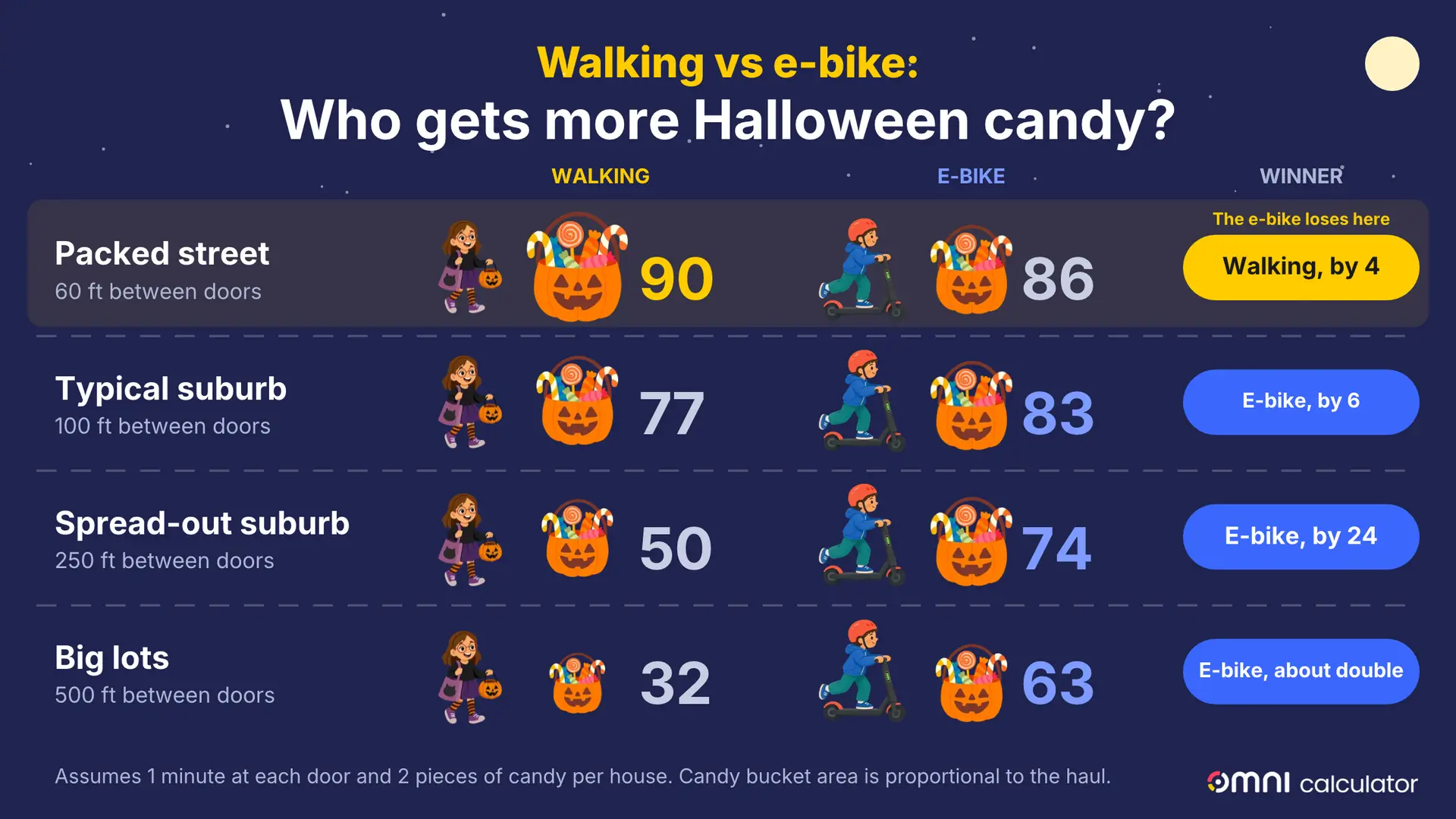
The answer changes a lot with how far apart the houses are. With the same one minute at each door and two pieces per house, here's how the evening plays out:
- Packed street, houses 60 feet apart: walking 90 pieces an hour, e-bike 86. Walking wins, because the stop at every house costs more time than the ride saves.
- Typical suburb, 100 feet apart: walking 77, e-bike 83. The e-bike is about 8% ahead.
- Spread-out suburb, 250 feet apart: walking 50, e-bike 74. Now the e-bike is almost 50% ahead.
- Big lots, 500 feet apart: walking 32, e-bike 63. The e-bike roughly doubles the haul.
The tipping point in the model sits at about 80 feet between doors. Below that, the e-bike's stop at each house cancels out its speed. Above it, every extra foot of driveway and lawn makes the e-bike look better, because that's the part of the night it can actually speed up.
There's an irony here. The neighborhoods where an e-bike helps most, with big lots and long gaps between houses, are often the ones that get the fewest trick-or-treaters, while packed streets where the e-bike is pointless tend to be the busiest. That may also be why so many families who live in spread-out areas already drive to a denser neighborhood for the night.
Before you swap the costume shoes for a saddle
The e-bike rider in this model is a teen or an adult riding alongside kids, with a helmet and lights, at neighborhood speed and on the road rather than the sidewalk. Halloween night is busy and dark, with excited kids darting between houses, so the 10 mph in the model is a deliberate choice, well below the 20 mph or 28 mph where most e-bikes stop helping the rider pedal. And as the numbers show, going faster than that wouldn't bring in more candy anyway.
E-bike rules vary a lot from state to state, including helmet requirements and age limits for some e-bike classes, so it's worth checking your local rules before heading out.
If you want to try the math for your own street, Omni's speed calculator can help you work out how long the trip between houses takes at your pace.
Methodology
This is a model built on stated assumptions, not measured data. Doors per hour equal 60 divided by the minutes spent at each door plus the minutes spent traveling to the next one. Travel time is the distance between doors divided by speed, and candy per hour is doors per hour times pieces per door.
The assumptions are:
- Walking speed: 3 feet per second, about 2 mph. That's a little slower than the 3.5 feet per second the federal Manual on Uniform Traffic Control Devices uses for timing crosswalks, to allow for kids in costumes.
- E-bike speed: 10 mph on residential streets, below the 20 mph and 28 mph assist limits used in most states' e-bike classes, according to the National Conference of State Legislatures.
- Time at each door: 1 minute in the base case, with 30 seconds as the low case and 2 minutes as the high case.
- Parking the e-bike: 20 seconds per house.
- Candy: 2 pieces per door.
- Distance between doors: 60, 100, 250 and 500 feet for the four neighborhood types.
Most Read


loading