Electricity Costs 82% More in the EU Than the U.S. Yet Hawaii Tops Every EU Country
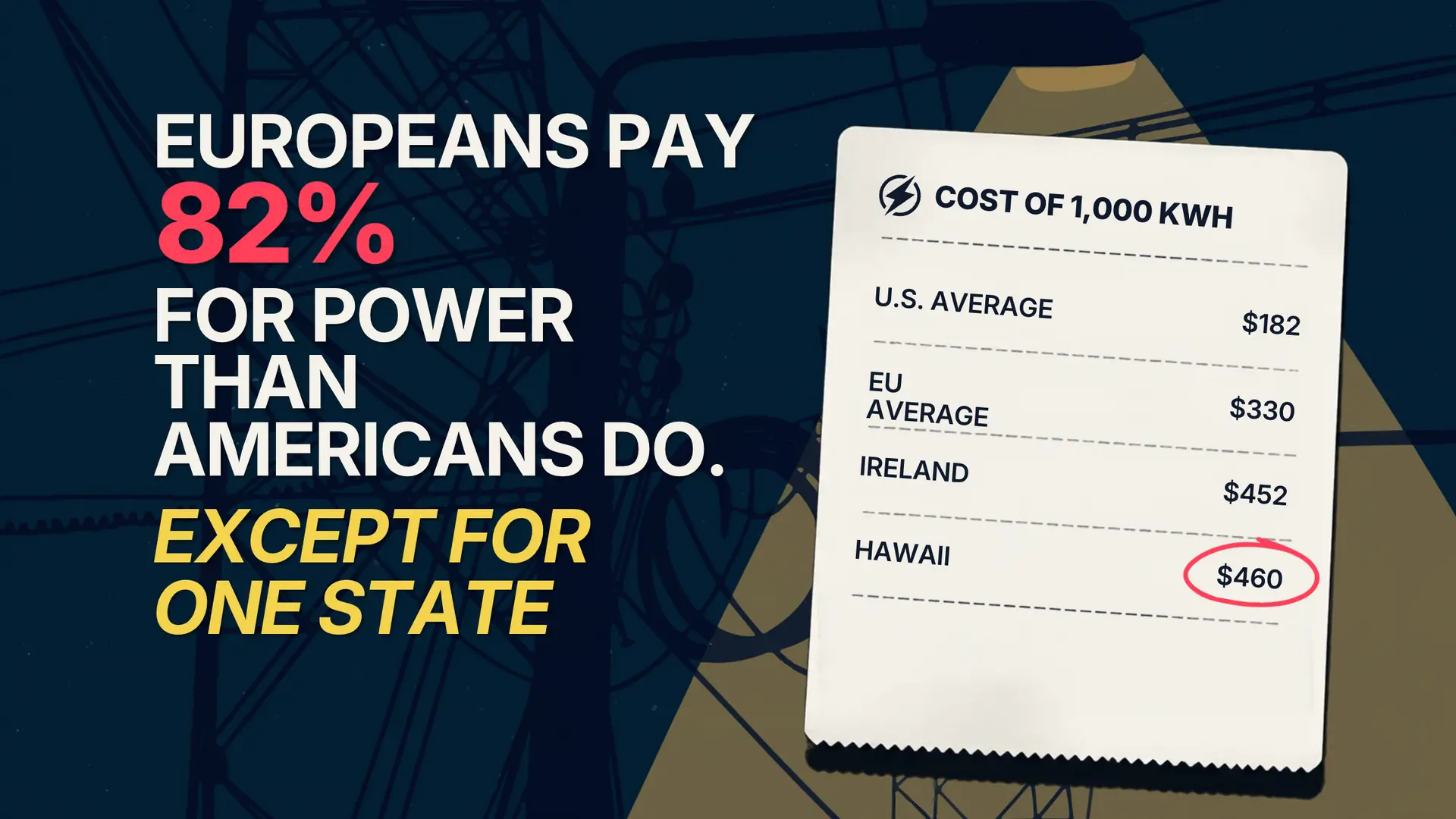
If you think your electricity bill is expensive, consider this: Europeans pay nearly twice as much for the same amount of electricity.
Key Takeaways
- Electricity costs 82% more in the EU than in the U.S., based on average residential prices in the first half of 2026.
- Hawaii has the highest electricity price in the comparison, exceeding every EU country, including Ireland and Germany.
- California is slightly more expensive than the EU average, while four U.S. states have cheaper electricity than Hungary, Europe's least expensive EU country.
Using January–June 2026 data from Eurostat and the U.S. Energy Information Administration, we compared electricity prices across all 27 EU countries and 50 U.S. states to see where households pay the most, which places have surprisingly affordable electricity, and how America's most expensive states compare with Europe.

Residential electricity prices, January–June 2026, in US cents per kWh.
Hawaii's electricity is more expensive than anywhere in the EU
Hawaii recorded an average residential electricity price of 45.95 cents per kWh during the first six months of 2026.
Ireland, the most expensive EU country, came in at 45.17 cents after converting its electricity price into US dollars. Germany and Belgium followed at 42.22 cents and 41.72 cents, respectively.
Hawaii's lead over Ireland is small, less than one cent per kWh. Still, it is worth noting that a single American state outranks every country in a region known for high electricity costs.
The reason lies partly in how Hawaii produces electricity. Unlike most US states, Hawaii depends heavily on imported petroleum to generate power. Transporting fuel to the islands is expensive, and each island operates its own separate electricity grid.
California is almost as expensive as the EU average
California has the second-highest residential electricity prices in the United States, averaging 33.17 cents per kWh. That puts it almost exactly alongside the EU average of 33.05 cents. Other expensive American states remain below Europe's average. Massachusetts recorded 30.06 cents per kWh, while New York stood at 29.26 cents.
At the opposite end, North Dakota averaged just 12.19 cents per kWh, the lowest of all 50 states. That is even cheaper than Hungary, the EU's least expensive country, where electricity averaged 13.29 cents per kWh.
In fact, four US states, North Dakota, Nebraska, Idaho, and Utah, had lower electricity prices than Hungary. The difference between the two sides of the Atlantic becomes even clearer when looking at the cheapest European countries.
Of the EU's 27 members, only three had average electricity prices below the US national average:
- Hungary: 13.29 cents per kWh
- Malta: 14.80 cents per kWh
- Bulgaria: 15.65 cents per kWh
Every other EU country was more expensive than the US average.
What the same 1,000 kWh would cost
The price gap becomes easier to appreciate when comparing the cost of buying exactly the same amount of electricity.
Here is what 1,000 kWh would cost at the average residential electricity price in each location.
| Location | Cost of 1,000 kWh |
| Hawaii | $460 |
| Ireland | $452 |
| Germany | $422 |
| California | $332 |
| EU average | $330 |
| Massachusetts | $301 |
| US average | $182 |
| Hungary | $133 |
| North Dakota | $122 |
At the EU average price, that amount of electricity costs about $148 more than in the United States.
Within the US itself, the difference is even larger. The same 1,000 kWh costs about $338 more in Hawaii than in North Dakota.
These are comparisons based on identical amounts of electricity, rather than on typical monthly bills. Actual household bills depend on how much power people use, which can vary substantially between countries and states.
You can estimate the cost of running appliances in your own home using Omni Calculator's electricity cost calculator.
Why is electricity more expensive in Europe?
Part of the difference comes down to taxes.
According to Eurostat 2026 data, taxes and government levies accounted for 28.4% of the average EU household electricity price. However, the higher taxes are not the only reason why electricity is more expensive in Europe. Even before taxes and levies, the EU's average electricity price was about 24 US cents per kWh, which is higher than the US average.
Europe also faces higher energy costs because it relies heavily on imported natural gas to generate electricity. So when its price rises, electricity often becomes more expensive too.
The U.S., by comparison, produces large amounts of its own natural gas, helping keep electricity prices lower in many states. Although prices still vary considerably from state to state.
For example, despite being part of US where electricity is rather affordable, Hawaii’s reliance on imported fuel pushes prices above even Europe's most expensive markets.
Methodology and sources
This analysis compares average residential electricity prices from January through June 2026 using data from Eurostat and the US Energy Information Administration (EIA).
European figures cover households consuming 2,500-4,999 kWh annually and include taxes and levies. US figures are residential averages calculated from electricity sales and utility revenues, which include applicable taxes and fees reflected in those revenues. The two reporting methods are not identical.
European prices were converted into US dollars using the average Federal Reserve exchange rate of approximately $1.167 per euro for the six-month period.
The EU average is weighted by household electricity consumption rather than being a simple average of its 27 member states. Some figures are preliminary and may be revised.
The comparison measures the price of electricity per kWh, not total household energy spending.
Most Read


loading