Karl Bushby took 28 years to walk home. By car, the same 31,000 miles would take less than 3 months
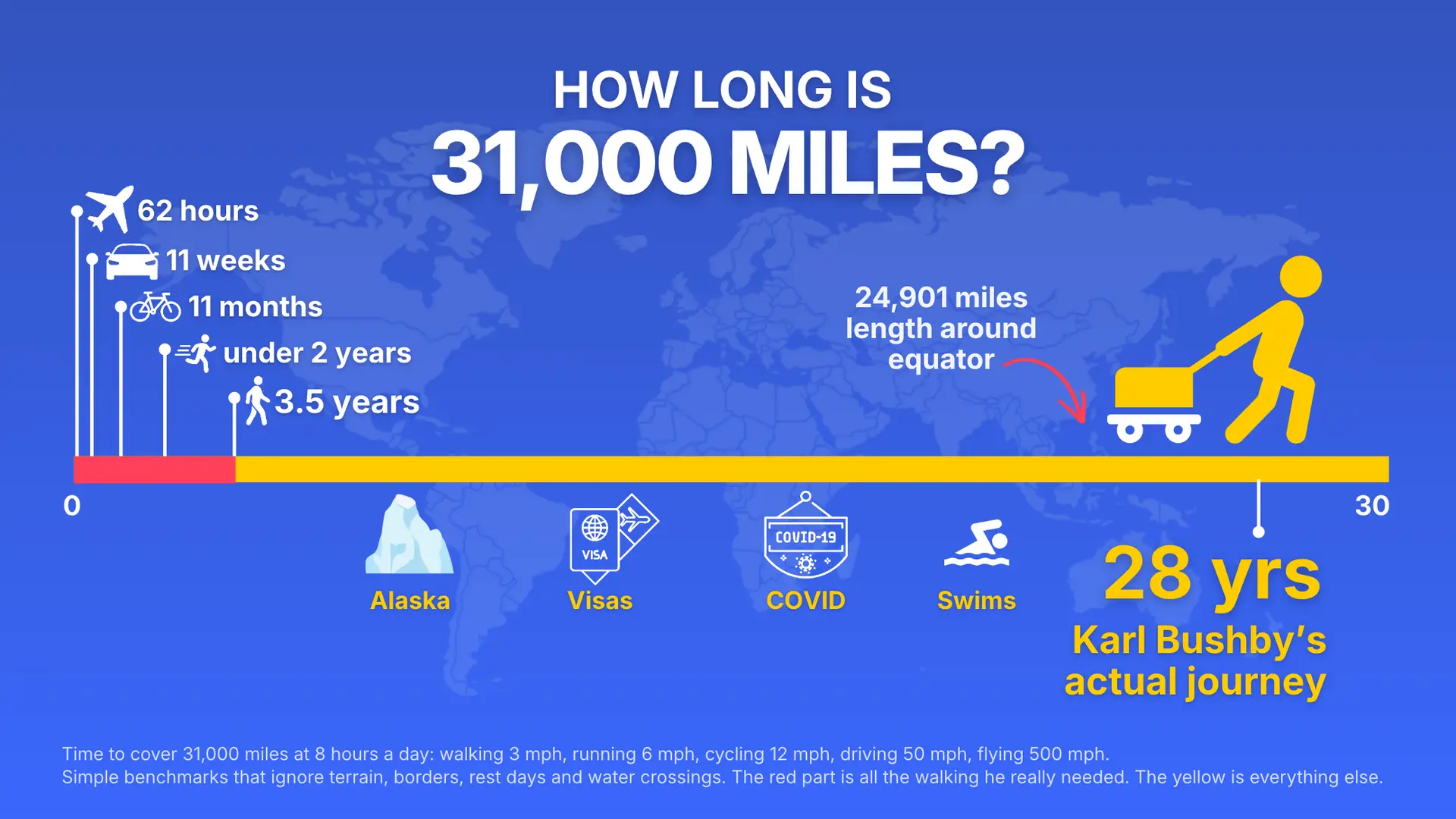
Karl Bushby needed 28 years to walk about 31,000 miles from the southern tip of South America to his mother's front door in Hull, England, a distance an ordinary car could cover in less than three months of 8-hour driving days.
Key takeaways
- Even at a normal walking pace, the walking itself would fill only a small part of those 28 years.
- A bicycle would have got him home in under a year.
- Most of his time went on things no amount of speed could fix.
The same journey, 5 ways
Bushby set off from Punta Arenas, Chile, on November 1, 1998, with two rules: no motorized transport, and no going home until he got there on foot. He reached Hull on Monday, November 2, 2026, one day after the 28th anniversary of his first step. By his expedition's count, the route covered more than 50,000 kilometers, or about 31,000 miles, across four continents.
So how long should 31,000 miles take? Here's a rough answer, assuming 8 hours of travel a day, every day, on a perfectly straight and open road:
- Walking at 3 mph: about 3.5 years. Walking around the clock without sleep, it would be roughly 14 months.
- Running at 6 mph: a little under 2 years.
- Cycling at 12 mph, a relaxed touring pace with luggage: about 11 months.
- Driving at 50 mph on average: about 11 weeks, or less than 3 months.
- Flying at 500 mph: about 62 hours in the air, under 3 days if the plane never landed.
The walking benchmark is the one that stands out. Even at a steady, ordinary pace, the walking itself adds up to about 3.5 years, around an eighth of the time the journey actually took.
Of course, none of these numbers fit the real route. Bushby pulled a heavy cart across deserts, mountains and frozen tundra, where 3 mph would have been a good day. Parts of the route weren't land at all. He crossed the frozen Bering Strait from Alaska to Russia on foot in 2006, spent 31 days swimming about 288 kilometers across the Caspian Sea in 2024, and swam the English Channel to reach Dover in October 2026. No car or bike would have got across any of those. The figures are a simple yardstick, not a real travel plan.
Where the other 24 years went
Bushby originally expected the trip to take about 12 years. What stretched it to 28 was mostly waiting, and the list reads like a tour of the past quarter-century's headlines.
In Alaska, he had to wait for winter so rivers would freeze into a path north. After crossing the Bering Strait he was detained by Russian border guards, and once in Russia he could move only within short visa windows. The 2008 financial crisis cost him his main sponsors, and he spent the next couple of years stuck in Mexico. When Russia refused him a visa in 2012, he walked across the United States to Washington, D.C., in protest.
Later came heavy restrictions in China, then sanctions, a pandemic and closed borders that blocked every land route from Central Asia toward Europe. That's how he ended up swimming the Caspian Sea instead. Even the last border fought back. After the Channel Tunnel operator turned down his request to walk through, he swam across.
There's no record of how many days each obstacle cost, and the total doesn't divide neatly. But the math makes one thing clear. Speed was never the problem. A faster walker would have spent just as long waiting at the same closed borders.
Methodology
The distance is the expedition's own, self-reported figure of more than 50,000 kilometers, rounded to about 31,000 miles, and other accounts of the route give different totals. Each travel time is that distance divided by an assumed average speed of 3 mph walking, 6 mph running, 12 mph cycling, 50 mph driving and 500 mph flying, then divided into 8-hour days. These are simple benchmarks that ignore terrain, rest days, borders and water crossings. Dates and route details come from the Goliath Expedition's official site and news coverage of his arrival.
Most Read


loading