How Four Astronauts Traveled 100 Million Miles Without Leaving Earth's Orbit
• Science
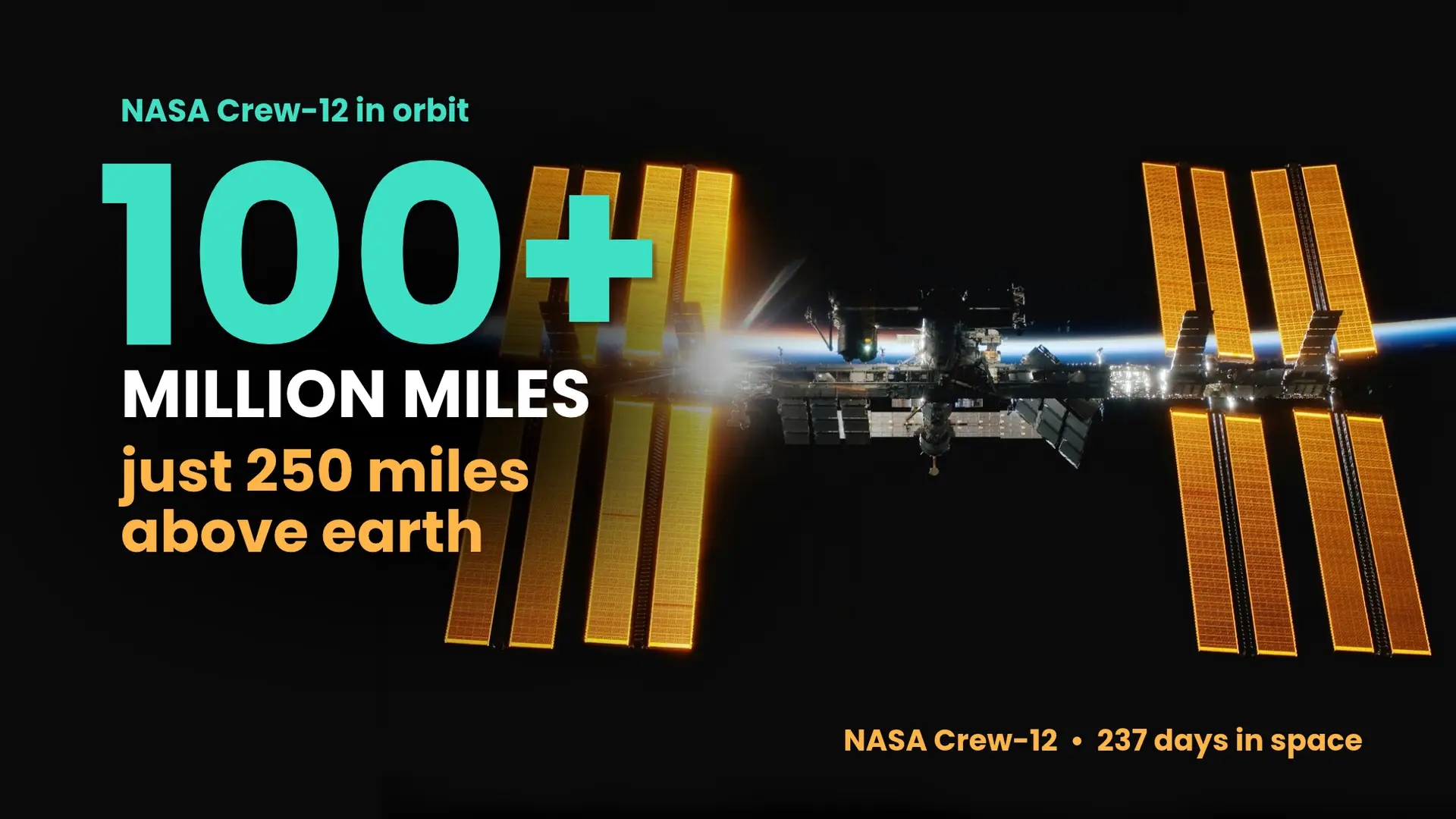
Four astronauts traveled enough miles to go to the Moon and back 209 times. Yet they never left Earth's orbit.
Key takeaways
- NASA's Crew-12 traveled more than 100 million miles during 237 days in space, completing over 3,792 orbits around Earth.
- The total distance covered is equivalent to approximately 209 round trips to the Moon, even though the astronauts remained only a few hundred miles above Earth.
- During the mission, the crew experienced roughly 3,800 orbital sunrises and sunsets.
On October 8, 2026, four astronauts returned to Earth after nearly eight months aboard the International Space Station (ISS). Over those 237 days, they covered an extraordinary distance while staying surprisingly close to home.
How can you travel 100 million miles without leaving Earth's orbit?
The International Space Station circles Earth roughly 250 miles above the surface. To put this into perspective, the Moon is nearly 239,000 miles away from us.
So how did the astronauts manage to cover more than 100 million miles?
The answer is speed. The space station travels at approximately 17,500 miles per hour, or nearly five miles every second. At that speed, it takes only about 90 minutes to complete one trip around Earth. By the time someone on the ground finishes an eight-hour workday, the station has already circled the planet more than five times. Over a full day, it completes around 16 orbits. Keep that pace going for 237 days, and the distance becomes enormous.
According to NASA's Crew-12 mission report, the astronauts traveled more than 100 million miles and completed over 3,792 orbits before returning home. The crew included NASA astronauts Jessica Meir and Jack Hathaway, European Space Agency astronaut Sophie Adenot, and Russian cosmonaut Andrey Fedyaev. They launched on February 13 and returned on October 8, splashing down in the Pacific Ocean off the coast of Los Angeles.
The same distance as 209 round trips to the Moon
The Moon is an average of 238,855 miles from Earth. A trip there and back would cover approximately 477,710 miles, assuming that average distance in each direction.
Now consider Crew-12's journey. Divide 100 million miles by 477,710 miles, and the result is approximately 209 round trips to the Moon.
Of course, the astronauts never actually traveled toward the Moon. Their spacecraft and the space station followed a path around Earth. The comparison simply shows how much distance accumulated during those thousands of orbits.
And the number is not unique to Crew-12. A typical six-month stay on the ISS, lasting around 180 days, would add up to approximately 76 million miles at the station's usual speed. That is enough distance for roughly 158 round trips to the Moon.
The calculation is surprisingly simple. Distance depends on speed and time. With Omni Calculator's speed calculator, you can see how quickly the miles add up when something travels at 17,500 mph around the clock.

Crew-12's 209 Moon round trips and mission statistics.
Nearly 3,800 sunrises in 237 days
The distance was extraordinary, but the astronauts also experienced something people on Earth never could: the equivalent of 16 sunrises and 16 sunsets every day.
Because the space station circles Earth every 90 minutes, it repeatedly moves from sunlight into Earth's shadow and back again. During Crew-12's 237-day mission, that works out to roughly 3,800 sunrises and 3,800 sunsets. An average person on Earth would need more than 10 years to experience that many daily sunrises.
But the astronauts weren't sitting by a window watching them all. Life aboard the ISS follows a regular 24-hour schedule. Astronauts have planned hours for sleeping, eating, exercising and working, even as the Sun rises and sets outside every 90 minutes.
They also have plenty to keep them busy. During Crew-12's mission, the astronauts conducted research on human health, nutrition, and stem cells. Their work helps scientists understand how the body responds to long periods in space and how future crews might stay healthy during journeys to the Moon and Mars.
For the astronauts, those thousands of trips around Earth were part of an ordinary working day, even if the view was anything but ordinary.
Humans have now lived in space continuously for 26 years
Crew-12's return came just weeks before another major milestone.
On November 2, 2026, the International Space Station marked 26 years of continuous human presence. The first crew arrived on November 2, 2000. Since then, the station has never been without people aboard.
Crews have come and gone, experiments have changed, and new equipment has been installed. Meanwhile, the station has continued circling Earth approximately every 90 minutes.
For the astronauts living there today, the miles are still accumulating, another 17,500 every hour.
Most Read



loading