How much can a small Caribbean island earn from domain fees?
The domain was assigned to this tiny British Caribbean territory decades before the AI boom. Now, it brings in almost half of all government revenue.
Key takeaways
- The government of Anguilla expects about US$94 million in revenue from .ai addresses in 2026.
- From January to July, .ai fees brought in US$80 million, which is US$5 million more than the taxes collected from the island’s productive sector.
- Trump’s order telling federal agencies to say “SI” instead of “AI” set off a rush for Slovenia’s .si domains.
US$6,500 in domain fees per resident
The island of Anguilla is about half the size of Washington, DC: 35 square miles. With under 14,400 residents, it expects EC$253 million from .ai fees in 2026 (US$94 million). From January to July alone, it collected EC$217 million (US$80 million), 47.5% of all government revenue and more than the EC$203 million in taxes from its entire productive sector.
EC$253 million ÷ 14,400 residents = EC$17,569.44 per resident = US$ 6,507.20
Though this money doesn’t go to the residents—it goes to the government.
For comparison, Alaska pays its residents US$1,200 per person as part of the 2026 Permanent Fund Dividend. Anguilla’s domain revenue per resident is over five times that.
Anguilla has used the money to fund its airport and road projects. A sovereign wealth fund is in legislative drafting, with assistance from the International Monetary Fund (IMF).

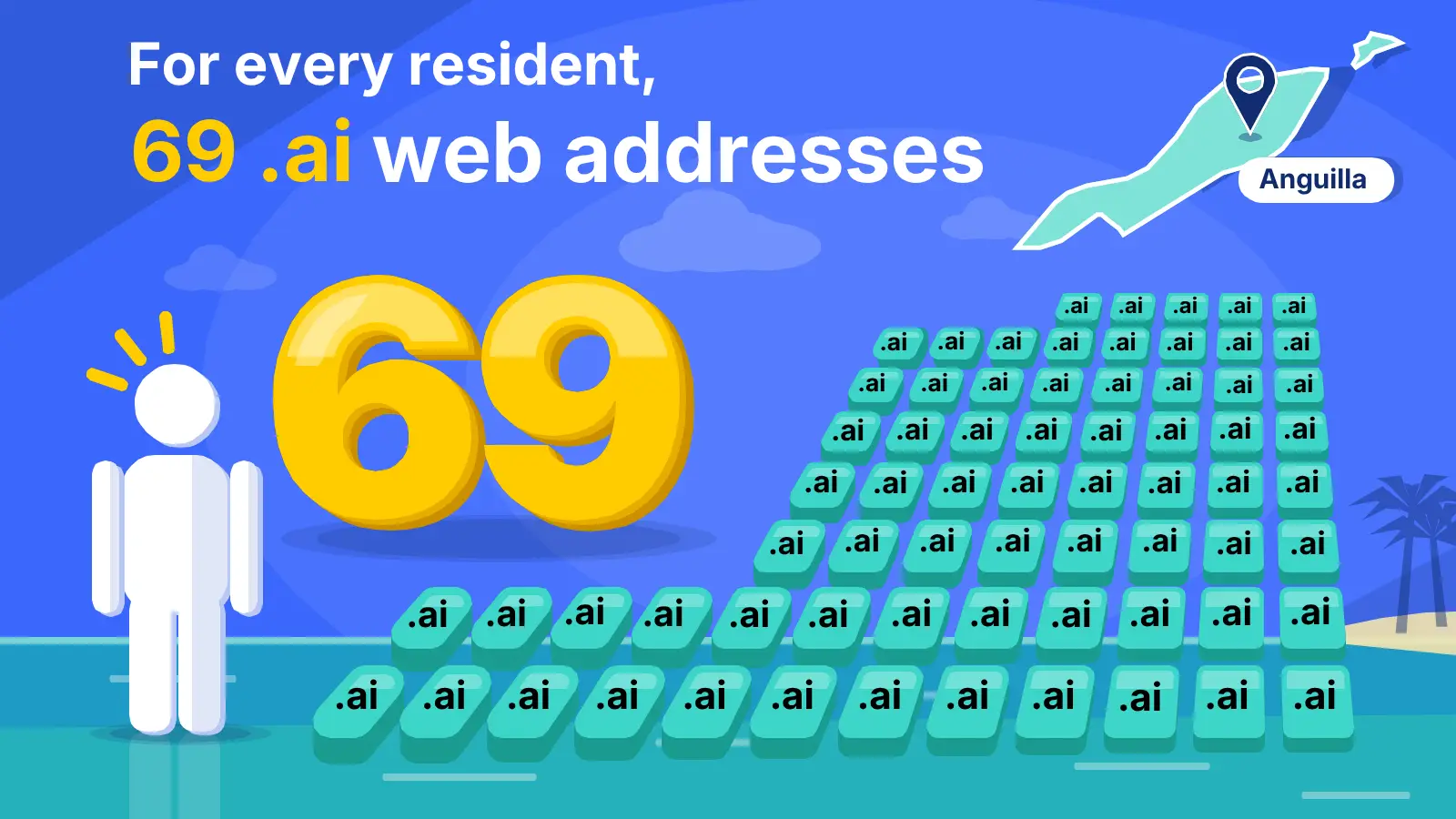
Anguilla has approximately 69 registered .ai domains per resident
How a country code became a brand
Anguilla’s .ai is one of hundreds of two-letter country codes handed out in the early days of the internet, like Tuvalu’s .tv. According to the IMF, there were about 144,000 .ai website registrations in 2022. They jumped to 354,000 in 2023, and passed 1 million in January 2026.
In 2023, Anguilla earned EC$87 million (US$32 million). Then, EC$230.5 million (US$85.4 million) in 2025. In 2026, it expects EC$253 million (US$94 million)—nearly three times as much as in 2023.
That forecast looks conservative: by the end of July, Anguilla had already collected EC$217 million, 86% of the full-year forecasts.
Since January 2025, sales have been run by Identity Digital, a US company. It signed a five-year deal in October 2024 and is paid a share of registration fees. On Hostinger, a .ai address costs US$89.99 for the first year and US$109.99 for the second, and both years must be paid upfront.
Will Slovenia become a rival?
On September 29, President Trump signed an executive order telling federal agencies to use the terms “Super Intelligence” and “SI” instead of “artificial intelligence” and “AI” in official communications.
The Slovenian .si domain had fewer than 2,000 new registrations in all of August, then 20,276 in a single day, the 24 hours to October 5. By October 9, the daily registrations had fallen to 8,607, but still remained well above past levels.
A .si domain costs about US$12 a year on Hostinger, against about US$200 for the two-year minimum on .ai.
There’s no public evidence that .si is taking buyers from .ai, since daily .ai figures aren’t published. And unlike Anguilla’s .ai fees, .si fees go to Slovenia’s national registry, not the treasury. Klaudijus Januitis, Hostinger’s head of domains, told TechCrunch: “For Anguilla, .ai became a second economy. For Slovenia, .si is a nice bonus.”
Methodology
Exchange rate: US$1 = EC$2.70 (fixed peg). Revenue source: The 2026 figures come from Premier Cora Richardson Hodge’s Sept 23 address, posted on Instagram and reported by the Jamaica Gleaner on Oct 9.
Sources
Most Read
loading