Four tech giants spent $1.3 trillion since 2023, 2.4x three US megaprojects
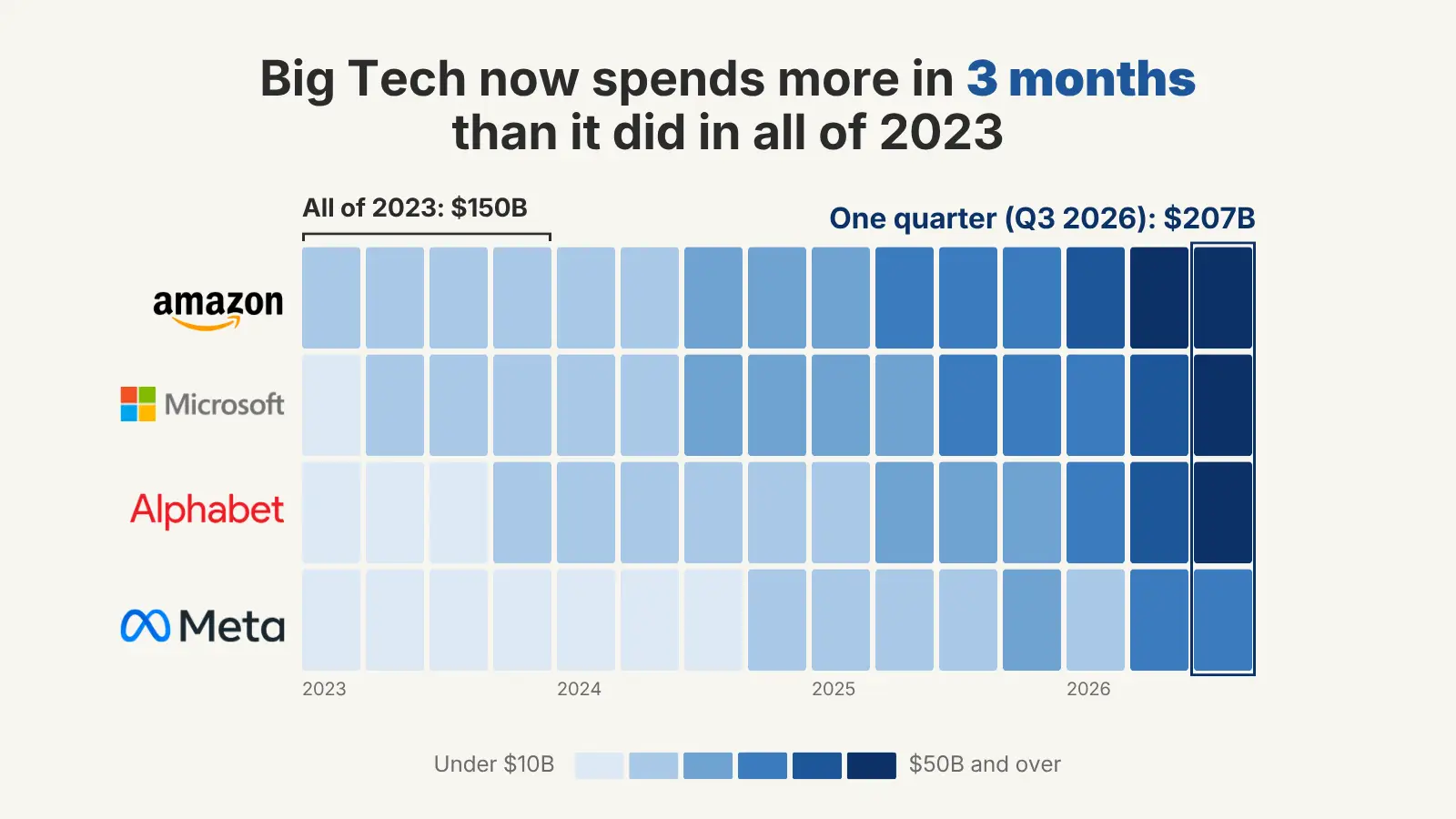
Big Tech’s 2026 spending alone is on track to top all three megaprojects combined. That’s one year of corporate budgets against three defining megaprojects.
Key takeaways
- Four big tech companies have spent $1.3 trillion since 2023—over twice what it cost to finance Apollo, the Manhattan Project, and the Interstates, adjusted for inflation.
- In Q3 2026, three of the four spent more on capex than their operations brought in: Alphabet, Amazon and Meta.
- The spending is accelerating: it nearly tripled from $150 billion in 2023 to $410 billion in 2025, and could reach about $730 billion this year.
The cost of three megaprojects
The Apollo program, the Manhattan Project and the construction of the interstate highway system happened at different times in history. To be able to compare them to the spending of modern tech giants, their budgets need to be adjusted for inflation.
We did it using the BLS Consumer Price Index (CPI-U). We divided the September 2026 index by the average index in the year of completion of each project, and multiplied this result by the cost of each project.
Apollo ran in the years 1960–1973 and cost the US government $25.8 billion, which is $196 billion, adjusted for inflation. The Manhattan Project consumed a total of $2.2 billion—that budget is equivalent to roughly $41 billion today. Finally, the interstate highway system cost $128.9 billion. In today’s money, that’s $319 billion.
In total, the US spent $556 billion on these three projects, adjusted for inflation. To put it into perspective, that’s roughly $1,600 per US resident today.

Since 2023, Amazon, Microsoft, Alphabet, and Meta have spent a combined $1.3 trillion, compared with $556 billion for the interstate highway system, Apollo program, and Manhattan Project combined
What big tech spent, year by year
Combined, Microsoft, Alphabet, Amazon, and Meta spent $150 billion in 2023, $245 billion in 2024, and $410 billion in 2025. Three quarters into 2026, they have already topped the previous year’s total, reaching $508 billion.
Microsoft has spent $353 billion since 2023, including leases. Alphabet, $308 billion, and this year, its capex was higher than its operating cash flow in both Q2 and Q3 ($44.9B and $51.4B). Amazon has spent the most of the four—$426 billion. This figure includes its warehouse and delivery network. Finally, Meta spent $225 billion, including $34.91 billion in Q3 of 2026, which is an 80% increase year over year.
If we combine all four tech giants, they are projected to spend a total of $730 billion in 2026. In 2026 alone, they’re on track to spend about $175 billion more than the three megaprojects combined.
This isn’t all AI
These figures aren’t limited to AI—they include the costs connected to data centers, servers, chips, fiber, office buildings, and in the case of Amazon, warehouses. To date, none of these companies have declared precise spending on AI.
Methodology
We converted each project’s official cost to 2026 dollars with the BLS CPI-U: cost × 336.940 (September 2026) ÷ the annual average in the project’s end year (1973: 44.4; 1945: 18; 1991: 136.2). Since most of the money was spent earlier, when the dollar had more purchasing power, this understates the adjustment for inflation. Capex comes from company filings and earnings releases for Q1 2023–Q3 2026, with Microsoft summed by calendar quarter. Since July 2026, Microsoft has excluded more data-center leases from capex, so its recent figures aren't directly comparable to earlier quarters. The Q4 2026 figures are company guidance, not actual spending. We start in 2023, the first full year after ChatGPT’s launch; quarterly spending has since risen about sixfold, from about $34B to $207B. Big Tech figures are in nominal dollars; adjusting them for inflation would raise the total by roughly 4–5%
Sources
Most Read
loading