The 10 states with the most credit card debt per person, and the one where it eats the most income
• Finance
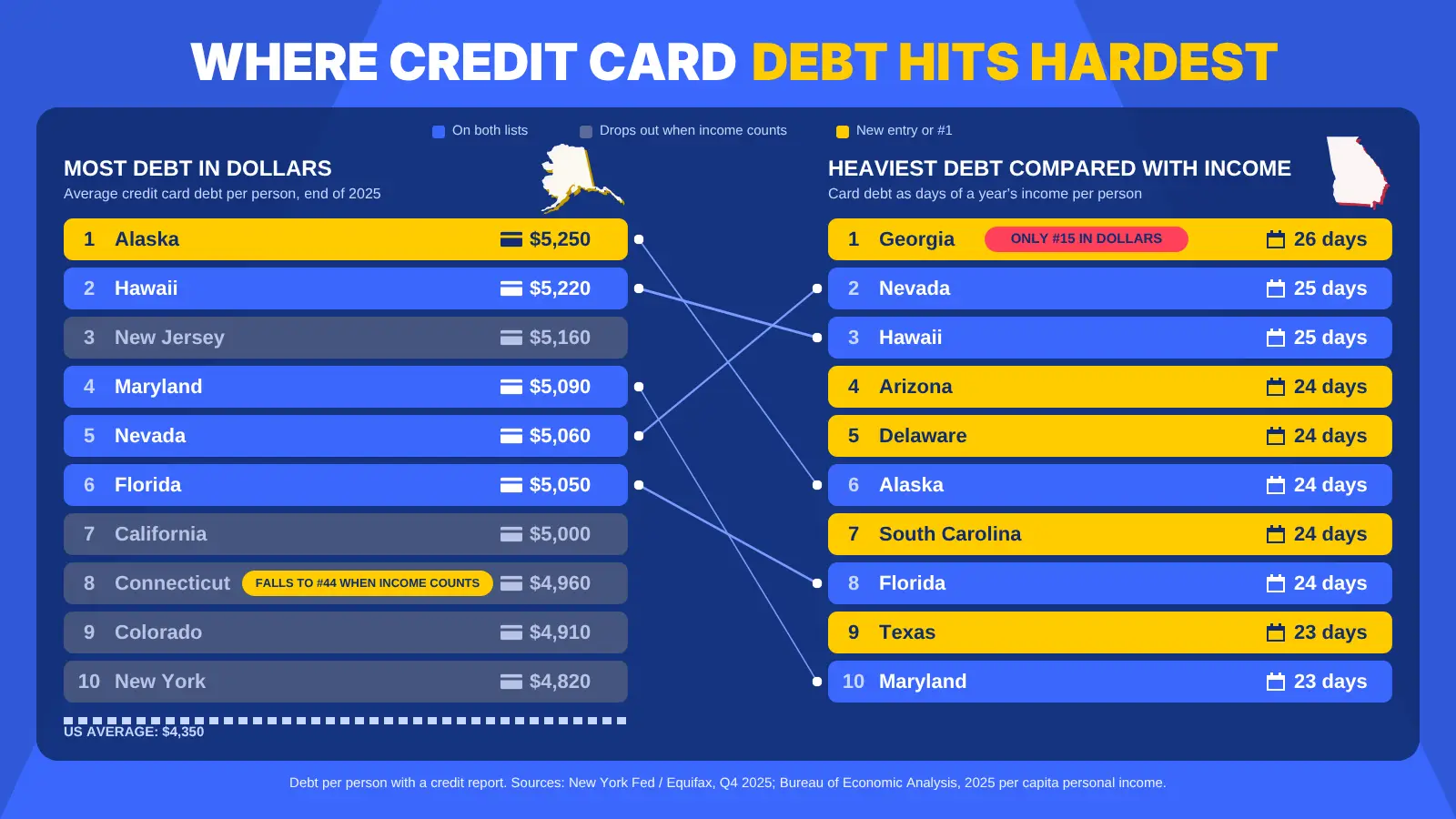
Alaskans carry an average of $5,250 in credit card debt per person, more than anyone else in the country and about $900 above the national average, just as another holiday shopping season gets going.
Key takeaways
- Seven states now average more than $5,000 in card debt per person.
- The state where card debt weighs most on people's income isn't on the top 10 list at all.
- One top 10 state drops almost to the bottom once you factor in what people earn.
The top 10
The ranking comes from the New York Fed's yearly state data, which shows how much credit card debt the average person with a credit report owed at the end of 2025. Across the US, that figure was $4,350, up from $4,180 a year earlier. Because it's a snapshot from the end of December, it captures balances right after last year's holiday shopping.
- Alaska: $5,250. Prices for almost everything are higher in Alaska, from groceries to fuel, and that shows up on the cards.
- Hawaii: $5,220. Another state where everyday costs are far above the mainland average, just $30 behind Alaska.
- New Jersey: $5,160. The highest in the Northeast.
- Maryland: $5,090.
- Nevada: $5,060.
- Florida: $5,050.
- California: $5,000. The last state to make the $5,000 club.
- Connecticut: $4,960.
- Colorado: $4,910.
- New York: $4,820.
At the other end of the list sit Mississippi at $3,030, Kentucky at $3,140, West Virginia at $3,180, Iowa at $3,250 and Arkansas at $3,310. The gap between first and last is $2,220. In other words, the average Mississippian owes about 42% less on their cards than the average Alaskan.
It's worth knowing what these numbers include. They cover everyone with a credit file, including people who pay their bill in full every month. That's why they're lower than the "average balance per cardholder" figures you'll often see from credit bureaus, which can run above $6,000.
The twist: debt against income
A $5,000 balance means something very different in a state where people earn a lot than in one where they don't. So we compared each state's card debt per person with its 2025 per capita personal income from the Bureau of Economic Analysis. The result is a rough measure of how heavy that debt is, shown as a share of a year's income and as days of income.
Re-ranked this way, the top 10 looks quite different:
- Georgia: 7.1% of a year's income, or about 26 days
- Nevada: 6.9%, about 25 days
- Hawaii: 6.8%, about 25 days
- Arizona: 6.6%, about 24 days
- Delaware: 6.6%, about 24 days
- Alaska: 6.5%, about 24 days
- South Carolina: 6.4%, about 24 days
- Florida: 6.4%, about 24 days
- Texas: 6.3%, about 23 days
- Maryland: 6.2%, about 23 days
Georgia is the biggest surprise. It ranks only 15th by dollars, at $4,610, but incomes there are lower, so its card debt equals more of a year's earnings than anywhere else. Arizona, Delaware, South Carolina and Texas also climb into the top 10. Five states fall out. New Jersey drops from 3rd to 16th, Colorado to 18th, California to 23rd and New York to 31st. Connecticut makes the biggest fall of all, from 8th in dollars to 44th, because its residents have some of the highest incomes in the country. Mississippi, last by dollars, ends up in the middle of the pack at 21st. Its residents owe the least, but they also earn the least, so their card debt equals about 5.6% of a year's income, close to Alaska's 6.5%. The $2,220 gap almost disappears.
What a balance like that costs
Not everyone in these averages pays interest, since many people clear their balance every month. But for those who don't, the cost adds up fast. The average rate on credit card accounts that were charged interest was 22.15% in the second quarter of 2026, according to the Federal Reserve.
At that rate, carrying Alaska's average balance of $5,250 for a full year would cost about $1,163 in interest. Mississippi's $3,030 would cost about $671.
Paying it down slowly makes the gap even wider. With a fixed payment of $150 a month and no new spending, the Alaska balance would take about 57 months to clear, almost five years, and cost around $3,270 in interest along the way. The Mississippi balance would be gone in about 26 months, with roughly $800 in interest. The first balance is less than twice as big, but it costs about four times as much to pay off.
With Black Friday at the end of the month, that's the math behind every new holiday purchase that doesn't get paid off in January.
Methodology
Card debt per person is the New York Fed's credit card balance per capita for each state at the end of 2025, from its state-level household debt statistics. It's based on Equifax data and counts people with a credit report, not only cardholders. The income comparison divides each state's figure by its 2025 per capita personal income from the Bureau of Economic Analysis. Because one figure counts adults with credit files and the other counts all residents, the ratio is an indicator of how heavy the debt is, not a share of anyone's paycheck. Days of income are that ratio multiplied by 365. Yearly interest is each balance times 22.15%, and the payoff figures assume a 22.15% rate, a fixed $150 monthly payment and no new purchases.
Most Read



loading