Zuckerberg would owe an estimated $12 billion under California's billionaire tax. See the top 10
• Finance
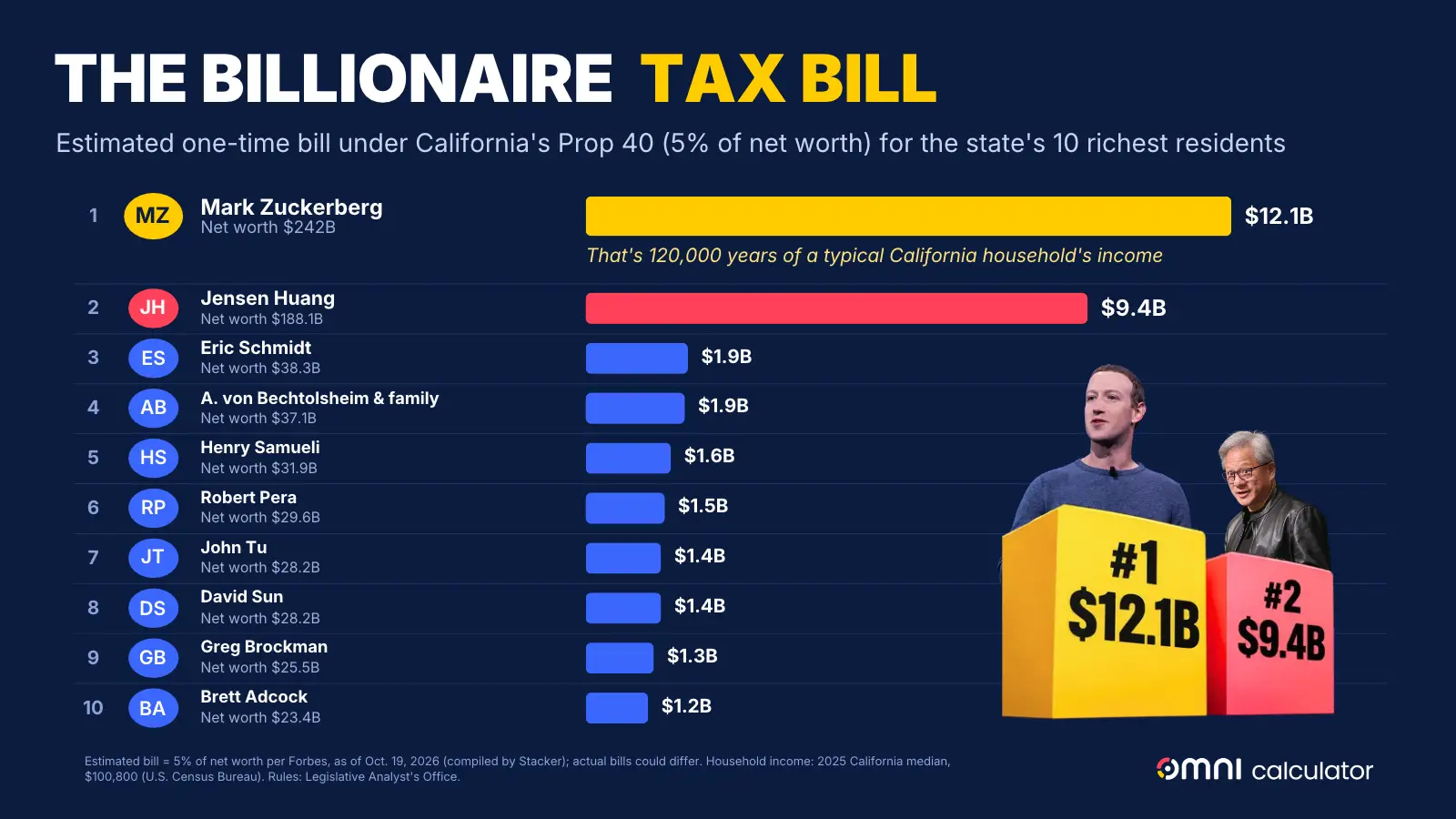
If California voters approve Proposition 40 on Tuesday, Mark Zuckerberg would owe an estimated $12.1 billion in a single payment, about what a typical California household would earn in 120,000 years.
Key takeaways
- The state's 10 richest residents would owe more than $33 billion between them.
- The smallest possible bill under the measure is still bigger than most people will earn in many lifetimes.
- Opponents have outspent supporters by more than five to one.
The 10 biggest estimated bills
The measure would charge a one-time 5% of net worth to every billionaire who lived in California on January 1, 2026. Applied to Forbes' net worth estimates for the state's 10 richest residents as of October 19, 2026, here's what each would owe:
- Mark Zuckerberg: an estimated $12.1 billion, on a net worth of $242 billion
- Jensen Huang: $9.4 billion, on $188.1 billion
- Eric Schmidt: $1.9 billion, on $38.3 billion
- Andreas von Bechtolsheim and family: $1.9 billion, on $37.1 billion
- Henry Samueli: $1.6 billion, on $31.9 billion
- Robert Pera: $1.5 billion, on $29.6 billion
- John Tu: $1.4 billion, on $28.2 billion
- David Sun: $1.4 billion, on $28.2 billion
- Greg Brockman: $1.3 billion, on $25.5 billion
- Brett Adcock: $1.2 billion, on $23.4 billion
Together, that's an estimated $33.6 billion. The top two alone account for about two-thirds of it, and the gap between second and third place is enormous. Huang's estimated bill is roughly five times Schmidt's, a reminder of how much of California's wealth now sits with the founders of a few very large tech companies.
Even at the bottom of the scale, the numbers are hard to picture. A billionaire worth exactly $1 billion would owe $50 million, the smallest bill the measure allows. That's about 500 years of income for a typical California household, which earned a median of $100,800 in 2025.
What voters are actually deciding
According to the state's nonpartisan Legislative Analyst's Office, the tax would apply to net worth, meaning the value of everything a person owns minus their debts. Real estate, pensions and retirement accounts would generally not count, so actual bills could come in lower than the estimates above, or higher if stock prices rise. The tax would be due in 2027, and billionaires could spread it over five years if they pay extra to do so. At least 90% of the money would have to go to public health care, and the LAO expects the state would probably collect tens of billions of dollars in total, though it says the exact amount is very hard to predict.
Supporters say the measure would bring in a large sum for health care from a small number of people who can afford it. Opponents say some billionaires would leave the state, taking their income taxes with them. The LAO puts that ongoing loss at probably less than $1 billion a year.
The campaign itself has been expensive, and lopsided. The opposing side has raised more than $195 million, against Proposition 40 and in favor of two related measures, compared with about $36 million in support, according to campaign filings reported by The Sacramento Bee in late September. Google co-founder Sergey Brin alone has given $102 million to the main opposition committee.
Most Read



loading