Nearly 9 A.M. Sunrises or 4 A.M. Dawn? What If America Stopped Changing Its Clocks?
Imagine leaving work at 5 p.m. and finding it's already dark outside. For millions of Americans, this is what November evenings look like after the clocks fall back. But what if we stopped changing the clocks altogether?
Key Takeaways
- Turning clocks back shifts sunset about an hour earlier without changing the total daylight duration.
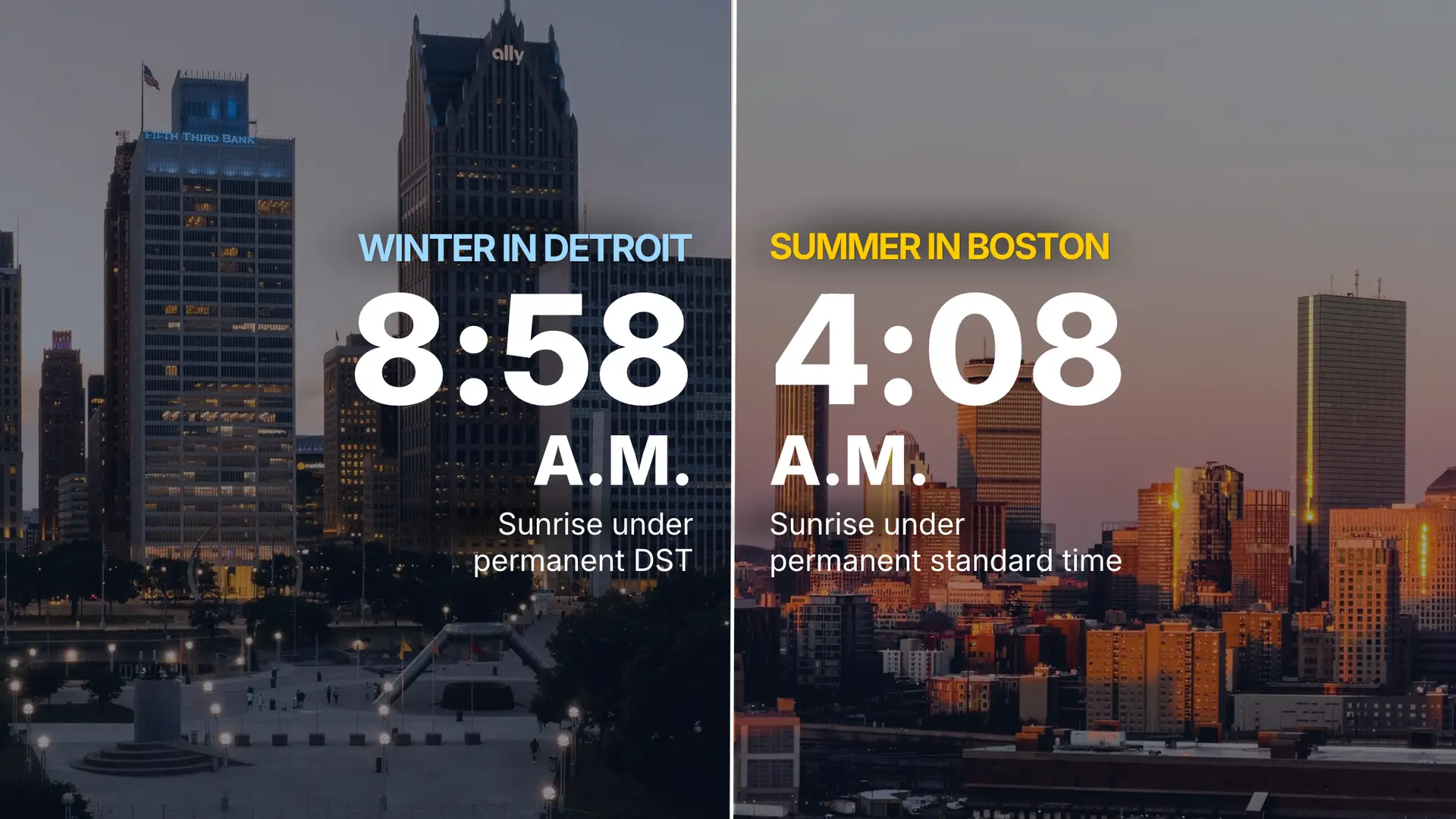
- Permanent daylight saving time could mean winter sunrises as late as 8:58 a.m. in Detroit.
- Permanent standard time could bring summer sunrises as early as 4:08 a.m. in Boston.
We compared sunrise and sunset times across eight U.S. cities to see what would happen if Americans stopped switching their clocks twice a year.
Did we really lose an hour of daylight on November 1?
Consider what happened in Boston when daylight saving time ended on Sunday, November 1, 2026. On Saturday, the sun set at 5:39 p.m. By Sunday, sunset had moved to 4:38 p.m. Even though the day itself was only about three minutes shorter, the difference on the clock is 61 minutes.
The clocks moved back an hour. Sunrise and sunset moved earlier with them.
Of course, days are naturally getting shorter as winter approaches. As our comparison of October daylight across U.S. cities shows, some places lose daylight much faster than others. But changing the clocks doesn't affect that natural pattern.
So what would happen if we picked one time system and kept it all year?

Daylight timelines comparing permanent DST in Detroit and standard time in Boston.
Permanent daylight saving time: Winter sunrises near 9 a.m.
Imagine leaving home at 8:30 on a December morning, and the sun still hasn't risen. In Detroit, this could become a winter reality under permanent daylight saving time. On December 21, the shortest day of the year, Detroit's sunrise would move from 7:58 a.m. to 8:58 a.m. Seattle wouldn't see sunrise until 8:55 a.m.
See how sunrise and sunset times would change in eight U.S. cities.
December 21, 2026: Current standard time vs. permanent daylight saving time
| City | Sunrise now | Sunrise with permanent DST | Sunset now | Sunset with permanent DST |
| Boston | 7:10 a.m. | 8:10 a.m. | 4:15 p.m. | 5:15 p.m. |
| Detroit | 7:58 a.m. | 8:58 a.m. | 5:03 p.m. | 6:03 p.m. |
| Chicago | 7:15 a.m. | 8:15 a.m. | 4:23 p.m. | 5:23 p.m. |
| Dallas | 7:26 a.m. | 8:26 a.m. | 5:25 p.m. | 6:25 p.m. |
| Denver | 7:18 a.m. | 8:18 a.m. | 4:39 p.m. | 5:39 p.m. |
| Seattle | 7:55 a.m. | 8:55 a.m. | 4:20 p.m. | 5:20 p.m. |
| Los Angeles | 6:55 a.m. | 7:55 a.m. | 4:48 p.m. | 5:48 p.m. |
| Miami | 7:03 a.m. | 8:03 a.m. | 5:35 p.m. | 6:35 p.m. |
Although there is a benefit on the other side of the day.
Detroit's sunset would move from 5:03 p.m. to 6:03 p.m. In Dallas, the sun would stay up until 6:25 p.m. instead of 5:25 p.m. That could mean more daylight after work, but darker mornings for people heading to school or starting their commute.
Regardless of which clock system it followed, Detroit would still receive nine hours and five minutes of daylight on December 21. The total daylight duration stays the same. Only the clock times of sunrise and sunset would shift by an hour.
Permanent standard time: Summer sunrises shortly after 4 a.m.
Now consider the opposite choice.
What if America kept standard time year-round, including during the summer?
In Boston, the sun would rise at 4:08 a.m. on June 21. Seattle would see sunrise at 4:11 a.m., and Chicago at 4:16 a.m. That's a lot of daylight arriving while most people are still asleep.
June 21, 2026: Current daylight saving time vs. permanent standard time
| City | Sunrise now | Sunrise with permanent standard time | Sunset now | Sunset with permanent standard time |
| Boston | 5:08 a.m. | 4:08 a.m. | 8:25 p.m. | 7:25 p.m. |
| Detroit | 5:56 a.m. | 4:56 a.m. | 9:13 p.m. | 8:13 p.m. |
| Chicago | 5:16 a.m. | 4:16 a.m. | 8:29 p.m. | 7:29 p.m. |
| Dallas | 6:20 a.m. | 5:20 a.m. | 8:38 p.m. | 7:38 p.m. |
| Denver | 5:32 a.m. | 4:32 a.m. | 8:31 p.m. | 7:31 p.m. |
| Seattle | 5:11 a.m. | 4:11 a.m. | 9:11 p.m. | 8:11 p.m. |
| Los Angeles | 5:43 a.m. | 4:43 a.m. | 8:08 p.m. | 7:08 p.m. |
| Miami | 6:30 a.m. | 5:30 a.m. | 8:15 p.m. | 7:15 p.m. |
The biggest adjustment would be to summer evenings. In Seattle, sunset would shift from 9:11 p.m. to 8:11 p.m. Boston's sunset would move from 8:25 p.m. to 7:25 p.m.
People who enjoy long summer evenings outdoors would lose an hour of evening daylight, while early risers might welcome the earlier sunrise.
Why do some cities get such extreme sunrise times?
Your location matters almost as much as the season. Even within the same time zone, sunrise doesn't happen everywhere at once.
Detroit is in the western part of the Eastern Time Zone. Hence, the sun generally rises later there than in cities farther east, such as Boston. It's one reason Detroit would see such a late winter sunrise under permanent daylight saving time.
How far north you live also matters. On December 21, Seattle gets about 8 hours and 25 minutes of daylight, while Miami gets roughly 10 hours and 32 minutes. In June, the situation reverses. Seattle enjoys 16 hours of daylight, compared with Miami's 13 hours and 45 minutes.
No clock change can alter those differences.
So, which clock system gives us more daylight?
Neither.
Permanent daylight saving time would keep winter sunsets later, at the cost of later winter sunrises. Permanent standard time would bring earlier summer sunrises, but summer evenings would get dark an hour sooner.
The United States already has examples of places that don't make the seasonal switch. Hawaii and most of Arizona observe standard time year-round.
For the rest of the country, the choice comes down to when people would rather have their daylight. You can move an hour of it from the morning to the evening, or vice versa. But you can't make the day any longer.
Methodology
We compared sunrise and sunset times for eight U.S. cities on December 21 and June 21, 2026, using data from the U.S. Naval Observatory.
For December, we added one hour to the standard-time sunrise and sunset values to show permanent daylight saving time. For June, we subtracted 1 hour from the current daylight saving time to show permanent standard time.
Times are shown in local clock time and rounded to the nearest minute. Daylight duration is measured from sunrise to sunset. These are calculated times for the selected city locations, so the exact times may vary slightly elsewhere within each city.
Most Read





loading