Anchorage loses nearly 3 hours of daylight in October. Miami loses just 43 minutes
• Science
Key Takeaways
- At the start of October, Miami and Anchorage are separated by only about half an hour of daylight.
- By Halloween, that gap has widened to about 2 hours and 37 minutes.
- The farther north a city is, the faster its daylight shrinks in autumn because of Earth’s tilt.
October gets darker everywhere in the United States, but not at the same rate.
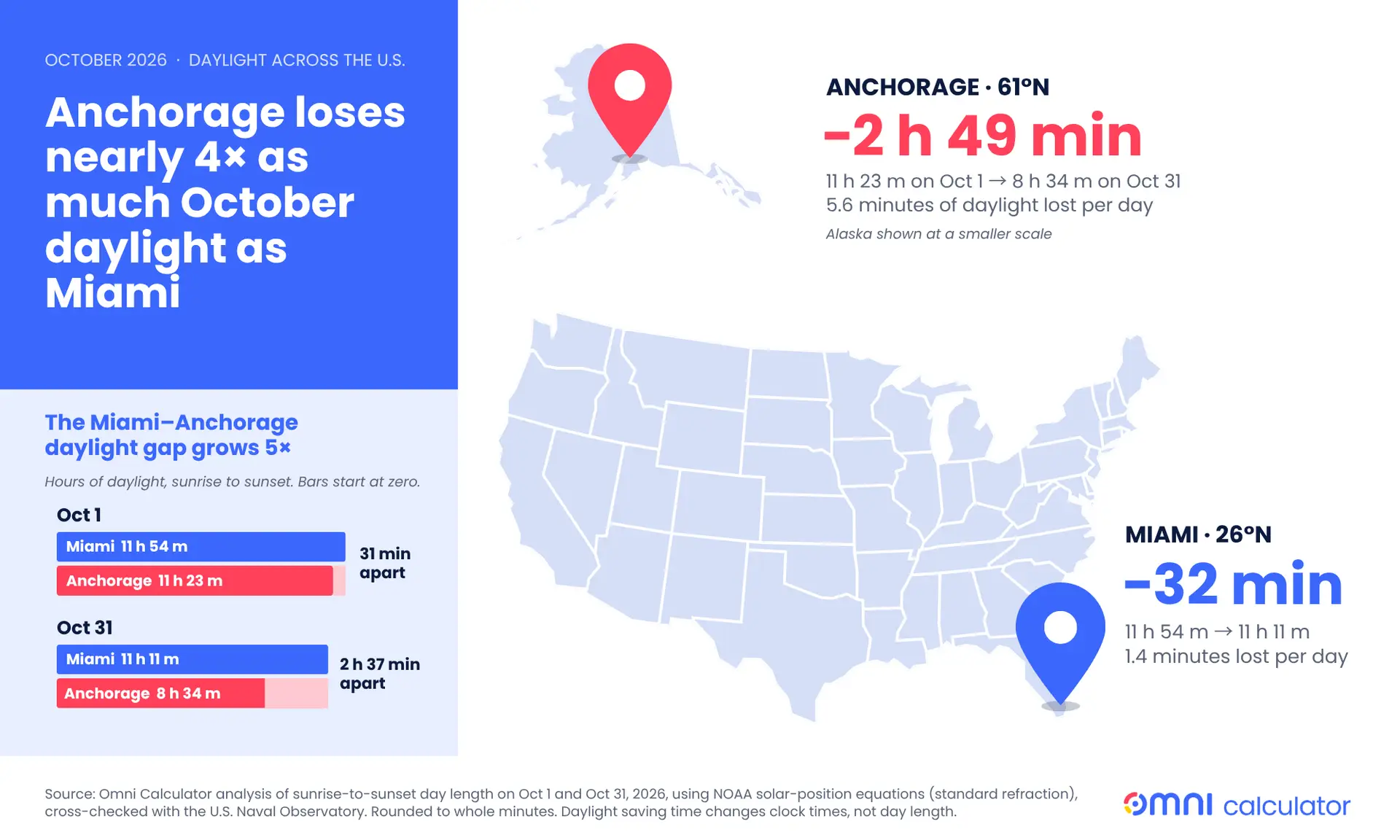
On October 1, Miami gets about 11 hours and 54 minutes of daylight. Anchorage gets 11 hours 23 minutes. Despite being roughly 3,900 miles apart, their days differ by just 31 minutes.
Then October happens.
By October 31, Miami still has about 11 hours and 11 minutes between sunrise and sunset. Anchorage is down to just 8 hours 34 minutes.
In a single month, Anchorage loses 2 hours 49 minutes of daylight. Miami loses just 43 minutes.
Put another way, Anchorage gives up nearly four times as much daylight each day as Miami.
How much daylight does your city lose in October?

Daylight loss rises sharply with latitude. Miami loses about 43 minutes during October, compared with 169 minutes in Anchorage.
Here is what happens across 10 major U.S. cities in October 2026:
| City | Daylight Oct. 1 | Daylight Oct. 31 | Daylight lost | Average loss per day |
| Miami | 11 h 54 m | 11 h 11 m | 43 min | 1.4 min |
| Houston | 11 h 52 m | 11 h 01 m | 51 min | 1.7 min |
| Los Angeles | 11 h 49 m | 10 h 49 m | 60 min | 2.0 min |
| Atlanta | 11 h 50 m | 10 h 50 m | 60 min | 2.0 min |
| Denver | 11 h 46 m | 10 h 31 m | 75 min | 2.5 min |
| New York | 11 h 45 m | 10 h 28 m | 77 min | 2.6 min |
| Chicago | 11 h 44 m | 10 h 24 m | 80 min | 2.7 min |
| Minneapolis | 11 h 42 m | 10 h 12 m | 90 min | 3.0 min |
| Seattle | 11 h 40 m | 10 h 01 m | 99 min | 3.3 min |
| Anchorage | 11 h 23 m | 8 h 34 m | 169 min | 5.6 min |
The pattern is hard to miss: go north, and October takes a bigger bite out of the day.
Seattle loses 56 minutes more daylight than Miami. Minneapolis loses an hour and a half. Anchorage loses nearly three hours.
And there is an interesting clue hiding in the middle of the table.
Los Angeles and Atlanta are thousands of miles apart, but both sit at roughly 34° north latitude. Both lose almost exactly one hour of daylight during October.
Denver and New York provide another example. They are on opposite sides of the country but sit at similar latitudes. Their October losses are almost identical: 75 minutes in Denver and 77 minutes in New York.
For the length of your day, east versus west matters surprisingly little. North versus south matters a lot.
Why does latitude make such a big difference?
The answer starts with Earth's tilt.
Earth's axis is tilted by about 23.5 degrees. Around the September equinox, neither hemisphere is tilted strongly toward or away from the Sun, so day and night are close to equal across much of the planet.
After that, the Northern Hemisphere increasingly tilts away from the Sun as Earth moves toward the December solstice.

Earth's 23.5° tilt changes the Sun's path across the sky through the seasons, with much larger daylight swings at higher latitudes.
Think of the Sun taking a slightly lower and shorter path across the sky each day. Close to the equator, shifting that path south makes relatively little difference to the time the Sun spends above the horizon.
Farther north, the same shift cuts away much more of the Sun's daily journey.
That is why the cities that begin October with relatively close-together daylight durations spread out so dramatically as the month goes on.
Miami and Anchorage start October only 31 minutes apart.
By Halloween, Anchorage has 2 hours 37 minutes less daylight than Miami.
October alone widens the gap between them by more than two hours.
Alaska shows what happens when you push latitude even further
Anchorage is striking, but it is nowhere near the northern edge of the United States.
Take Utqiagvik, Alaska, at about 71° north.
Using the same calculation, Utqiagvik begins October with roughly 11 hours of daylight. By October 31, it is down to around six hours.
That's a loss of almost five hours in one month — roughly 10 minutes of daylight per day on average.
At the other end, Honolulu loses only about 35 minutes during October.
So across the United States, the same 31 days can mean anything from losing a little over half an hour of daylight to losing almost five hours.
Then November 1 makes the darkness feel even more sudden
There is one more twist waiting immediately after October ends.
For most Americans, daylight saving time ends on Sunday, November 1, 2026. Federal rules set the end of daylight saving time on the first Sunday in November for places that observe it.
The clocks move back one hour.
That doesn't remove an hour of sunlight. The amount of daylight is determined by the positions of the Sun and Earth, not by the time displayed on a clock.
It simply moves that daylight earlier.
So after a month in which Seattle has already lost 99 minutes of daylight, New York 77 minutes, and Anchorage 169 minutes, sunset suddenly appears another hour earlier on the clock.
No wonder November can feel as if someone switched off the lights.
Methodology
Daylight is defined here as the time from sunrise to sunset. We calculated day length for October 1 and October 31, 2026, using NOAA's published solar-position equations, which use a solar zenith angle of 90.833° to approximately account for atmospheric refraction and the size of the Sun's disk. Results were rounded to the nearest minute. Sunrise/sunset data were cross-checked against the U.S. Naval Observatory.
Most Read





loading
Loading