$10,000 on a credit card costs about $2,100 a year in interest. At the Fed's rate, it would be $400
• Finance
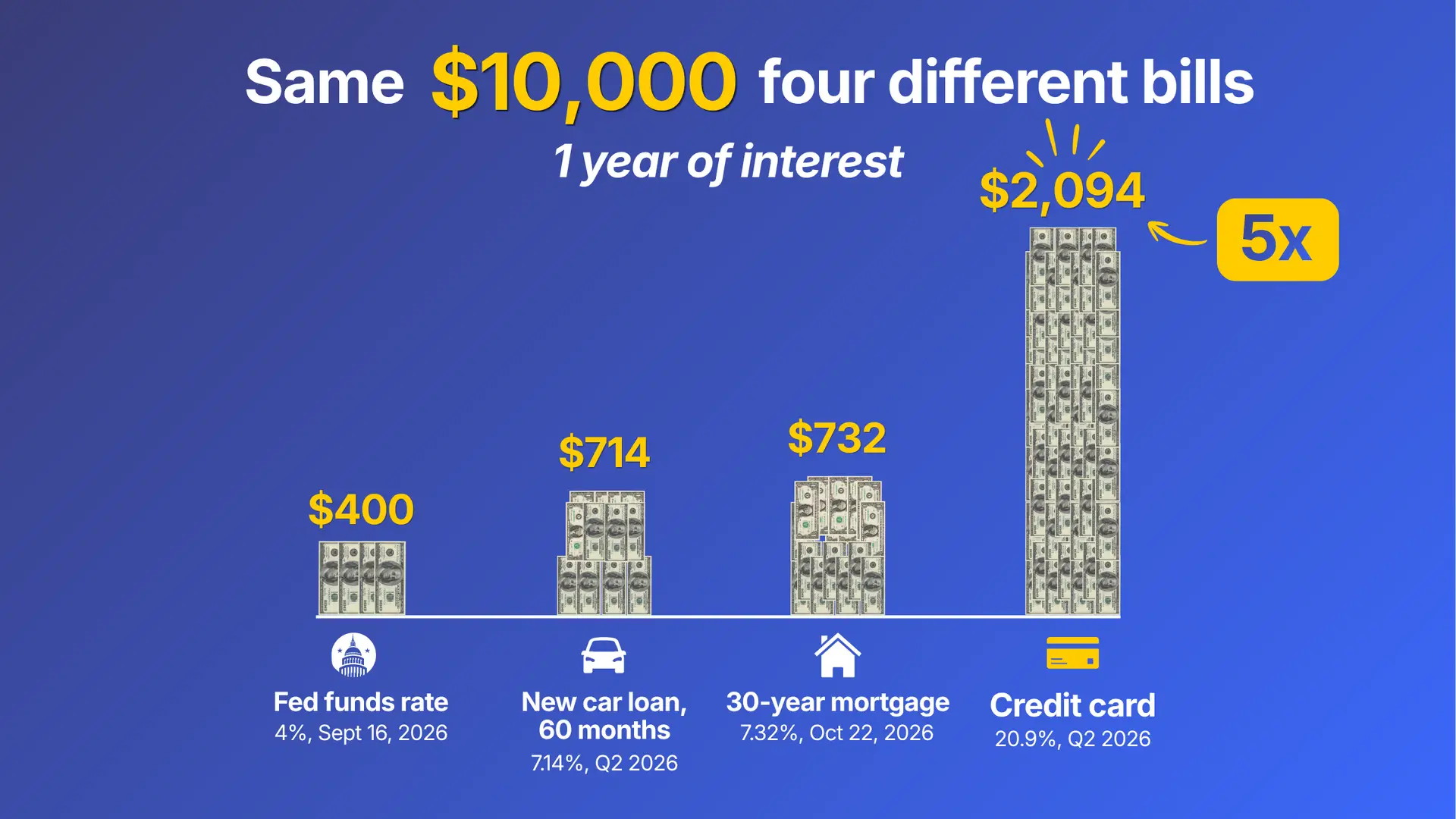
A $10,000 balance at the average credit card rate costs about $2,094 in interest over a year, more than five times the $400 it would cost at the Federal Reserve's own benchmark rate.
Key takeaways
- The Fed's decision moves some of your rates within weeks and barely touches others.
- Mortgage rates started climbing this fall weeks before the Fed acted.
- If your loan is fixed, today's decision changes nothing about what you pay.
Same $10,000, four very different bills
The Federal Reserve raised its target range for the federal funds rate to 3.75% to 4% at its September meeting, and that's the number most headlines mean when they talk about "the Fed's rate." But it's not a rate any household actually pays. To see how far apart the rates people do pay really are, we ran the same simple calculation four times: one year of interest on $10,000 at each rate.
- Fed funds rate, top of the range: 4%, or $400 a year
- New car loan, 60 months: 7.14%, or $714 a year
- 30-year fixed mortgage: 7.32%, or $732 a year
- Credit card: 20.94%, or $2,094 a year
The car loan sits about 3 percentage points above the Fed's rate, which adds about $314 a year on $10,000. The mortgage is about 3.3 points higher, adding $332. The credit card is almost 17 points higher, and that gap alone costs $1,694 a year.
This is a like-for-like illustration, not what any real loan would cost. Car loans and mortgages are paid down every month, so the balance shrinks and so does the interest. Credit cards compound, so an unpaid balance can cost more. The point is to compare the rates on equal terms.
Why the gaps are so big
The federal funds rate is what banks charge each other for overnight loans. It's the cheapest money in the system, lent between institutions that trust each other and get it back the next morning. Every rate a household pays is built on top of it, plus a cushion for the risk that the loan won't be repaid, the bank's costs and its profit.
Credit cards carry the biggest cushion. The debt isn't backed by anything a lender can take back, like a car or a house, and many balances are never paid off. Most card rates are variable and tied to the prime rate, which banks usually set 3 percentage points above the top of the Fed's range. That's why card rates follow Fed moves closely, rising or falling within a billing cycle or two.
Mortgages work differently. A 30-year mortgage is priced off long-term borrowing costs, mainly the yield on 10-year Treasury bonds, which reflects what investors expect over many years, not what the Fed did this week. This fall showed it clearly. The average 30-year rate climbed for seven straight weeks into early October, according to Freddie Mac, a run that started well before the Fed's September hike, as bond investors priced in rates staying high for longer.
Car loans sit in between. They're shorter than mortgages and backed by the car, so the rate follows the Fed more than a mortgage does but carries a smaller cushion than a credit card.
Will my rate change now?
It depends on the kind of loan you have, and whether you already have it.
- Credit cards: most have variable rates, so when the Fed moves, card rates usually follow within a statement or two. When the Fed holds, they generally stay put.
- An existing fixed-rate mortgage: nothing changes. The rate was locked in when the loan was signed.
- A new mortgage: the rate depends on the bond market, so it can move before, after or even against a Fed decision.
- An existing car loan: most are fixed, so the payment stays the same.
- A new car loan: rates tend to drift in the same direction as the Fed over time, but lender offers and your credit score matter at least as much.
Methodology
The fed funds figure is the top of the target range set in the Federal Reserve's FOMC statement of September 16, 2026. The credit card rate is the commercial bank rate on credit card plans for all accounts, and the car loan rate is the commercial bank rate on 60-month new car loans, both for the second quarter of 2026 from the Federal Reserve's G.19 consumer credit release of October 7, 2026. Both predate the latest Fed decision. The mortgage rate is Freddie Mac's 30-year fixed average for the week of October 22, 2026. Yearly interest is $10,000 times each rate for one year, calculated with Omni's interest rate calculator.
Most Read


loading