Boeing’s 737 MAX 10 is finally certified. At 47 jets a month, the MAX backlog runs until 2035
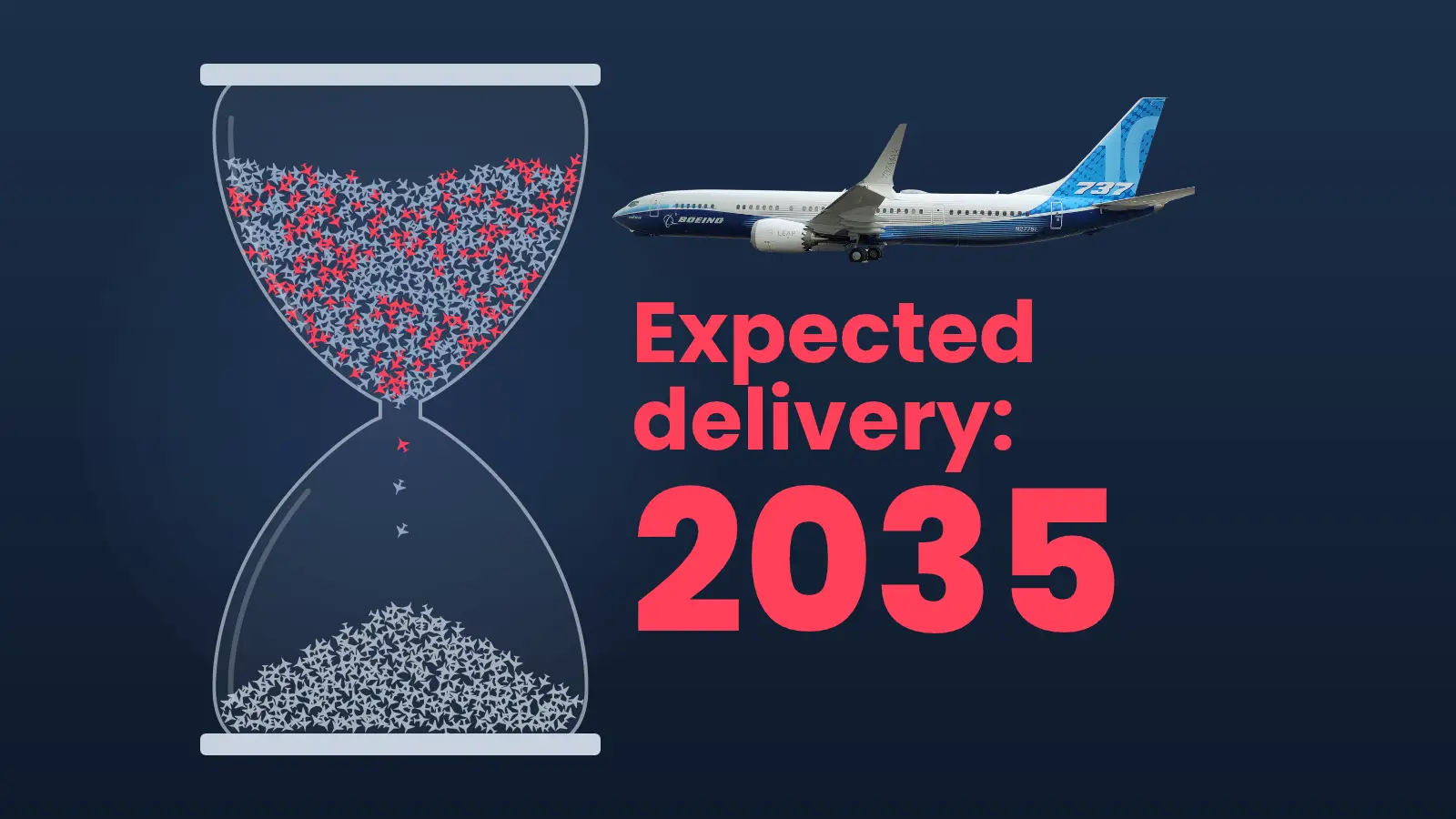
On October 20, the FAA certified the Boeing 737 MAX 10, the largest of the 737 family, with up to 230 seats. Boeing has FAA clearance to build 47 jets a month across all four of its 737 assembly lines. The backlog is long: the manufacturer is currently due to produce and deliver 4,850 MAXs, which at the current pace will take roughly 8.6 years, until 2035—and that’s if no new orders come in.
Key takeaways
- The MAX 10 can have 230 seats in a full-economy layout, and between 185 and 210 seats in a two-class layout, about 23–32 more than the MAX 8.
- Boeing had initially planned to deliver its first MAX 10 in 2020, then pushed the target to 2023.
- At about 4,850 undelivered MAX jets, any new orders would join a queue stretching into the mid-2030s.
The biggest 737 yet
The MAX 10 is the largest of the 737 family, with a capacity of 185–210 in a two-class layout, according to Boeing. In comparison, the MAX 8 can hold 162–178 seats, the MAX 9, 178–193 seats, and the smaller MAX 7 (certified by the FAA back in August), 135–160.
Its range is the shortest of the family—3,100 nautical miles, or about 3,570 statute miles vs. 3,500 nautical miles of the MAX 8. But the MAX 10 burns about 20% less fuel and emits 20% less CO2 than the jets it replaces.

Boeing’s 737 MAX 10 received FAA certification on October 20, 2026
Certification took nearly a decade
Boeing unveiled the MAX 10 at the Paris Air Show in June 2017 and wanted to deliver the first jets in 2020. Then, it revised its target: in the 2020 report, it planned the first delivery for 2023.
The timeline has now been pushed to 2027—seven years later than originally planned. The model was granted its certification over nine years after the unveiling. As per AP, Boeing ran into technical and regulatory difficulties, following two MAX crashes in 2018 and 2019. It then had problems with its engine anti-ice systems in 2023, which delayed both the MAX 7 and the MAX 10.
The FAA’s approval means that the MAX 10 meets its safety standards. Now Boeing needs to show that it can do that consistently—each plane will be cleared before it carries passengers. WestJet will be the first to take delivery in early 2027.
The math: 4,850 jets, 47 a month
As of the end of September, Boeing had delivered nearly 2,500 737 MAXs. Given that it has received a total of 7,350 orders, roughly 4,850 jets are yet to be built.
4,850 ÷ 47 ≈ 103 months, or about 8.6 years
At this rate, production will take until 2035, assuming there are no new orders, no cancelations, and a steady pace of 47 airframes a month. And this estimate could be optimistic, since Boeing’s CEO Kelly Ortberg claims the production line is not stable at 47 a month.
How the timeline would change at different rates
After a door-plug blowout in an Alaska Airlines 737 MAX in January 2024, the FAA capped production at 38 a month. The cap was raised to 42 in late 2025.
- 42 a month (the FAA’s previous production cap): 115 months, ~9.6 years
- 47 a month: 103 months, ~8.6 years
- 52 a month (rate discussed by Boeing): 93 months, ~7.8 years
The MAX 10 constitutes about 32% of the current MAX backlog, with 1,555 orders placed so far. The whole MAX 10 backlog alone would, therefore, take almost three years, and that’s only if every jet Boeing built were a MAX 10.
Sources

loading


Loading