Here is where your gas money goes
• Finance
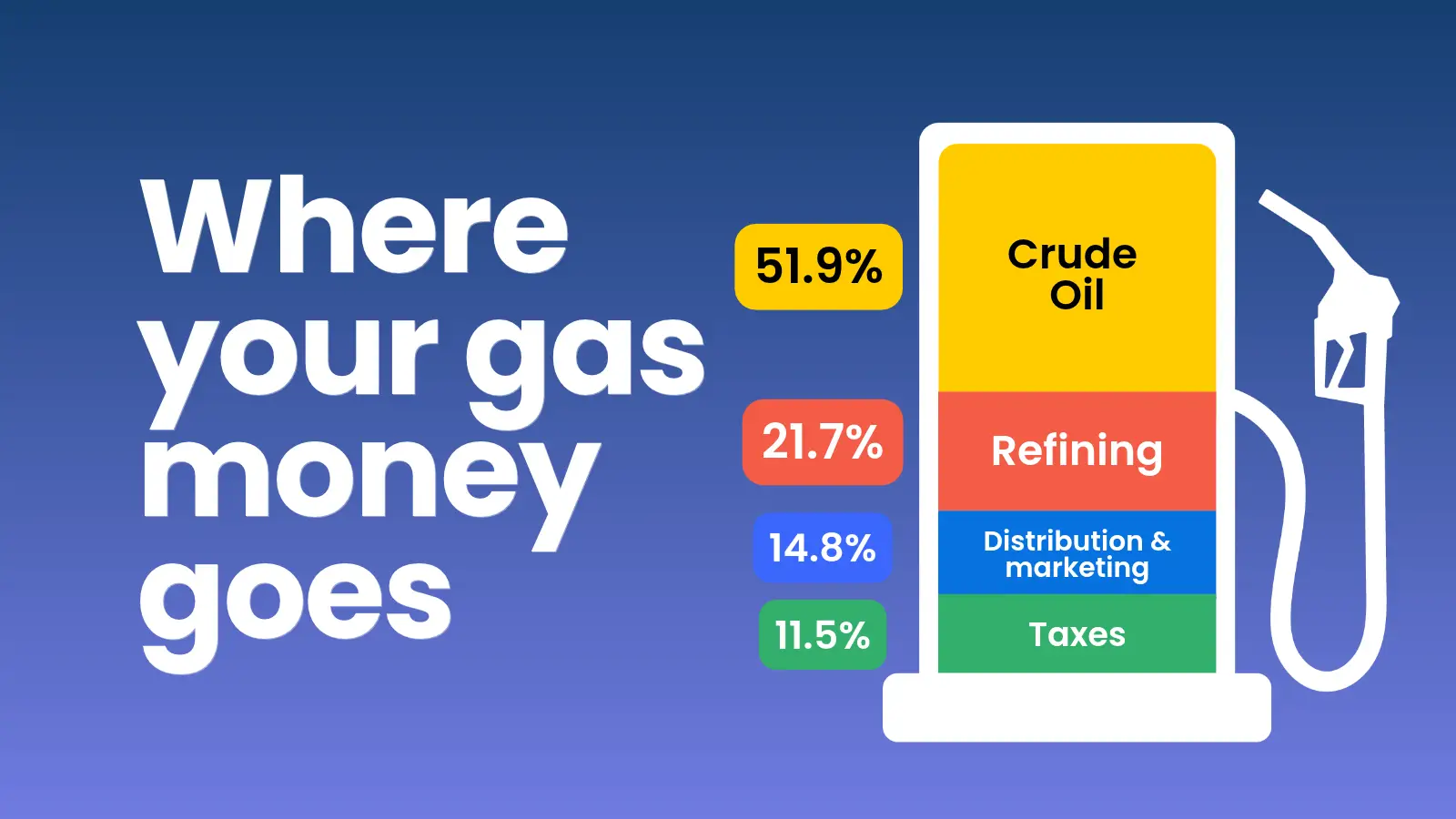
Every $10 rise in the price of a barrel of crude oil can add about 24 cents to a gallon of gasoline once it fully reaches the pump, according to the US Energy Information Administration. With oil near $100 a barrel, that matters: the national average for regular gas was $4.28 on October 20, according to AAA, up from $3.04 a year earlier. Crude is also the biggest single slice of what drivers pay, more than half of the price in EIA's latest breakdown.
Key takeaways
- A $1 change in the price of a barrel of crude works out to about 2.4 cents a gallon at full pass-through, so $10 adds about 24 cents (EIA).
- About half of a crude price change reaches the pump within two weeks, and about 80% within four weeks.
- Crude oil made up 51.9% of the price of a gallon of regular in May 2026, the latest month EIA has published.
- September 2026 set a record for the month, with a $4.33 average, beating September 2023's $3.83 (AAA).
What each $10 of oil adds, and how fast
A barrel holds 42 gallons. EIA's rule of thumb is that every $1 change in the price of a barrel of crude means about a 2.4-cent change per gallon of gasoline. You can run the barrel-to-gallon math yourself with our unit price calculator. A $10 rise therefore adds about 24 cents a gallon, if it is passed on in full.
It doesn't arrive all at once. According to EIA, about 50% of a change in crude prices usually reaches the pump within two weeks, and about 80% within four weeks.
The 24 cents is what crude adds to the cost of making gasoline. The price drivers actually pay can move by more or less, because refining margins, competition between stations and taxes can push it in either direction.
Oil vs. the pump over the past year
The price of West Texas Intermediate crude, the main US benchmark, averaged $97.31 a barrel in September 2026, compared with $63.96 in September 2025, according to EIA data. At 2.4 cents per dollar, that rise of about $33 a barrel works out to roughly 80 cents a gallon at full pass-through.
At the pump, the national average for regular was $4.28 on October 20, up from $3.04 a year earlier, according to AAA. That increase is bigger than crude alone would explain. The rest comes from the other parts of the price, mainly refining margins and distribution costs.
Taxes: mostly a fixed number of cents
The federal gas tax is 18.4 cents a gallon, and state taxes and fees averaged 33.55 cents a gallon as of January 2026, according to EIA. Together that's about 52 cents.
Most gas taxes are set in cents per gallon rather than as a percentage, so they don't rise when gas gets more expensive. That's why taxes take a smaller share of the price when pump prices climb, although some states have taxes that move with the price.
Methodology
Pump prices are the AAA national average for regular gasoline on October 20, 2026, and AAA's own year-ago figure from the same page. The September record comes from AAA (October 1, 2026). The price breakdown is EIA's gasoline pump components for May 2026, the latest month available. The 2.4-cents-per-dollar rule and the pass-through timing come from EIA, and taxes from EIA's Gasoline explained. WTI prices are EIA monthly averages, via FRED.


loading


Loading