503 major leaguers were born in August, only 313 in July
• Sports
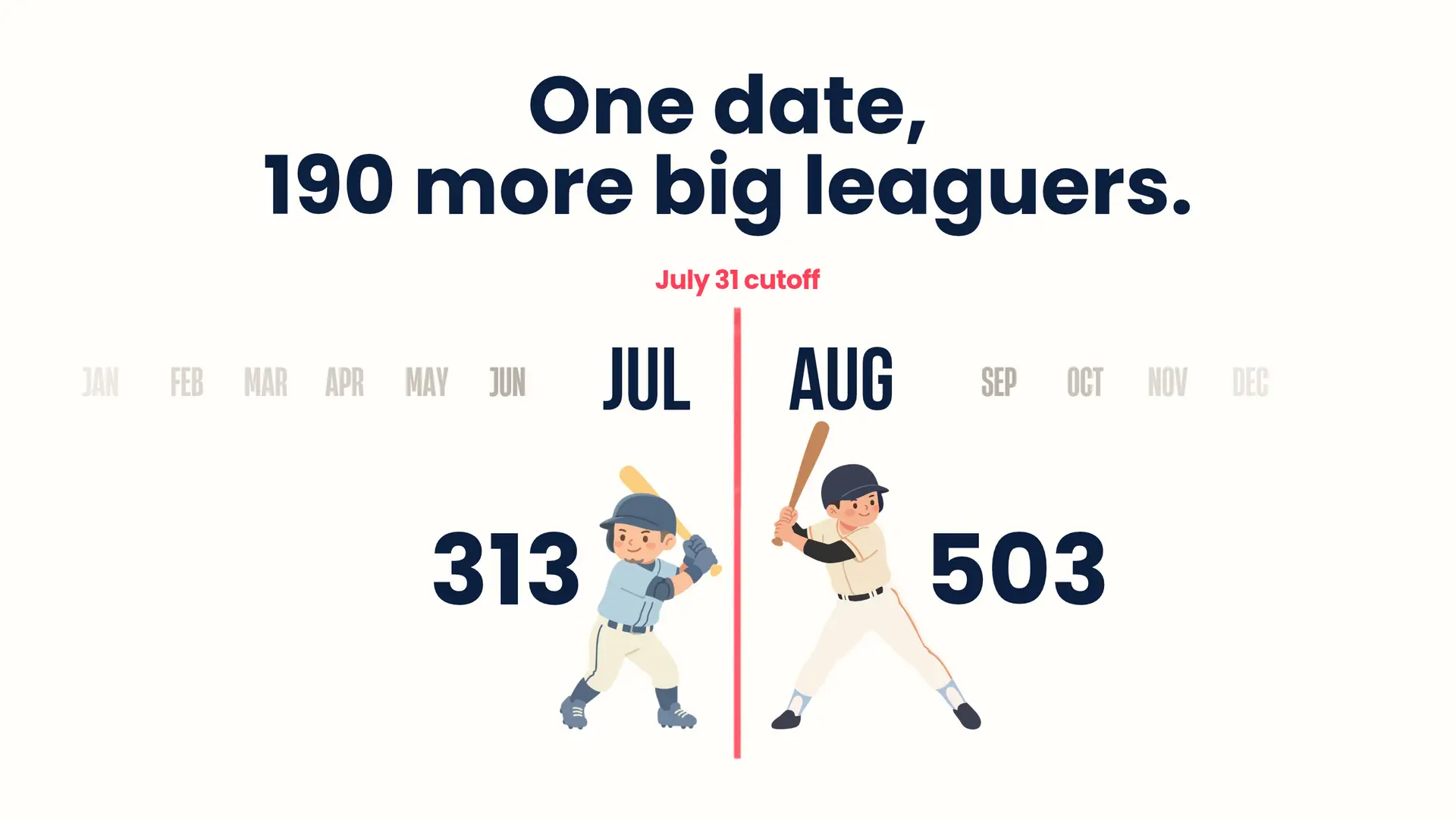
Among American-born major leaguers born since 1950, 503 had August birthdays and only 313 were born in July, and the reason likely has more to do with a youth baseball age rule than with talent.
Key takeaways
- A baby born in the US in August has had a 50 to 60 percent better chance of making the big leagues than one born in July.
- Two neighboring months, and a gap of nearly 200 big-league players between them.
- The likely bottleneck is a single date on the youth baseball calendar.
- That date has since changed, so the pattern may not last.
August vs. July
Baseball writer and researcher, Greg Spira, looked at every US-born major leaguer born from 1950 on, using data through 2005, and counted their birthdays by month. August came out far ahead of July: 503 players to 313.
By Spira's estimate, a baby born in the US in August has had a 50 to 60 percent better chance of making the big leagues than one born in July.
The comparison with players from Latin America makes the case even stronger. Youth leagues there have no single cutoff date that everyone follows, so there's no built-in reason for any one month to come out ahead. And Spira found that the August advantage disappears. Minor leaguers born in Latin America actually tend to have birthdays later in the year, in October, November and December, the reverse of the American pattern. When the calendar rule changes, the pattern changes with it, which is what you would expect if the rule is doing the work.
One date on the calendar
For more than 55 years, nearly all US youth baseball leagues outside of schools used July 31 as their age cutoff. Kids were grouped by how old they were on that date.
That made a child born on August 1 the oldest on the team, and a child born on July 31 the youngest. At age 8 or 10, almost a full year is a big difference. The older kids are usually bigger, stronger and more coordinated, so they're more likely to stand out, make the all-star team and get extra coaching. Over years of youth baseball, those small head starts can add up.
Researchers call this the relative age effect. The birth-month gap is a strong sign of it, though it doesn't prove that the cutoff alone decided who made the majors.
The rule has changed since. USA Baseball moved its cutoff to April 30 in 2005, and Little League switched to August 31 starting in 2018. Many of today's players spent at least part of their childhood under the newer dates, so only a fresh count will show whether the August advantage has faded.
So as the Brewers and Rays play the World Series, it might be worth checking a few birthdays on the roster.
Methodology
The player counts, the 50 to 60 percent estimate, the July 31 cutoff history, the USA Baseball change and the Latin American comparison come from Greg Spira's analysis in Slate, published April 16, 2008. It covers US-born major leaguers born in 1950 or later, with data up to 2005. The Little League change comes from ABC News.

loading

Loading