A hitter gets about two blinks to decide on a 100 mph fastball
• Sports
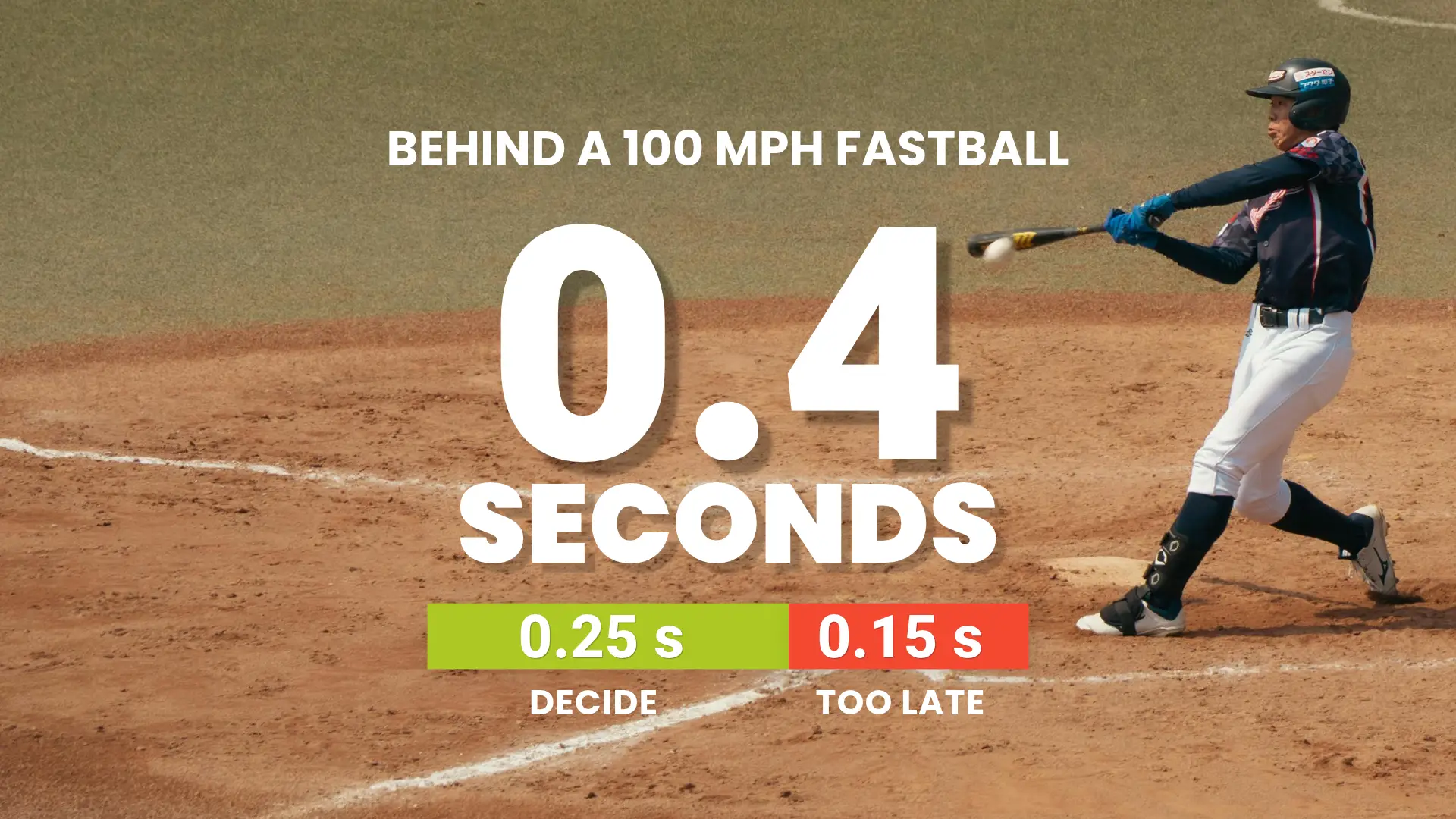
A 100 mph fastball reaches home plate in under four-tenths of a second, which means a hitter has to decide whether to swing in about the time it takes to blink twice.
Key takeaways
- From the pitcher's hand to home plate, the whole pitch is over in less than half a second.
- The last part of the pitch is too late to react to, so the real decision comes much earlier.
- With the World Series starting on October 23, here is what the hitter's brain is doing in that sliver of time.
The pitch, moment by moment
The pitching rubber sits 60 feet, 6 inches from home plate, but the ball never travels that far. Pitchers stride forward and let go of the ball in front of the rubber. The average major league pitch is released 6.4 feet in front of it, according to MLB.com, so the ball covers just over 54 feet.
At 100 mph, that trip takes under four-tenths of a second. The ball also loses a little speed on the way, slowed by the air, so it arrives a bit slower than it left the pitcher's hand.
Here is the catch. A hitter's body can't respond to anything it sees in the last 150 milliseconds of the pitch. As Physics Today put it in an article on the physics of baseball, "Any new information obtained in the last 150 ms is useless," because the body can't react in time. That leaves roughly the first quarter of a second to read the pitch and commit.
For comparison, a normal blink interrupts vision for 100 to 150 milliseconds, according to research collected by Harvard's BioNumbers database. Two blinks, and the decision is already made.
So how does anyone hit it?
Hitters can follow the ball for its whole flight, Physics Today notes, but following it isn't the same as reacting to it. In the final stretch, it's simply too late to change the swing.
So the swing is really a prediction. In that first quarter of a second, a hitter typically reads the pitcher's release, the spin and the early path of the ball, then commits to where the ball will be when it crosses the plate. The rest of the flight is the swing catching up with that guess.
That's why speed alone doesn't make a pitcher unhittable, and why a well-placed slower pitch can fool a hitter who has already committed to a fastball.
Want to see how the time changes at other speeds, from a 90 mph fastball to a Little League pitch? Plug the distance and speed into our speed calculator.
Methodology
The flight time of a 100 mph fastball and the average release point come from MLB.com, July 2025. The 150-millisecond reaction limit comes from Physics Today, April 2016. Blink duration comes from Harvard BioNumbers, citing Volkmann, Vision Research, 1986. The decision window of about a quarter of a second is our estimate, the total flight time minus the final 150 milliseconds. All times are approximate.

loading
Loading