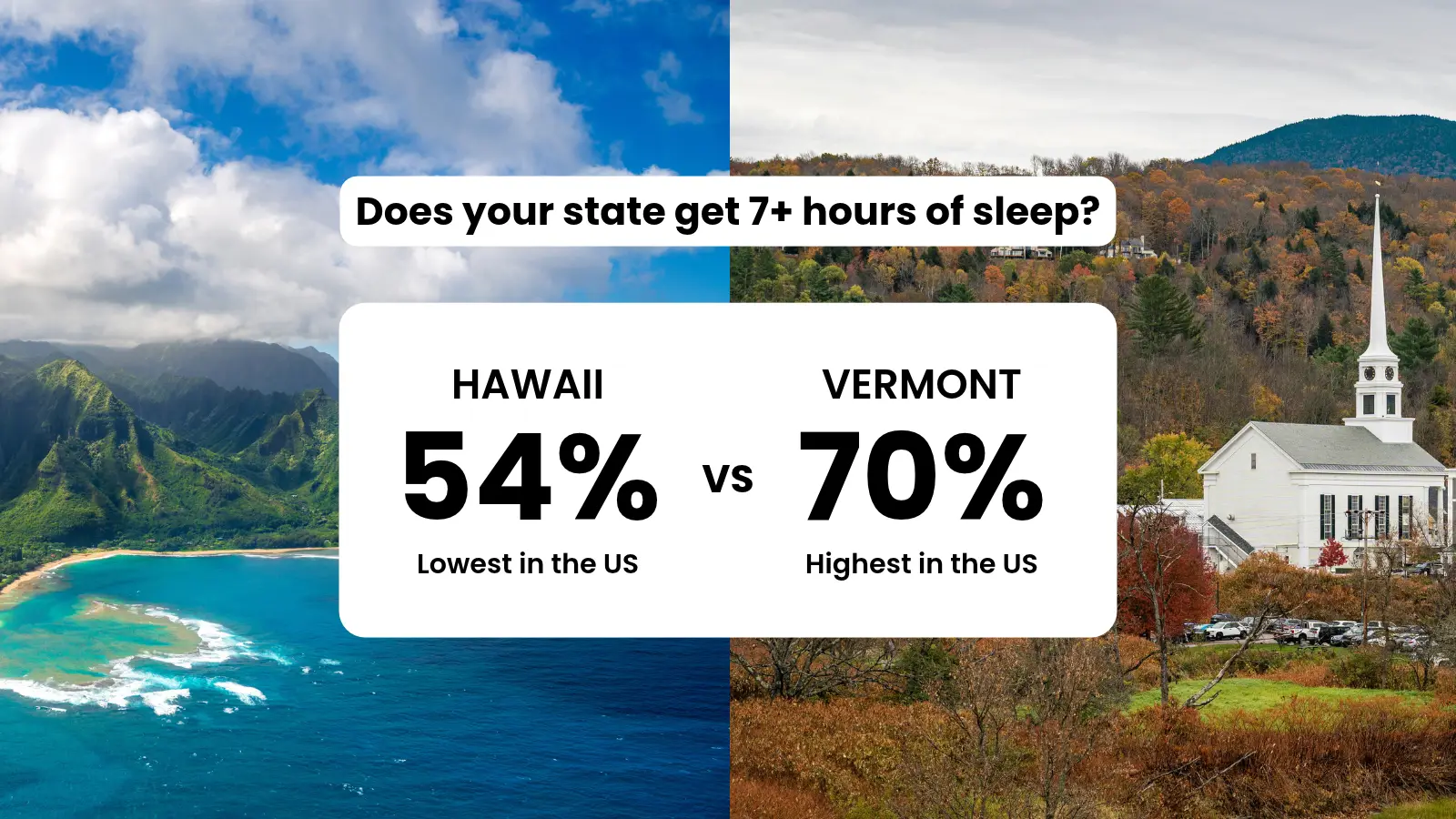
In Vermont, 70% of adults sleep 7+ hours a night. In Hawaii, just 54%
Daylight saving time ends on November 1, giving Americans an extra hour of sleep. But for the 97 million who sleep less than 7 hours, one night won’t be enough to catch up.
Key takeaways
- The three states with the highest share of adults who sleep 7 hours or more are: Vermont (70.0%), Minnesota (69.7%), and Colorado (69.4%).
- West Virginia is second-to-last, at 57.4%. The last state, Hawaii, is 3.3 points below, with 54.1%.
- Nationwide, about 97 million adults, more than one in three, sleep less than 7 hours.
Overview by state
Vermont (70.0%), Minnesota (69.7%), Colorado (69.4%), Nebraska (68.5%), Oregon (68.2%), Washington, DC (68.2%)—these are the states with the highest share of adults sleeping 7 hours or more. The first three are statistically indistinguishable, as their 95% confidence intervals overlap.
On the other side, we have Hawaii (54.1%), West Virginia (57.4%), Alabama (58.6%), Louisiana (59.5%), Ohio (60.1%), and Arkansas (60.1%). Hawaii’s confidence interval overlaps West Virginia’s by only 0.3 points, and a direct comparison shows the gap is statistically significant.
So, the difference between the first and the last is big: while in Vermont, about 3 in 10 adults sleep less than 7 hours, in Hawaii, that number is closer to 5 in 10.

CDC data from 2022 reveals significant differences in sleep duration across US states
The sleeping pattern
The top 10 states are all in the North and the West (VT, MN, CO, NE, OR, WA, MT, SD, ID, MA). The lowest group is a band going through the Southeast and Appalachia (WV, AL, LA, AR, OH, TN, KY).
CDC had found a similar pattern at a county level in 2020—the counties with the highest share of adults sleeping less than 7 hours were clustered in the Southeast and the Appalachian Mountains.
From percentages to people
Percentages say one thing, but the story becomes real once we look at real numbers. With an adult population of 535,049, Vermont’s 70.4% share (crude rate) means that there are 377,000 adults sleeping 7 hours or more, vs. 158,000 who don’t.
For contrast, in Hawaii, 626,000 report 7+ hours, and about 525,000 don’t. So, Hawaii has roughly 1.7 times the number of adults sleeping 7 hours or more, but 3.3 times the number of those who don’t.
On a national scale, 63.9% of 269.8 million adults, or 172.4 million, report sleeping 7 hours or more, and 97.4 million sleep less.
Methodology
Data come from the CDC’s 2022 Behavioral Risk Factor Surveillance System (BRFSS), as published in CDC’s Chronic Disease Indicators under “Short sleep duration among adults.” BRFSS asks: “On average, how many hours of sleep do you get in a 24-hour period?” Answers are rounded to whole hours. Our calculation involves the reverse of CDC’s short-sleep measure: 100% minus the share of adults sleeping less than 7 hours is the share saying that they sleep 7 hours or more. Rankings use age-adjusted shares (2000 US standard population) with 95% confidence intervals. Headcounts use crude shares. Answers are self-reported and come from a single survey year. Data for 2022 is the latest, as the 2024 report did not include data related to sleep.
Sources

loading


Loading