Which Is More Common in US Homes: A Dog or Kids?
Want more stories like this?
Follow Omni on Google.


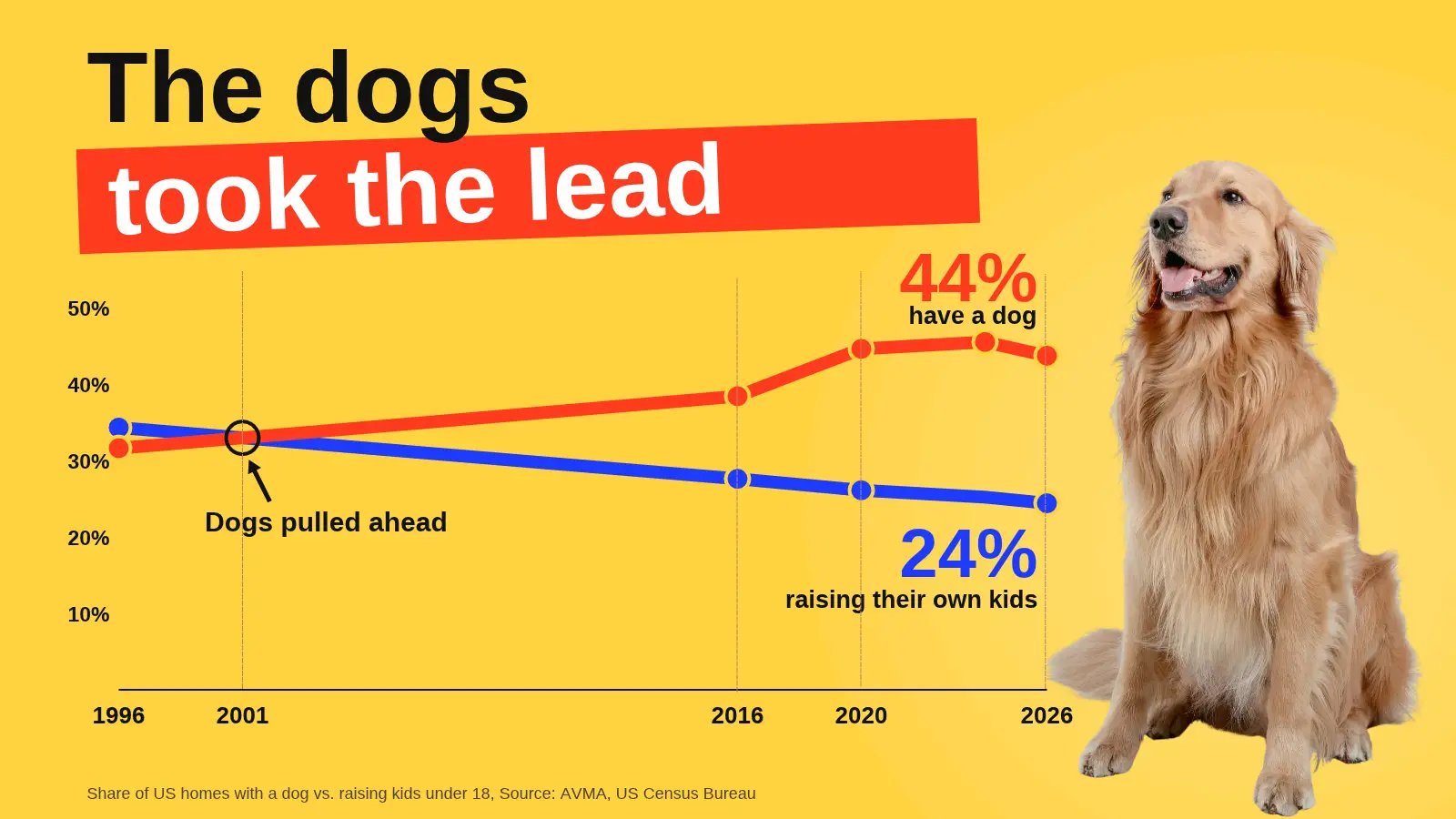
Thirty years ago, slightly more households were raising children, as opposed to keeping a dog. Today, the gap is big.
Key takeaways
- About 44% of US households have a dog vs. 24% raising children under 18.
- In 1996, homes with kids were slightly ahead.
- There are about as many families raising kids as 30 years ago. The US has added 37 million households since then, many of them people living alone or older Americans.
Nearly two dog homes for every home with kids
About 59 million US households have a dog, while 33 million are raising kids. The ratio is roughly 2 to 1.
The American Pet Products Association (APPA) puts the figure even higher: more than half of US homes have a dog (53% in 2025).
But in 1996, slightly more US homes were raising kids than had a dog (34% vs. 32%). Dog ownership was at a low back then. It climbed for most of the next three decades, while the share of homes raising children went in the opposite direction.
In the last 30 years, the number of households with a dog has nearly doubled, and the biggest jump came during the pandemic.
Families didn’t vanish—everything else grew
The number of families with kids actually barely changed—about 33 million today vs. 34 million in 1996. But the US now has roughly 37 million more households than in 1996. So, if the number of families with children didn’t grow, what did?
Much of that growth came from people living alone and older Americans whose kids have moved out. Today, 3 in 10 US homes are one person living alone, and nearly a third are headed by someone 65 or older.
These people don’t have children, and often have enough space to adopt a dog.
Dogs fill the years before kids, and after them
Americans also wait longer to start a family. The typical American now marries for the first time at around 29 to 30, three to four years later than in 1996, and the US birth rate has dropped by almost a quarter since 2007. Together, that means more years of adult life without kids at home.
Dog ownership is growing both before having kids and after they move out. APPA says that a lot of the rise in households with dogs concern Gen Z and Millennials. Gen X also saw a substantial rise: 12% in 2025 alone.
A dog is now almost as common in US homes as a married couple: about 44% of homes have a dog, and about 47% are married couples.
How we did the math
Dogs: the American Veterinary Medical Association's (AVMA) 2026 survey of about 7,500 people; results adjusted to Census data; earlier years come from AVMA’s 2024 and 2022 reports. Kids: families raising their own children under 18, including stepchildren and adopted kids, divided by all households (Census, 1996–2026). The Census Bureau also supplies figures on living alone and older households, marriage age and married couples. Birth rates come from the CDC; generational trends and the 53% dog figure from APPA.
Want to keep your dog safe? Check how toxic chocolate is for dogs.
Most Read


loading