Kids eat the most ultra-processed foods. A new brain study adds to the concern
Want more stories like this?
Follow Omni on Google.


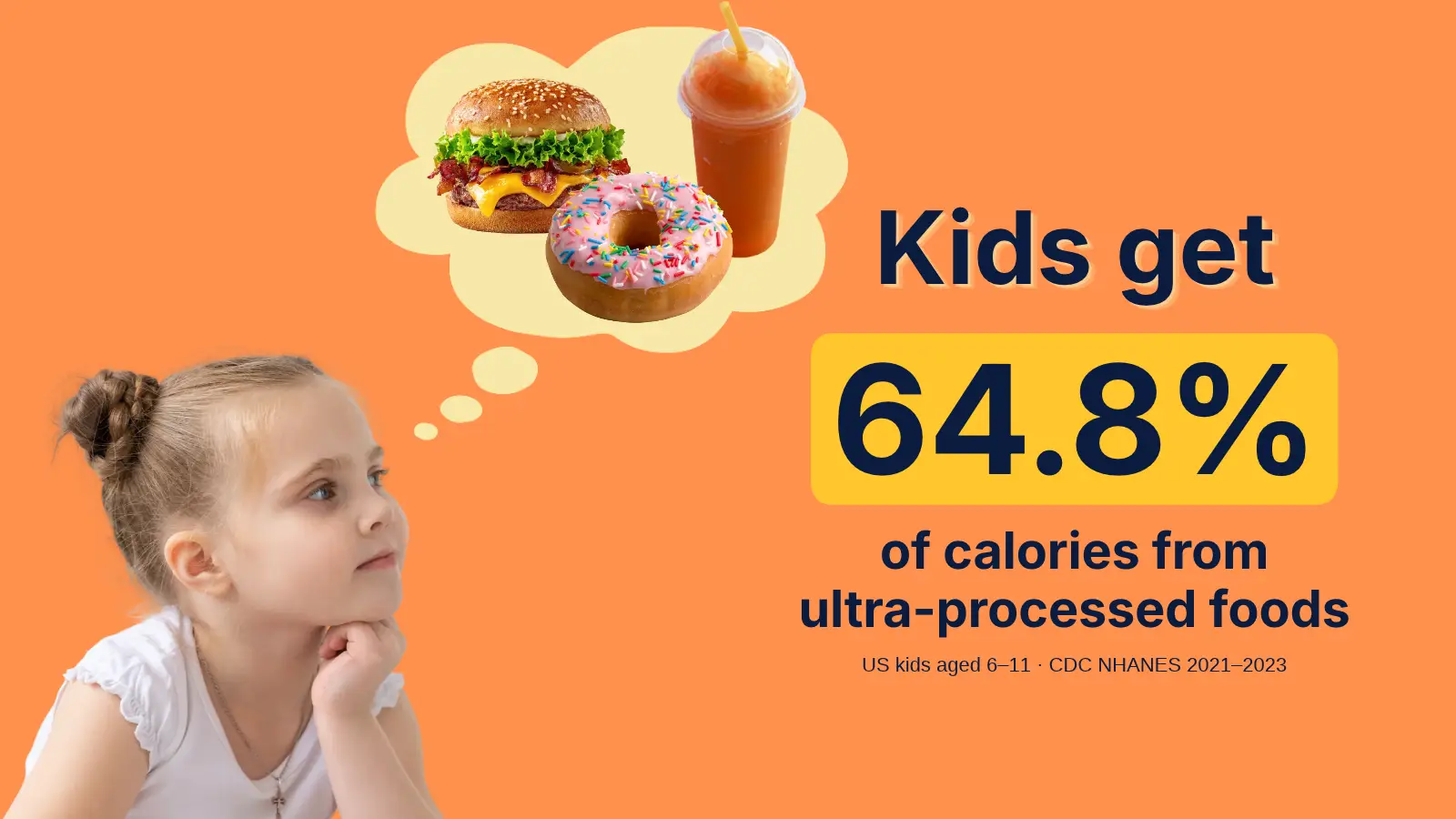
Primary school children are getting as much as 64.8% of their daily calories from ultra-processed foods (UPFs), CDC finds. A separate new study links high consumption of those foods with a stronger brain response to food cues and, in consequence, greater increases in body fat percentage.
How kids’ brains react to food cues
Imagine looking at pictures of cookies and pizza while lying inside an MRI scanner. That's what 46 children aged 7 to 10 did as part of a study at the Keck School of Medicine of USC. Researchers studied how the children's brains responded to tempting food images, and whether those responses were connected to their established eating habits.
Children who regularly ate more ultra-processed foods showed stronger activity in a brain region tied to rewards. A year later, stronger responses to food images were associated with greater increases in body fat percentage and BMI.
This study gives us a new reason to pay attention to what children eat. And CDC data suggests that American children are particularly exposed to ultra-processed foods.
Primary-school children top the ranking
The most popular stereotype around ultra-processed foods is the image of teenagers surviving on nothing but chips, pizza and fizzy drinks. But, surprisingly, teenagers are not the age group with the highest UPFs consumption.
Kids aged 6 to 11 get as much as 64.8% of their daily calories from ultra-processed foods, according to CDC’s National Health and Nutrition Examination Survey. Teenagers come second, at 63%. And grown-ups aren’t doing much better: American adults still get over 50% of their calories from ultra-processed foods.

UPFs are not just chips and soda
…they’re also burgers.
Ultra-processed foods (UPFs) are industrially-made products that are designed to be highly appealing and calorie-dense. Under the NOVA classification system, examples can include packaged snacks, sweetened breakfast cereals, soft drinks, and ready-made meals.
But the biggest culprit behind children’s UPF consumption is perhaps not the first food that comes to mind. Ultra-processed sandwiches (including burgers) account for 7.6% of primary school children’s total calories.
Other popular categories include sweet bakery products (cakes, pies, cookies, donuts and pastries), savory snacks (such as chips, popcorns, and pretzels), pizza, and sweetened beverages.

The high intake of ultra-processed foods isn’t limited to snacks in-between meals, or even to fizzy drinks. These foods pop up as parts of ordinary meals - for example, as pre-packaged sandwiches for lunch, which makes them trickier to eliminate or substitute with less processed options.
What does 64.8% of a child's calories look like?
According to the Agricultural Research Service, an average American child consumes 1875 calories a day. If 64.8% of that comes from UPFs, it means that about 1215 calories would come from ultra-processed products, every day. What does that look like on a plate?
An illustrative day of eating for a child. Highlighted rows are ultra-processed foods (UPF).
| Meal | Food | Calories | Is this UPF? |
|---|---|---|---|
| Breakfast | Sweetened breakfast cereal | 180 | UPF |
| Flavored yogurt | 140 | UPF | |
| Banana | 105 | ||
| Snack | Packaged granola bar | 140 | UPF |
| Lunch | Packaged turkey sandwich | 350 | UPF |
| Apple | 95 | ||
| Carrot sticks | 40 | ||
| Sweetened fruit drink | 100 | UPF | |
| Snack | Packaged cookies | 95 | UPF |
| Dinner | Store-bought chicken nuggets | 210 | UPF |
| Mashed potatoes | 180 | ||
| Broccoli | 45 | ||
| Homemade dinner roll | 195 | ||
| Total | 1875 | ||
| Total calories from UPF | 1215 | ||
This illustrative menu shows how easily you can find UPFs sneaking into your child’s calorie intake. Even though the overall meal plan appears quite healthy, with a lot of fruit and vegetables in the mix, ultra-processed foods still dominate.
UPF consumption is falling. But it's still high
The situation is slowly getting better. In 2017-2018, children and teenagers got almost 66% of their calories from ultra-processed food. By 2021-2023, that share had fallen to 62%. Adults saw a similar pattern, seeing a decline from 56% in 2017-2018 to 53% in 2021-2023 of their calorie intake coming from UPFs.
Does it mean that “the kids are alright”, and we don’t need to worry about what ends up on their plates? No, far from it. A four-percentage-point improvement doesn't change the bigger picture.
As the USC study's senior author, Kathleen A. Page, said: "Children's brains are still developing, habits are still forming and food preferences are still being made. It's an important period where the brain is very sensitive to food and the food environment.” What happens when children grow up surrounded by foods that are designed to be hard to resist?
Sources
- Williams AM, Couch CA, Emmerich SE, Ogburn DF. Ultra-processed food consumption among youth and adults: United States, August 2021–August 2023. NCHS Data Brief. 2025 Aug;(536)1–11. DOI: https://dx.doi.org/10.15620/cdc/174612.
- Alves JM, Morgan E, Angelo B, et al. Ultraprocessed Food Intake, Striatal Response to Food Cues, and Adiposity Gain in Children. JAMA Netw Open. 2026;9(10):e2640252. doi:10.1001/jamanetworkopen.2026.40252
- Braesco, V., Souchon, I., Sauvant, P. et al. Ultra-processed foods: how functional is the NOVA system?. Eur J Clin Nutr 76, 1245–1253 (2022). https://doi.org/10.1038/s41430-022-01099-1
- What We Eat in America, NHANES August 2021-August 2023. https://www.ars.usda.gov/ARSUserFiles/80400530/pdf/2123/Table_1_NIN_MaleFemale_2123.pdf
Most Read
loading