Calculated: Frozen Potatoes Now Outweigh Fresh Ones 2 to 1
Want more stories like this?
Follow Omni on Google.


Most of the potatoes that Americans eat nowadays don’t come in a mesh bag. Half of them come frozen, mostly as fries, and usually on a restaurant tray.
Key takeaways
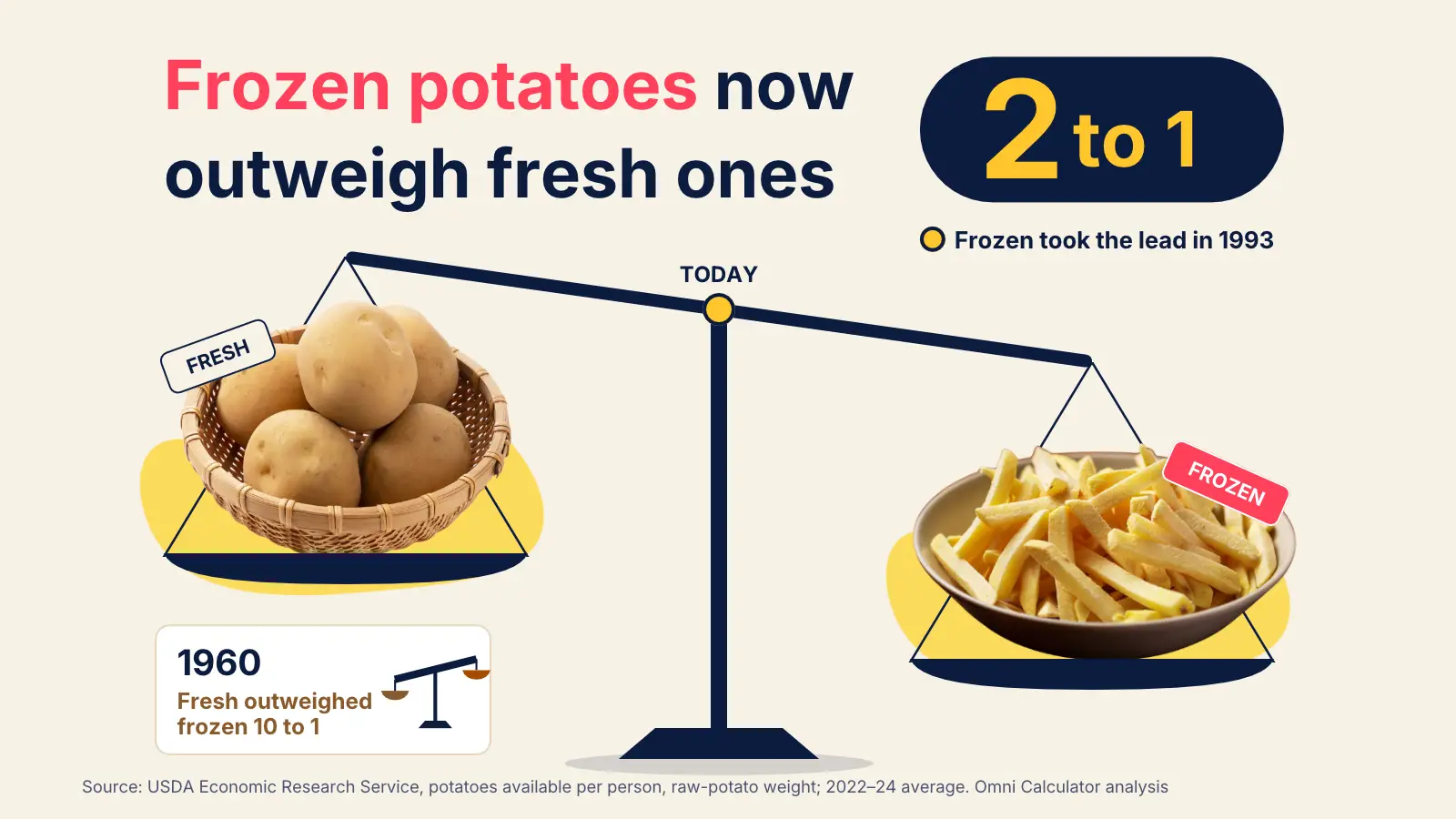
- Americans now get twice as much potato in frozen form as fresh.
- In 1960, fresh outweighed frozen 10 to 1.
- Frozen potatoes pulled into the lead in the early 1990s.
Five potatoes a week became fewer than two
In 1960, American households had nearly 5 medium fresh potatoes per person per week—today, that figure is closer to 1.5.
The supply of frozen potatoes, on the other hand, grew nearly eightfold. In 1960, 3 in 4 potatoes were sold fresh. Now it's 1 in 4, and half come frozen.
How the fry took over
The frozen french fry was introduced by the J.R. Simplot Company in the early 1950s. The manufacturer started supplying fast food restaurants, so that they could serve their fries faster. The bonus: ready-made, frozen fries were also more regular, making cooking times consistent, without worrying about a raw fry here and there.
Nowadays, most of the fries that are consumed in the US aren’t bought in a supermarket—only 1 in 10 is. The rest go mainly to fast food chains, other restaurants, and school cafeterias.
The frozen potato wasn’t a sudden revolution. Frozen potatoes climbed slowly for decades while fresh ones kept dropping, and frozen finally took the lead in 1993.
Where the fries come from
About 4 in 10 potatoes grown in the US end up frozen, mostly as fries. Idaho and Washington alone supply about two-thirds of the potatoes that go to processing plants.
But America doesn't make all its own fries. It buys more than one and a half times as many frozen fries from abroad as it sells, with nearly 9 in 10 imported fries coming from Canada.
The total barely changed. The form did
US households actually consume slightly more potato per person than they did in 1960. The total peaked in 2000.
The USDA's Economic Research Service says fries stopped rising as many Americans turned to low-carb diets or other cuisines. So, the frozen potato hasn’t gained much popularity since 2000.
But the Americans kept buying less fresh potatoes (about 40% less now than in 2000), so the gap widened anyway. Part of the reason is where we eat: more than half of Americans' food spending now goes to restaurants and other meals away from home.
How we did the math
We took the potato supply per person from the USDA Economic Research Service (history: data system; 1960 figures and the 1993 switch; “now” are the 2022–24 averages). Every product is counted as the raw potatoes that went into it. Potatoes per week assume a 5.3-ounce medium potato and 52 weeks in a year. Other data: frozen fry's history, low-carb diets, where fries are sold, 2025 potato report, fry trade (July 2026 outlook).
Most Read

loading