Falls Now Kill More Americans Than Car Crashes
Want more stories like this?
Follow Omni on Google.


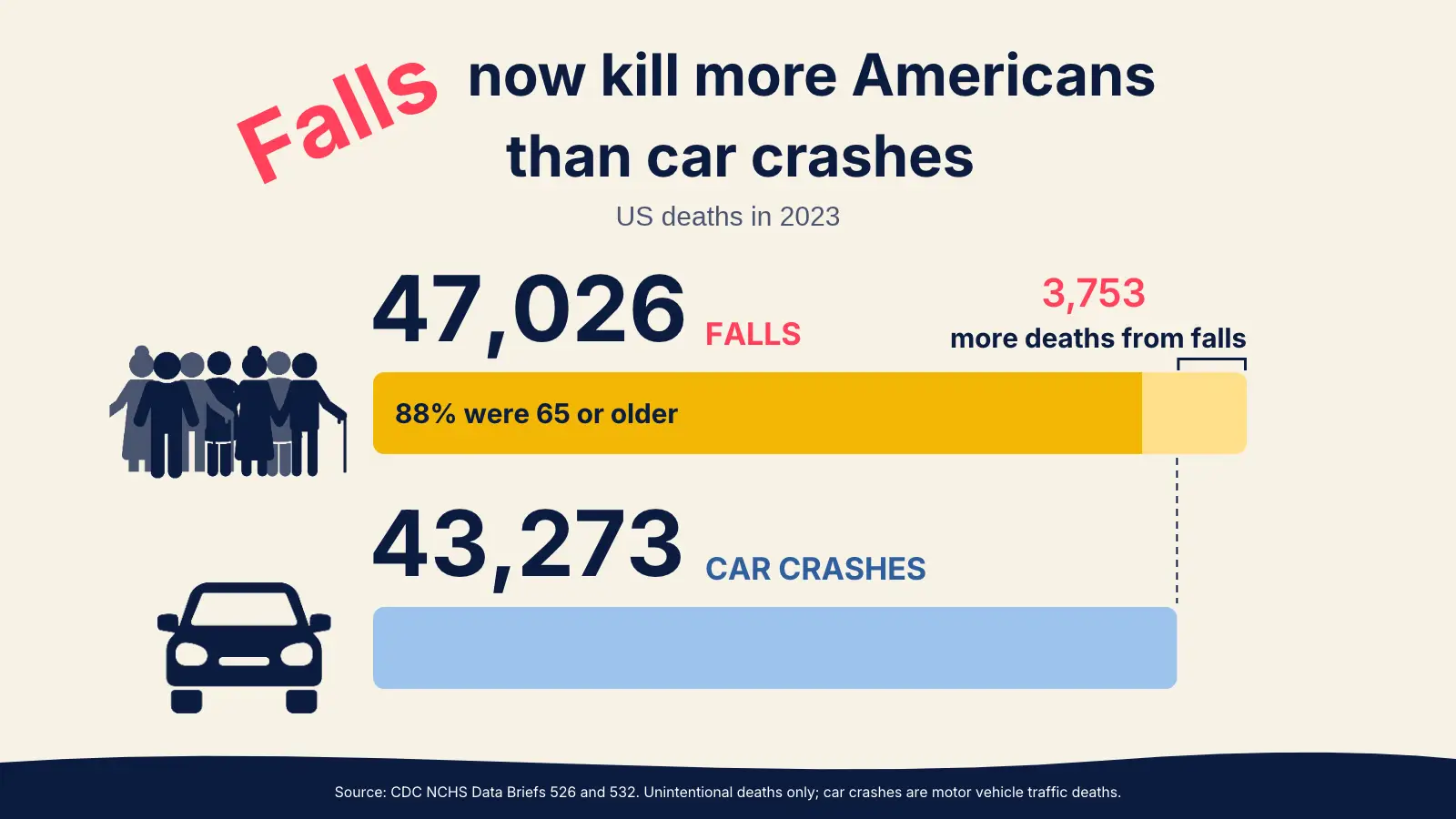
This week, millions of Americans are on the road for Thanksgiving, and road safety is on everyone's mind. Yet the bigger danger may be a lot closer to home. In 2023, 47,026 Americans died from falls, 3,753 more than the 43,273 killed in car crashes, according to the CDC.
Key takeaways
- The reason has less to do with the road than with an aging country.
- For most of life, the road is still the bigger risk. The switch comes late.
- In Europe, falls outnumber transport deaths by a much wider margin.
Why falls pulled ahead
There's an important catch. Falls kill more Americans in total, but that doesn't mean falling is riskier than driving for the average person. When the CDC adjusts for age, car crashes are still slightly deadlier, at 12.5 deaths per 100,000 people compared with 11.4 for falls.
So what changed? Mostly, America got older. Falls are far more dangerous for older adults, and there are more older adults than ever. Over the past two decades, the CDC's age-adjusted death rate from falls nearly doubled, rising 90% from 2003 to 2021 before leveling off. Over the same period, the car crash rate went the other way, from 14.9 to 12.5 per 100,000.
Put those two trends together, and falls overtook car crashes in raw numbers. The newest CDC data, for 2024, shows the gap widening further, with about 48,300 fall deaths and 41,200 traffic deaths.
Find your age group
For most of life, the road is the bigger danger by far. Falls only take over late. According to the CDC, 41,400 of the 47,026 Americans who died from falls in 2023 were 65 or older, about 88%. More than half of those were 85 or older.
| Age group | Deaths from falls, 2023 | Deaths in car crashes, 2023 | Which is higher |
| Under 25 | about 200 | 8,156 | Car crashes |
| 25 to 34 | 332 | 7,738 | Car crashes |
| 35 to 44 | 677 | 6,612 | Car crashes |
| 45 to 54 | 1,250 | 5,574 | Car crashes |
| 55 to 64 | 3,172 | 6,068 | Car crashes |
| 65 and older | 41,400 | 9,123 | Falls |
| All ages | 47,026 | 43,273 | Falls |
The pattern is clear. For people in their 20s and 30s, car crashes kill at least 10 times as many people as falls. By the late 50s and early 60s, the gap has narrowed to about two to one. Then, after 65, it flips completely: falls kill more than four times as many older Americans as car crashes do.
The National Safety Council, which looks at the same death records year by year of age, puts the crossover at about age 70.
In Europe, it isn't even close
If falls only just edge out car crashes in the US, in Europe they win by a landslide. In 2023, falls killed 69,471 people across the EU, according to Eurostat. All transport accidents combined, which includes cars, trains, planes and boats, killed 23,253.
That means falls killed three times as many Europeans as transport did. In the US, the two are almost level.
Two things likely explain much of the difference. First, Europe's roads are much safer per person. About 20,400 people died on EU roads in 2023, in a population larger than America's. Second, Europe's population is older on average, and as the US numbers show, age is what drives fall deaths.
The European comparison is, if anything, cautious. Eurostat counts all transport deaths, not just road deaths, so falls would come out even further ahead if we could compare them with car crashes alone.
| Region | Deaths from falls, 2023 | Transport deaths, 2023 | Falls for every transport death |
| United States | 47,026 | 43,273, motor vehicle traffic | 1.1 |
| European Union | 69,471 | 23,253, all transport | 3.0 |
What this means for the holidays
None of this means the drive to Thanksgiving dinner is safe to take lightly. For anyone under 65, the road is still by far the bigger risk, so the usual advice still holds: buckle up, don't drive tired and don't drink and drive.
But if older relatives are part of the gathering, it's worth thinking about falls too. The CDC's STEADI program, its fall-prevention initiative for older adults, encourages people to talk to a doctor about their fall risk, keep active to build strength and balance, have their eyes checked and make their homes safer, for example with better lighting and fewer tripping hazards.
How we calculated this
US totals, age-adjusted rates and trends come from CDC NCHS Data Brief 526 (March 2025), covering 2023. Fall deaths among adults 65 and older come from CDC NCHS Data Brief 532 (June 2025). Deaths by age group come from CDC WISQARS, 2023, and 2024 figures from CDC WISQARS and CDC FastStats. EU figures come from Eurostat's causes of death data, dataset hlth_cd_aro, for 2023, and Eurostat's road safety statistics. The crossover age comes from the National Safety Council. The gap is 47,026 fall deaths minus 43,273 car crash deaths, or 3,753. The ratio for each region is fall deaths divided by transport deaths: 1.09 for the US and 2.99 for the EU, rounded to 1.1 and 3.0. The share of fall deaths among people 65 and older is 41,400 divided by 47,026, or 88%. Car crash deaths under 25 add up the CDC's figures for each age group from infants to 24. Fall deaths under 25 are too few to appear in CDC's top-10 tables, so we estimated them as the total minus all the older groups.
All figures cover unintentional deaths only. US car crash figures are CDC's motor vehicle traffic deaths. They differ from NHTSA's count of 40,901 traffic deaths for 2023, which uses different counting rules, such as only deaths within 30 days of a crash on a public road. The EU figure covers all transport accidents, not just road crashes. The comparison uses raw counts, not age-adjusted rates. Adjusted for age, US car crashes are still slightly deadlier than falls.
Most Read


loading