Ranked: AI models vs animal brains
Want more stories like this?
Follow Omni on Google.


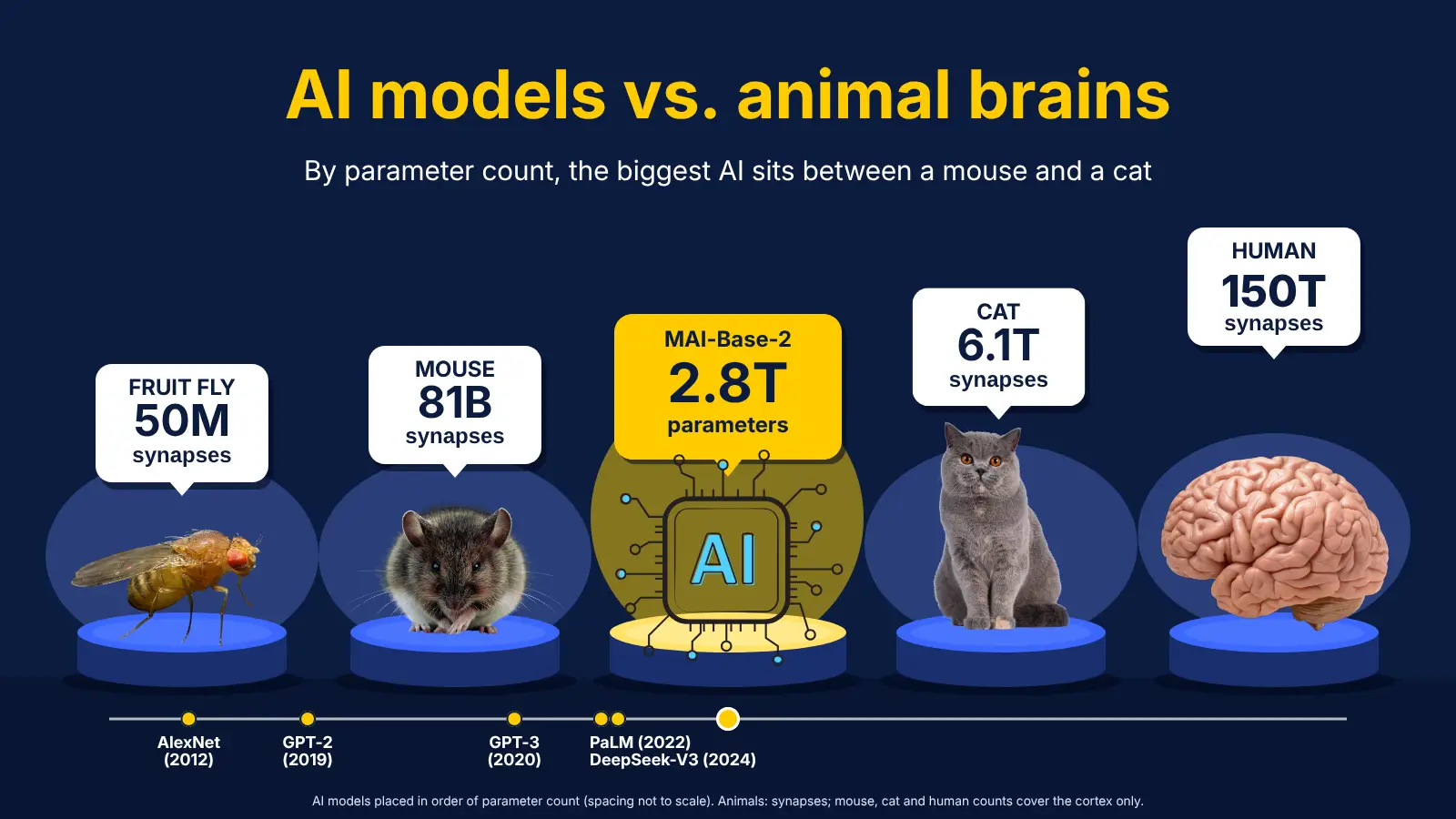
The largest AI model in Epoch AI's database has about 2.8 trillion parameters, far more connections than a mouse's cortex but only about half as many as a cat's.
Key takeaways
- The first famous image recognition AI was roughly the size of a fruit fly's brain.
- AI models passed the mouse more than five years ago.
- A human brain is still dozens of times bigger, but size isn't the same as smarts.
First, a parameter is not a synapse
Comparing AI models with brains is tempting because both come down to huge numbers of connections. In a brain, those connections are synapses, the junctions where one nerve cell passes signals to another. In an AI model, the closest equivalent is a parameter, a single number the model learns during training that decides how strongly one part of the network influences another.
But the two are very different things. A synapse is a living structure with its own chemistry and timing that keeps changing as you learn. A parameter is one stored number. Matching the count doesn't mean matching the ability, so think of this comparison as a size chart, not an intelligence test.
The ladder, rung by rung
Here are four brains, from smallest to largest, by the best scientific counts of their synapses:
- Fruit fly, whole brain: more than 50 million synapses, counted one by one in the first complete map of an adult fly brain, published in Nature in 2024
- Mouse, neocortex only: about 81 billion
- Cat, cerebral cortex only: about 6.1 trillion
- Human, neocortex only: about 150 trillion
Only the fly figure covers the whole brain. The others cover just the outer, wrinkled layer where most thinking happens, so a full brain would hold even more. Each step up the ladder is a jump of anywhere from about 25 to 1,600 times.
Now place AI models on the same ladder, from early milestones to the biggest today:
- AlexNet, 2012: 60 million parameters. The image recognition model that kicked off the modern AI boom lands right at fruit fly level.
- GPT-2, 2019: 1.5 billion. Well past the fly, but far short of a mouse.
- GPT-3, 2020: 175 billion. About twice the mouse's neocortex.
- PaLM, 2022: 540 billion.
- DeepSeek-V3, 2024: 671 billion in total, though only 37 billion work on each word it writes.
- MAI-Base-2, 2026: 2.8 trillion in total, with 80 billion active at a time. This Microsoft model, released in October, is the largest in Epoch AI's database.
That puts today's biggest model about 35 times above a mouse's neocortex, but still at less than half of a cat's cortex. By raw count, the top of the AI ladder sits between a mouse and a cat.
The newest models, including DeepSeek-V3 and MAI-Base-2, use a design called mixture of experts. The full model is huge, but for each word it only switches on a small slice of itself, a bit like a hospital with many specialists where only a few see each patient. Counting only the active part, the biggest model's 80 billion parameters land almost exactly on a mouse's neocortex.
How far from a human?
The human neocortex has about 150 trillion synapses, roughly 54 times more than MAI-Base-2's 2.8 trillion parameters. Put another way, the biggest model would have to double in size about six times to reach the low end of the human count, and the whole human brain holds more synapses still.
That gap has been closing fast. In just over a decade, the largest notable models went from fly-sized to somewhere between a mouse and a cat. But that's a look back at a trend, not a forecast, and there are good reasons to think raw size won't keep driving progress the way it once did.
Does bigger mean smarter?
Not on its own. The number of parameters says how big a model is, not how well it reasons, writes or solves problems. Training data, design and the way a model is tuned all matter at least as much.
In fact, AI labs have been getting more out of fewer parameters. Many newer models match or beat older, much larger ones, and the mixture of experts trick means even the giants only use a fraction of their size at a time. Many of the best-known models, including the latest from OpenAI, Anthropic and Google, don't publish their parameter counts at all, so they aren't on the ladder.
And the comparison works the other way too. A fruit fly, with a brain the size of the first modern AI model, can fly, find food, avoid predators and find a mate, all on a tiny fraction of the energy any computer uses. Counting connections is a fun way to picture scale. It isn't a measure of a mind.
Methodology
Synapse counts come from four sources. The fruit fly figure is the whole-brain count from the FlyWire connectome, published in Nature in October 2024. The mouse figure covers the neocortex only, from Schüz and Palm, 1989. The cat figure is an estimate for the cerebral cortex from Ananthanarayanan and colleagues, 2009, based on neuron counts and an average of about 8,000 synapses per neuron. The human figure covers the neocortex only, from Pakkenberg and colleagues, 2003. Parameter counts for AlexNet, GPT-2, GPT-3, PaLM and DeepSeek-V3 were published by the developers. The MAI-Base-2 figure comes from Epoch AI's Notable AI Models database as of November 2026. For mixture of experts models, the figures are total parameters, with active parameters noted. Comparisons divide synapses by parameters, and the number of doublings is the base-2 logarithm of that ratio.
loading