Which Generation of Americans Has Cheated the Most?
byReyhaneh Mansouri
Want more stories like this?
Follow Omni on Google.


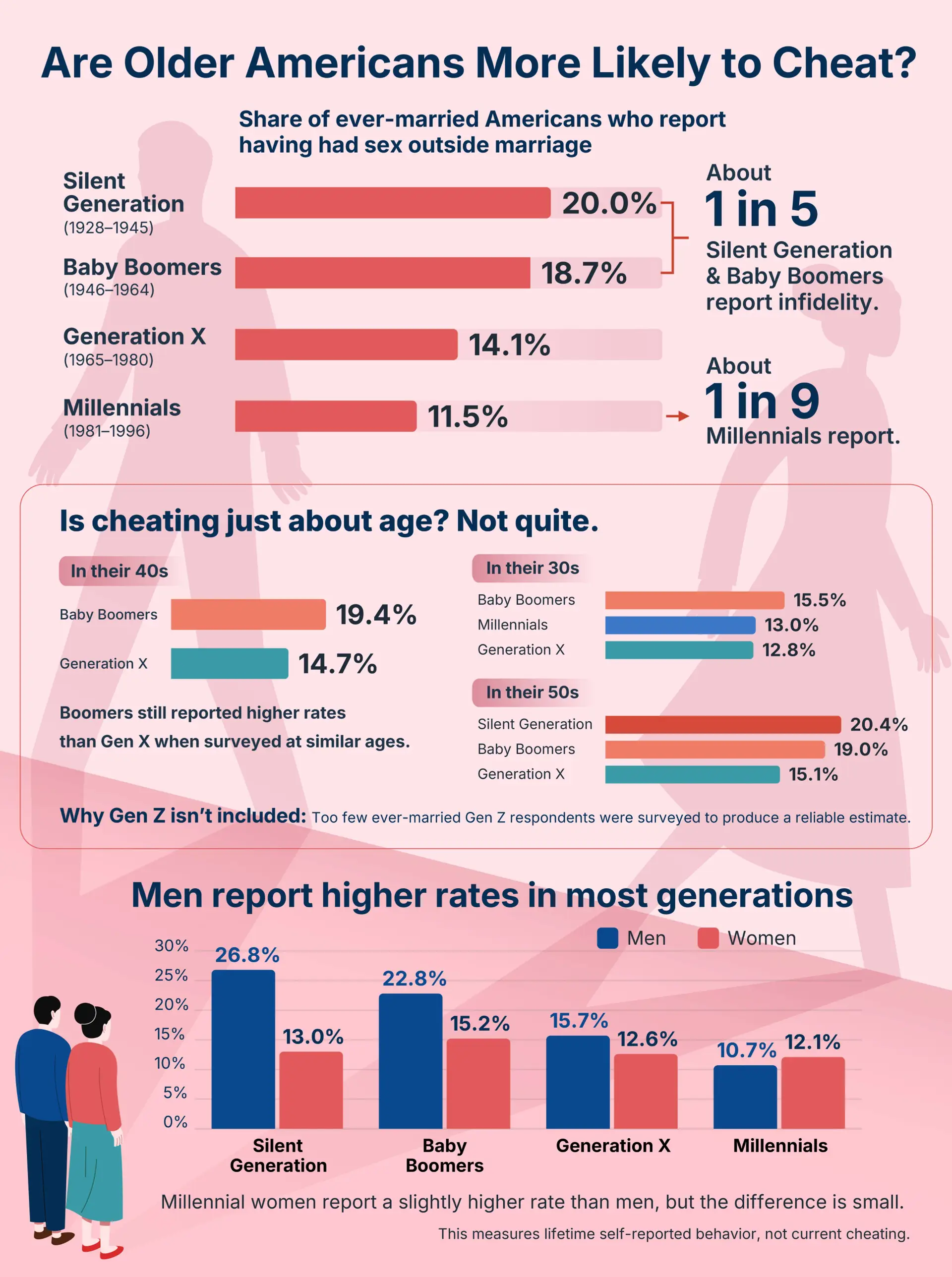
If you had to guess which generation has cheated the most, would you pick your own, your parents', or your grandparents'? The results might surprise you. About 1 in 5 Baby Boomers and Silent Generation adults who have ever been married say they've had sex outside marriage, compared with roughly 1 in 9 Millennials.
We analyzed decades of General Social Survey responses to see how Americans across four generations compare, whether the differences hold up at similar ages, and what men and women reported.
Key Takeaways
- Older generations lead: Roughly 20% of Baby Boomers and Silent Generation adults report having had sex outside marriage.
- Millennials report the lowest rate: at 11.5%, it is considerably below that of older generations.
- Age doesn't explain everything: Boomers still report higher rates than Gen X when we compare people surveyed in their 40s.
Which generation has cheated the most?
The Silent Generation, born between 1928 and 1945, has the highest reported rate of marital infidelity at 20.0%. Baby Boomers follow closely at 18.7%. The difference between these two groups is small enough that we cannot confidently say one has a higher rate than the other.
Generation X comes next at 14.1%, followed by Millennials at 11.5%.
Here's how all four generations compare, including the differences between men and women.
| Generation | Birth years | Overall | Men | Women |
| Silent Generation | 1928–1945 | 20.0% | 26.8% | 13.0% |
| Baby Boomers | 1946–1964 | 18.7% | 22.8% | 15.2% |
| Gen X | 1965–1980 | 14.1% | 15.7% | 12.6% |
| Millennials | 1981–1996 | 11.5% | 10.7% | 12.1% |
Source: Omni Calculator analysis of GSS data, 2016–2022. Figures represent Americans who have ever been married and report having had sex with someone other than their spouse while married.
The oldest generation's reported rate is about 1.7 times the Millennial rate. Across all ever-married respondents included in the survey analysis, 15.7% said they had been unfaithful.
The gender figures reveal another important detail. Men report higher rates than women in the three older generations. Among Millennials, women report a slightly higher rate, 12.1% versus 10.7% for men, although the difference is too small to draw a firm conclusion.
You may have noticed that Gen Z is missing. Only 34 ever-married Gen Z respondents answered this question across the survey years we studied, too few to provide a reliable estimate.
Are older generations reporting more infidelity simply because they've had more time?
There's an obvious question about these results.
Someone who has been married for 40 years has had far more time to experience an affair than someone who married five years ago. Could that explain why older generations report higher rates?
To find out, we examined survey responses collected between 1991 and 2022 and compared generations when respondents were in the same age groups.
Here's what we found.
| Age when surveyed | Generation | Reported infidelity |
| 30–39 | Baby Boomers | 15.5% |
| 30–39 | Gen X | 12.8% |
| 30–39 | Millennials | 13.0% |
| 40–49 | Baby Boomers | 19.4% |
| 40–49 | Gen X | 14.7% |
| 50–59 | Silent Generation | 20.4% |
| 50–59 | Baby Boomers | 19.0% |
| 50–59 | Gen X | 15.1% |
Source: Omni Calculator analysis of GSS responses, 1991–2022.
The comparison among Americans in their 40s is particularly interesting.
Nearly 1 in 5 Boomers surveyed in their 40s reported having cheated, compared with about 1 in 7 Gen X respondents of the same age. The difference of 4.7 percentage points is large enough to be unlikely to result from random variation in the survey.
The gap is smaller among people surveyed in their 30s. Boomers reported 15.5%, compared with 13.0% of Millennials and 12.8% of Gen X. So, having more years of married life may explain part of the difference, but it doesn't appear to explain all of it.
There is still an important distinction: people of the same age haven't necessarily been married for the same number of years. These comparisons also reflect marriages experienced during different periods in American history.
Does this mean younger Americans are more faithful?
Not necessarily.
The survey asks whether someone has ever had sex with another person while married. It doesn't measure how often affairs occur or whether someone is currently cheating.
A 65-year-old reporting an affair from 30 years ago is counted the same way as a 35-year-old reporting one from last year.
The findings also depend on people being willing to answer a very personal question honestly. Some may choose not to disclose an affair, and attitudes toward admitting infidelity may differ across generations.
There's another limitation: the survey measures sex outside marriage, which isn't necessarily the same as cheating in every relationship.
What the data does establish is that older generations report more lifetime extramarital sex than younger generations. And the difference between Boomers and Gen X remains visible even when we compare respondents at similar ages.
How we calculated this
For the main ranking, we combined responses from the 2016, 2018, 2021, and 2022 survey waves, the most recent survey waves that contained this question. We included only respondents who had ever been married and answered yes or no.
The percentages were adjusted using the survey's population weights to represent American adults better.
For the age comparison, we used responses from 1991 through 2022 and grouped people by their age at the time of the survey.
We also checked the number of respondents and the statistical uncertainty around the results. The Silent Generation and Baby Boomers were too close to identify a clear leader, while the difference between Boomers and Gen X in their 40s was statistically meaningful.
The results are based on people's own answers, rather than independently confirmed affairs.
loading