What size would you have been in 1958?
Want more stories like this?
Follow Omni on Google.


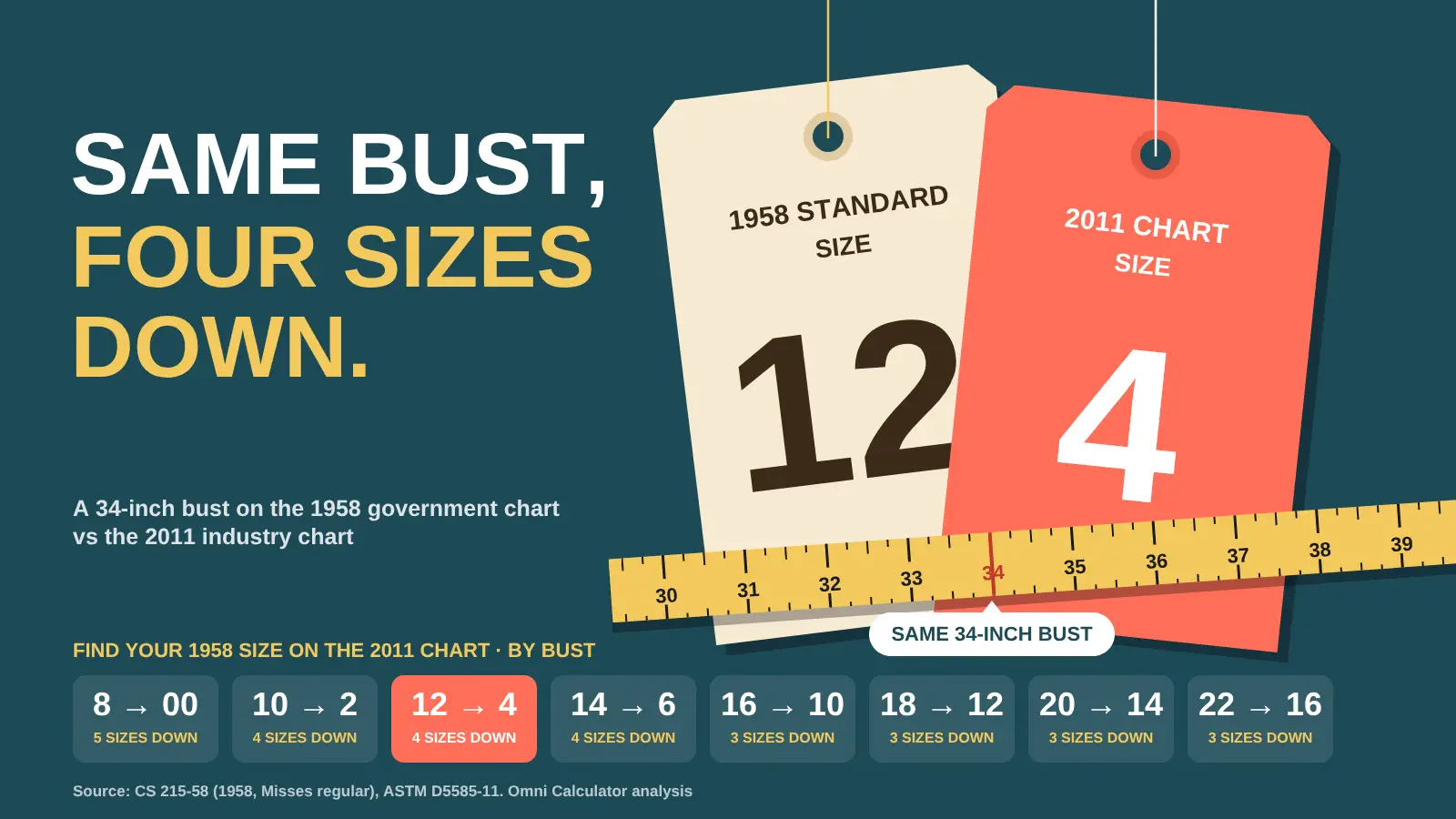
If your bust measures 34 inches, according to the sizing chart published by the government in 1958, you would be a size 12. But the 2011 industry chart puts you at a 4.
Key takeaways
- By bust, every size from 1958 is three to five sizes smaller on the 2011 chart.
- By waist, the difference between sizes is even bigger—a 12 in 1958 is a 00.
- Brands started setting their own charts after the government dropped the size standard in 1983.
Your 1958 size depends on where you measure
There is no single match for any 1958 size on the 2011 chart. Those sizes depended on what you were measuring: your bust, waist, or hips. By waist, the gap between 1958 sizes and 2011 sizes is the biggest—the smallest size on the 2011 chart, a 00, was a 12 in 1958.
The reason behind such discrepancies is that the 1958 chart was built on an hourglass shape, with a waist about 8 inches smaller than the bust. The chart that came out in 2011 assumes a straighter figure, with a difference of about 6 inches between the bust and the waist.
The smallest size in 1958 was an 8. By bust, that’s a 00, and by hips and waist, it’s smaller than anything on the 2011 chart. And the difference gets smaller with larger sizes—by size 16, the difference with the current system is three sizes.
Your size in 1958
| 1958 size | 1958 bust / waist / hips (in) | 2011 size by bust | 2011 size by waist | 2011 size by hips |
|---|---|---|---|---|
| 8 | 31 / 23½ / 32½ | 00 | <00 | <00 |
| 10 | 32½ / 24½ / 34 | 2 | <00 | 0 |
| 12 | 34 / 25½ / 36 | 4 | 00 | 4 |
| 14 | 35½ / 27 / 38 | 6 | 2 | 6 or 8 |
| 16 | 37 / 28½ / 40 | 10 | 6 | 10 |
| 18 | 39 / 30½ / 42 | 12 | 10 | 14 |
| 20 | 41 / 32½ / 44 | 14 | 12 | 16 |
| 22 | 43 / 34½ / 46 | 16 | 14 | 18 |
Closest match on each measurement, using the 2011 straight-figure chart. Most matches are within half an inch. Sources: US Commerce Department CS 215-58 (1958); ASTM D5585-11 (2011).
The changes were gradual
The sizes didn’t change overnight. In 1958, a 31-inch bust meant a size 8. By 2011, the same size was about 36 inches, and most of that growth had already happened by 1995, when the first industry chart came out.
Size 0 first appeared in the 1990s. But as they ran out of room, brands started inventing sizes even lower than a 0 by 2006.
Why the numbers drifted
The 1958 standard was made for catalogue shopping—companies needed to sell clothes to customers without the need to try anything on, so the government created a standard. The chart was based on measurements of women from around 1940. The volunteers that agreed to have their measurements taken were mostly white and lower-income, so the sizes were not representative of the larger population.
The government standard dropped in 1983. Any chart published afterwards was just a suggestion, so every brand is free to use their own.
Why did the sizes go down so drastically? People tend to like buying smaller numbers, so brands kept labeling the clothes down. At the same time, American women got bigger on average, which pushed every size’s measurements up.
Use a dress size calculator to find out your size.
How we did the math
We compared the US Commerce Department’s 1958 size standard (CS 215-58, Misses, regular height) with the industry’s 2011 chart (ASTM D5585-11, straight figure). For each 1958 size, we picked the 2011 size with the closest bust, waist and hip measurements. Most matches are within half an inch.
Sources

loading