Mapped: What Women-Owned Businesses Make per $1
• Finance
Want more stories like this?
Follow Omni on Google.


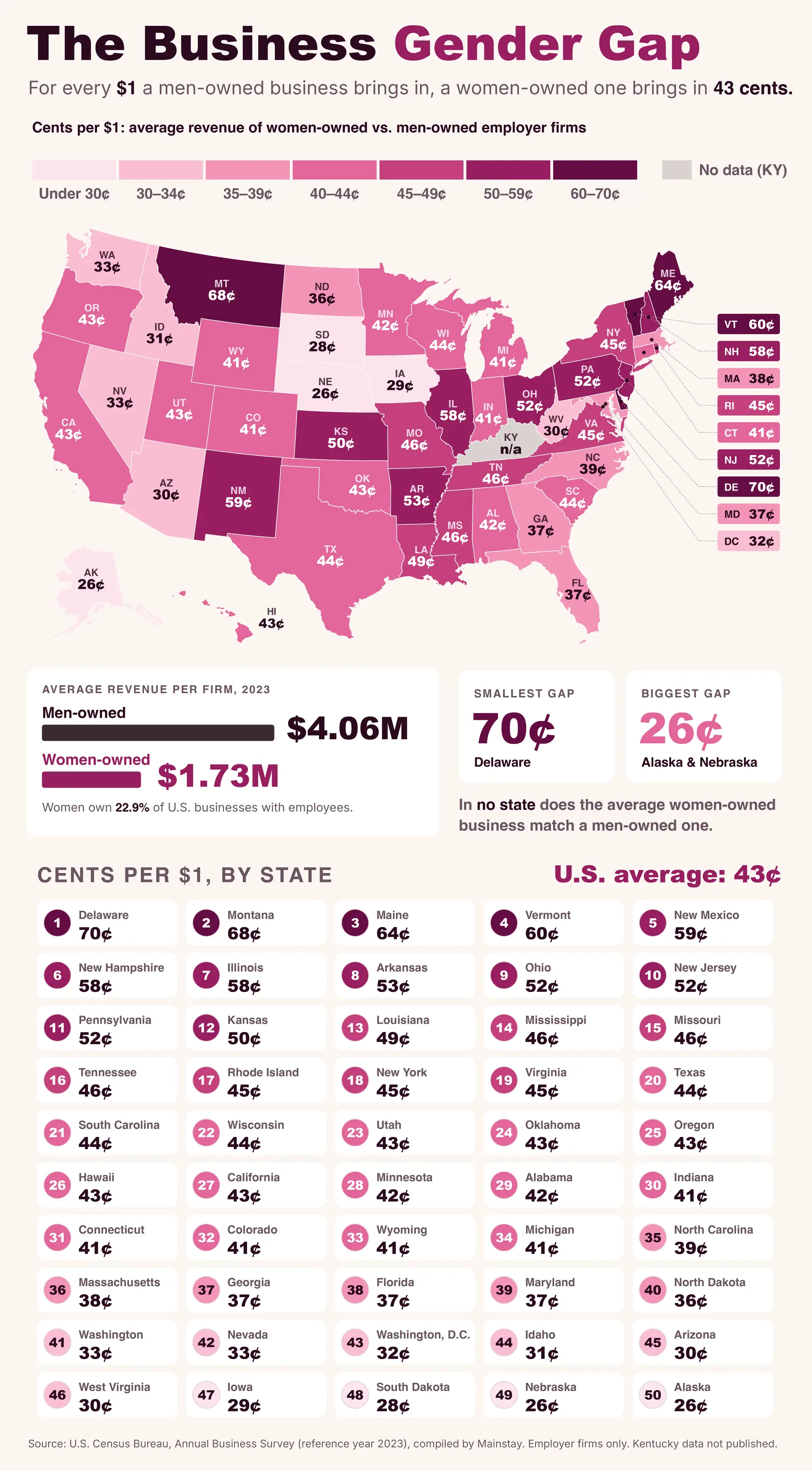
For every dollar the average men-owned business with employees brings in, the average women-owned one brings in about 43 cents, a gap far wider than the familiar gender pay gap, ranging from 70 cents in Delaware to just 26 cents in Alaska and Nebraska.
Key takeaways
- In no state does the average women-owned business come close to matching a men-owned one.
- The smallest gaps are mostly in small, rural states.
- Part of the gap comes down to size and industry, but not all of it.
State by state
Women own about 1.4 million of the roughly 5.9 million businesses in the US that have at least one paid employee, or 22.9%, according to the Census Bureau. On average, each of those women-owned firms brought in about $1.73 million in 2023. The average men-owned firm brought in about $4.06 million, close to two and a half times as much.
We compared the two averages in every state. The result is how many cents a women-owned business brings in for every dollar a men-owned business does.
Where the gap is smallest:
- Delaware: 70 cents
- Montana: 68 cents
- Maine: 64 cents
- Vermont: 60 cents
- New Mexico: 59 cents
Where the gap is biggest:
- Alaska: 26 cents
- Nebraska: 26 cents
- South Dakota: 28 cents
- Iowa: 29 cents
- West Virginia and Arizona: 30 cents
The top of the list isn't always where women-owned businesses earn the most. Delaware ranks first partly because its men-owned businesses bring in less than in most states, about $2.87 million on average. In Montana, the men-owned average is the lowest in the country at about $2.04 million, which narrows the gap.
The largest single average for women-owned firms is in Illinois, at about $2.55 million, which puts the state among the top 10 at 58 cents. At the other end, Alaska and Nebraska land at the bottom because their men-owned firms are unusually large on average, both above $5 million.
Among the biggest states, Texas and New York sit at 44 and 45 cents, California at 43, right around the national figure, and Florida at 37.
What's behind the gap
The data shows the size of the gap, not its causes. But two things clearly play a part.
Size. Women-owned employer firms are, on average, small. Nationally, they employ about 11.7 million people across about 1.36 million firms, roughly nine employees per business. Fewer workers usually means less revenue.
Industry. Women-owned businesses are concentrated in particular parts of the economy. The two biggest groups are health care and social assistance, with about 250,000 women-owned employer firms, and professional, scientific and technical services, with about 225,000. Average revenue varies a lot from one industry to another, so where a business operates shapes how much it brings in.
Size and industry explain part of the gap, and the rest is unexplained. This data can't show why women-owned firms tend to be smaller or work in different industries.
The gap in revenue also doesn't mean women-owned businesses are less successful by every measure. Women-owned firms brought in about $2.8 trillion in total in 2023, counting businesses without employees too, and they make up nearly a quarter of all employer firms in the country.
How we calculated this
Sources and data dates. All business figures come from the US Census Bureau's Annual Business Survey for reference year 2023, released on November 20, 2025, as compiled state by state by Mainstay. No newer survey year had been released at the time of writing.
Formula. Average revenue per firm is total receipts divided by the number of firms, for women-owned and men-owned firms separately in each state. Cents on the dollar equals the women-owned average divided by the men-owned average, times 100, rounded to the nearest cent.
Assumptions and limits. The figures cover employer firms only, meaning businesses with at least one paid employee. Businesses without employees and firms owned equally by women and men are left out. Women-owned means at least 51% owned by women. These are survey estimates, and Kentucky is left out because its figures were not published. The comparison describes a gap, not its causes.
loading