How much does the average American need to retire early?
• Finance
Want more stories like this?
Follow Omni on Google.


To retire early on the popular 4% rule, the average American household would now need about $2,048,000 saved, $472,000 more than in 2019, and almost nine-tenths of that jump is simply inflation.
Key takeaways
- The target got bigger, but incomes grew even faster than spending.
- How long it takes to get there depends far more on one percentage than on the size of the target.
- Every $1,000 you spend a year adds $25,000 to the finish line.
A $2 million finish line
FIRE stands for Financial Independence, Retire Early, and its followers all chase one figure: their FIRE number. It's the amount of savings that would let you live off your investments for good, without a paycheck.
The usual way to work it out is simple. Take what you spend in a year and multiply it by 25. That comes from the 4% rule, the idea that you can withdraw about 4% of your savings in the first year of retirement, then adjust that amount for inflation each year, with a good chance the money lasts at least 30 years.
So what does that look like for a typical American home? According to the Bureau of Labor Statistics' Consumer Expenditure Survey, the average US household spent $81,905 in 2025. Multiply by 25, and the FIRE number comes to about $2,048,000.
Back in 2019, the same household spent $63,036 a year, which put the FIRE number at about $1,576,000. In six years, the finish line moved $472,000 further away.
It's worth saying plainly that this is an average across all US households, including retirees, large families and people with big mortgages. It isn't what a typical FIRE budget looks like. Many people chasing early retirement deliberately spend far less, which is exactly why their numbers are smaller.
Most of the jump is just inflation
Headlines often say inflation has put early retirement out of reach. The numbers show what's really behind the bigger target.
Prices rose about 26% between 2019 and 2025, measured by the consumer price index. If the 2019 household had simply kept spending on the same things at the new prices, its FIRE number would now be about $1,986,000. That means roughly $410,000 of the $472,000 increase, around 87%, is inflation. Only about $62,000 comes from households actually spending more in real terms.
There's a second part to the story. Over the same six years, the average household's income before taxes rose from $82,852 to $110,847, an increase of about 34%. Spending grew by about 30%. So while the target moved, incomes moved a little faster.
In other words, the FIRE number didn't run away from the average household. It mostly rose with prices, and paychecks kept up.
The number that matters more: your savings rate
Here's the less obvious part. The size of your FIRE number tells you surprisingly little about how long you'll need to work. What decides that is the share of your income you save.
The reason is that spending sits on both sides of the equation. Spend more, and your target gets bigger and you have less left over to save. Spend less, and the target shrinks while your savings grow. A household earning $50,000 and one earning $200,000 that both save half of what they take home will reach their very different FIRE numbers in about the same time.
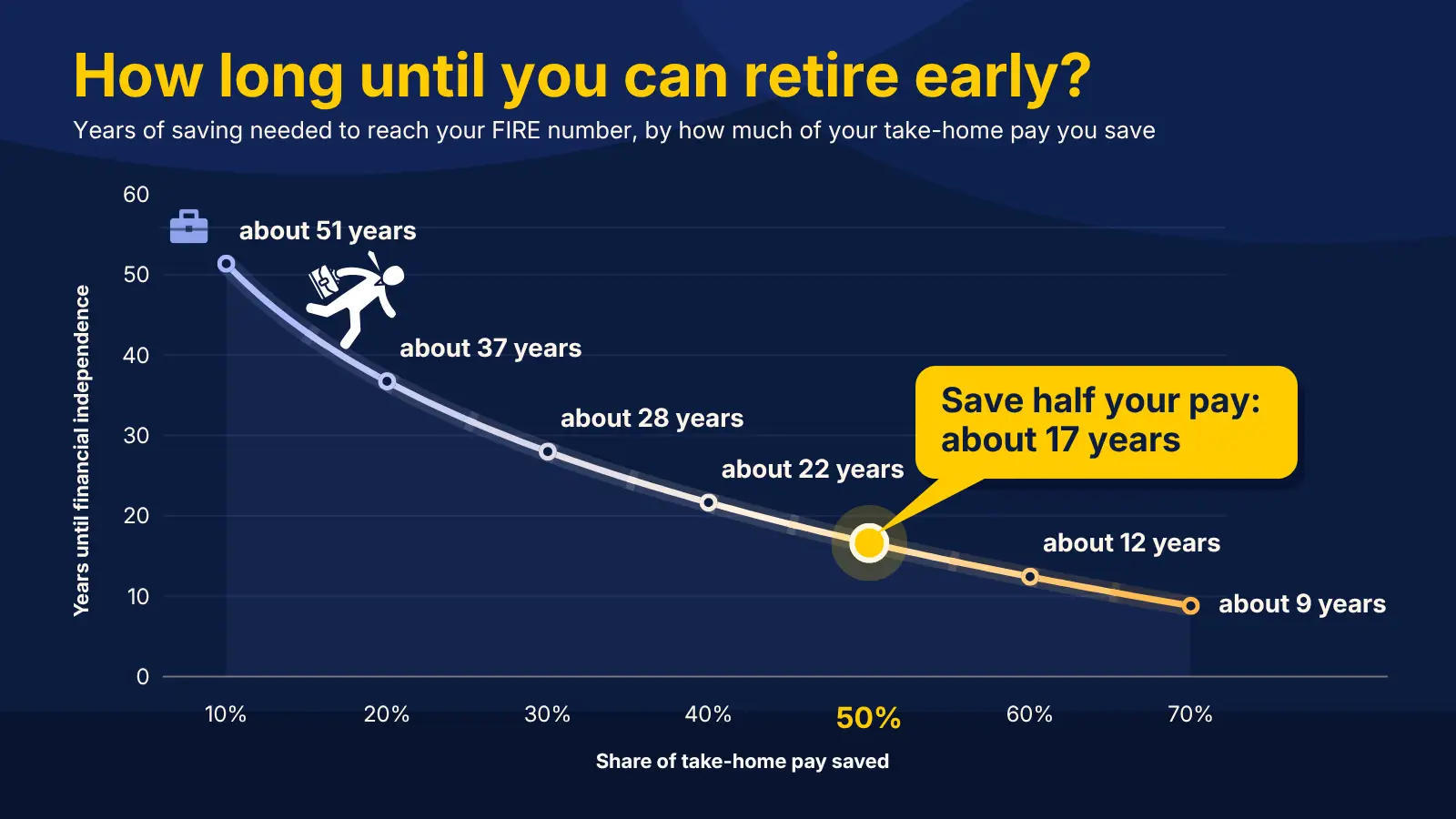
Starting from zero and earning an assumed 5% a year above inflation on investments, here's roughly how long it takes to reach a FIRE number at different savings rates:
- Saving 10% of take-home pay: about 51 years
- 20%: about 37 years
- 30%: about 28 years
- 40%: about 22 years
- 50%: about 17 years
- 60%: about 12 years
- 70%: about 9 years
The biggest gains come early. Going from saving 10% to 20% cuts about 15 years off the wait. Going from 50% to 60% cuts about four. That's why the FIRE community focuses so much on cutting spending. It works twice, lowering the target and raising the savings at the same time.
This is an illustration under fixed assumptions, not a projection for any real household. Actual returns go up and down, and few people save the same share of their income every year.
To use the rule on your own budget, just multiply your yearly spending by 25:
- Spend $30,000 a year: your FIRE number is about $750,000
- Spend $50,000 a year: about $1.25 million
- Spend $80,000 a year: about $2 million
What the 4% rule leaves out
The 4% rule comes from research by financial planner William Bengen in 1994, later backed up by the so-called Trinity study from Trinity University in 1998. Both looked at how US stocks and bonds performed in the past and asked how much a retiree could withdraw without running out of money over 30 years. It's a historical rule of thumb, not a guarantee, and it skips a few things that matter for anyone planning to stop work early.
Taxes. Withdrawals from many retirement accounts are taxed, so the money you actually get to spend can be less than 4% of your savings.
Health insurance. Medicare doesn't start until 65. Anyone retiring earlier has to pay for their own coverage, which can be one of the biggest costs in an early retirement budget.
Bad timing. A big market drop in the first few years of retirement can do lasting damage, because you're selling investments while they're down. The original research covered 30-year retirements, and someone stopping work at 40 may need their money to last much longer.
Methodology
Spending and income figures are averages for all consumer units from the Bureau of Labor Statistics' Consumer Expenditure Survey, for 2025 and 2019. The FIRE number is 25 times average annual spending, rounded to the nearest thousand dollars. To separate inflation from real growth, the 2019 figure was adjusted to 2025 dollars using the annual average consumer price index for all urban consumers. The years-to-financial-independence figures assume a household starting with no savings, saving a constant share of its after-tax income, earning a constant 5% a year after inflation, and stopping once savings reach 25 times its yearly spending.
loading