SpaceX Just Made History With Starship. See How It Compares With NASA's Moon Rocket
Want more stories like this?
Follow Omni on Google.


After circling Earth 14 times, SpaceX's Starship spacecraft returned to Texas and was caught in midair by giant mechanical arms on its launch tower.
Key takeaways
- A historic first: On November 14, SpaceX successfully caught Starship's upper stage returning from orbit for the first time. However, its Super Heavy booster was lost during recovery.
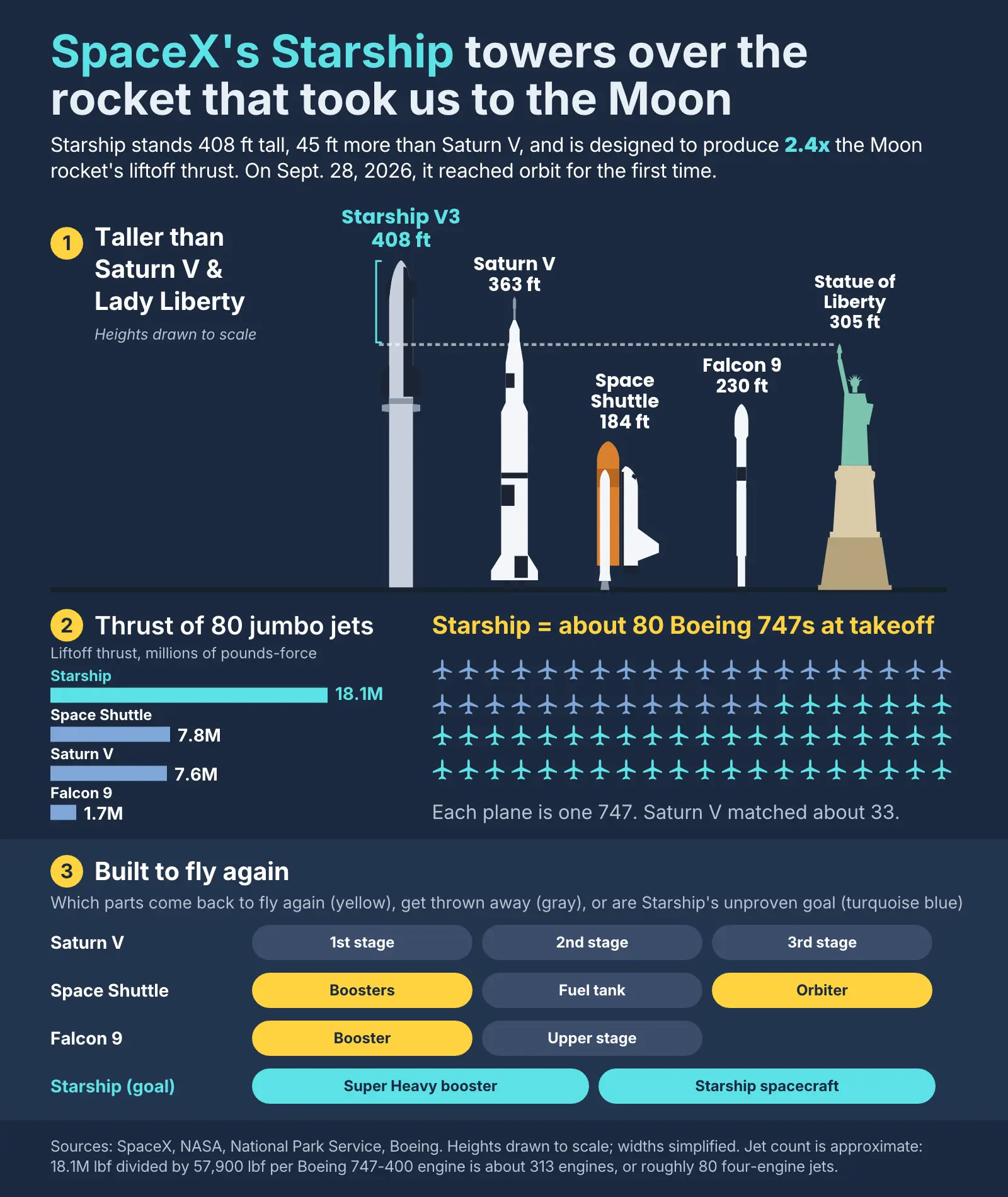
- Taller than the Moon rocket: At 408 feet, the complete Starship rocket stands 45 feet taller than Saturn V, which took astronauts to the Moon.
- The thrust of 80 jumbo jets: Starship's published liftoff thrust is about 2.4 times Saturn V's, roughly equivalent to the combined thrust of 80 Boeing 747s.
Flight 15 launched on November 13, 2026, and successfully deployed 26 Starlink satellites. We compared Starship with Saturn V, the Space Shuttle, and Falcon 9 to see how these famous rockets measure up in size, power, and cargo capacity.
How big is Starship compared with other famous rockets?
NASA's Saturn V was once the ultimate symbol of rocket power. It carried the Apollo astronauts toward the Moon, including the Apollo 11 crew, which made the first human Moon landing in 1969. At 363 feet tall, it was enormous. Yet Starship stands another 45 feet taller.
NASA's Space Shuttle, which carried astronauts into orbit for 30 years, was considerably smaller. Its complete launch configuration stood 184 feet tall, less than half Starship's height.
And SpaceX's Falcon 9, which regularly carries satellites and astronauts into space, is just 230 feet tall, a little over half the height of Starship.
For perspective, the Statue of Liberty, including its pedestal, measures about 305 feet. Starship would tower more than 100 feet above it.
Here's how the four rockets compare.
| Rocket | Height | Liftoff thrust | Cargo capacity to low Earth orbit |
| Starship V3 | 408 ft | 18.1 million pounds-force | 100+ metric tons (target) |
| Saturn V | 363 ft | 7.6 million pounds-force | About 118 metric tons |
| Space Shuttle | 184 ft | 7.8 million pounds-force | About 29.5 metric tons |
| Falcon 9 | 230 ft | 1.7 million pounds-force | 22.8 metric tons |
Sources: SpaceX and NASA. These are published specifications and capacity figures, not necessarily loads carried on actual flights. Starship's cargo capacity is a design target. Actual carrying capacity depends on the mission and rocket configuration.
Starship is more than twice as powerful as the rocket that took humans to the Moon
A rocket needs an enormous amount of force to lift itself, its fuel and its cargo off the ground. This pushing force is called thrust.
Saturn V produced about 7.6 million pounds of thrust at liftoff. Starship's Super Heavy booster is designed to produce 18.1 million pounds, nearly 2.4 times as much.
To match that force, you would need approximately 313 Boeing 747-400 engines, each producing around 57,900 pounds of thrust. That's roughly 80 four-engine jumbo jets. The comparison is approximate, as jet engines and rocket engines operate under different conditions.
But can Starship carry more than Saturn V?
According to NASA, Saturn V could send about 118 metric tons of cargo into low Earth orbit. That's roughly the weight of 20 adult African elephants.
SpaceX is designing Starship to carry at least 100 metric tons into orbit while remaining fully reusable. However, Starship hasn't demonstrated that carrying capacity yet. Even during Flight 15, which successfully deployed 26 Starlink satellites, the rocket was still far from testing its full cargo capacity.
There's also a difference in what the two rockets are designed to do after delivering their cargo. Saturn V was built to complete its mission and be discarded. Starship is being built to return and fly again.
Starship made it home. Its booster didn't
For decades, rockets were largely disposable. NASA's Saturn V stages were discarded after launch, meaning a new rocket had to be built for every mission.
The Space Shuttle changed that by reusing its spacecraft and solid rocket boosters, although its large external fuel tank was discarded after every flight.
SpaceX went further with Falcon 9, whose first-stage boosters can land back on Earth and fly again. Its upper stage, however, is still discarded.
Starship is designed to bring back both parts: the massive Super Heavy booster that lifts it off the ground and the Starship spacecraft that continues into orbit.
On November 14, 2026, SpaceX achieved a historic first. After spending roughly 22.5 hours in space and completing 14 orbits around Earth, Starship returned to Texas, where giant mechanical arms on the launch tower caught the spacecraft as it descended.
The mission wasn't a complete success, however. The Super Heavy booster's planned recovery had been called off shortly after launch the previous day. The booster was diverted into the Gulf of Mexico and lost, preventing SpaceX from recovering both stages in the same mission.
Still, catching a spacecraft returning from orbit marks an important step toward SpaceX's goal of making Starship fully reusable.
The next challenge is proving that both stages can be recovered, prepared for another mission, and flown again reliably. If SpaceX achieves this, it could launch more frequently without building an entirely new rocket each time, potentially reducing the cost of space travel.
More than 50 years after Saturn V took humans to the Moon, Starship has demonstrated something new: a giant spacecraft can return from orbit to the same launch site and be caught for potential reuse.

loading