Which state gained the most college grads?
Want more stories like this?
Follow Omni on Google.


In 2000, Massachusetts had the highest bachelor’s degree rate in the country, at 33.2% of adults 25 and over. Today, that rate would rank 35th.
Key takeaways
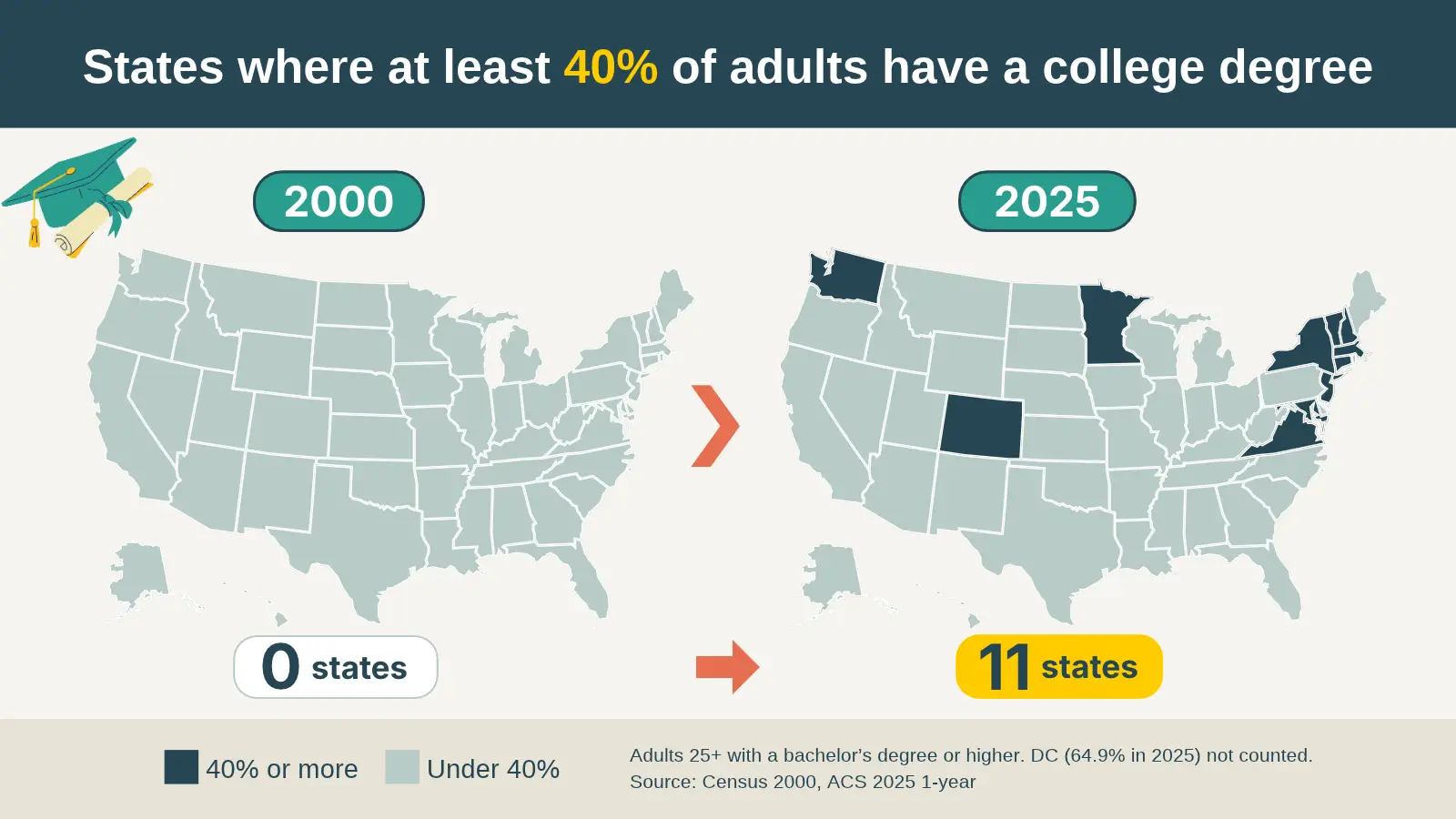
- In 2025, at least 40% of adults held a bachelor’s degree in 11 states. In 2000, no state did.
- Massachusetts still ranks first, and West Virginia still ranks last.
- Arkansas’ rate is 1.72 times as high as its 2000 rate—the largest relative rise.
The states that gained the most
A total of six states gained over 15 percentage points. Lowest on the list are New Mexico, Alaska, and Oklahoma. In terms of percentage points, the states that gained the most from 2000 to 2025 are:
- Massachusetts: +16
- Maine: +16
- North Carolina: +16
- New Jersey and Virginia: +15
- Vermont: +15
In relative terms, the states that were already at the top grew less—Massachusetts, for example, grew only by 48%, which is below the median level. Measured that way, the top state is Arkansas: its rate grew from 16.7% to 28.8%. Maine, North Carolina and South Carolina come next, each up 69%. All of them started low.
Today’s bottom looks like 2000’s top
The states near the bottom of today’s ranking would have been near the top in 2000.
Arkansas, Kentucky and Oklahoma are where New Hampshire was in 2000, when it ranked 8th. New Mexico is now where Maryland and Connecticut were in 2000, tied for 3rd. Iowa is about where Colorado was in 2000, at 2nd.
The typical state today has a higher rate than the best state had in 2000. The median state is at 36.2%, against Massachusetts’ 33.2% in 2000. In total, 34 states now beat that 2000 record.
The bottom has moved up too. In 2000, nine states were below 20%, most of them in the South and Appalachia: Tennessee, Alabama, Arkansas, Kentucky, Indiana, Nevada, Mississippi, West Virginia and Louisiana. Today none is. The lowest rate today is West Virginia’s 24.7%.
43 states are now above 30%, against just 4 in 2000.
The map tilted east
The states that climbed the most are concentrated along the East Coast—South Carolina rose 11 places, Florida 10, and Maine, North Carolina and Pennsylvania 9 each. The biggest drops were in the West. Alaska and New Mexico each fell 17 places. Their rates still rose by about 8 points each; other states simply rose faster.
The extremes barely moved: Massachusetts, Colorado and Maryland are still the top 3, and West Virginia is still last.
Part of the rise is simply because younger adults are more likely to have degrees than older ones. Where those graduates end up is a different story. According to Strada/Upjohn (Aug 2026), only 36% of college-educated workers in Colorado and 38% in Maryland grew up there, against 55% nationally.
Other states train graduates who then leave: Strada estimates that 72% of graduates from Vermont’s colleges and 59% from West Virginia’s move to another state.
How we did the math
We compared the share of adults 25 and older with at least a bachelor’s degree in each state (not counting D.C.) in 2000 and 2025. The 2000 numbers come from the 2000 Census, the 2025 numbers from the Census Bureau’s American Community Survey, and the figures on where graduates move from Strada and the Upjohn Institute. To get each state’s gain, we subtracted its 2000 rate from its 2025 rate. For growth relative to where a state started, we divided the 2025 rate by the 2000 rate.
Sources
loading