What would the US midterms cost under Spain’s rules?
Want more stories like this?
Follow Omni on Google.


Americans just paid for what’s on track to be the most expensive midterm ever. On November 29, Spaniards vote in a national election, and no party is allowed to buy a single TV ad.
Key takeaways
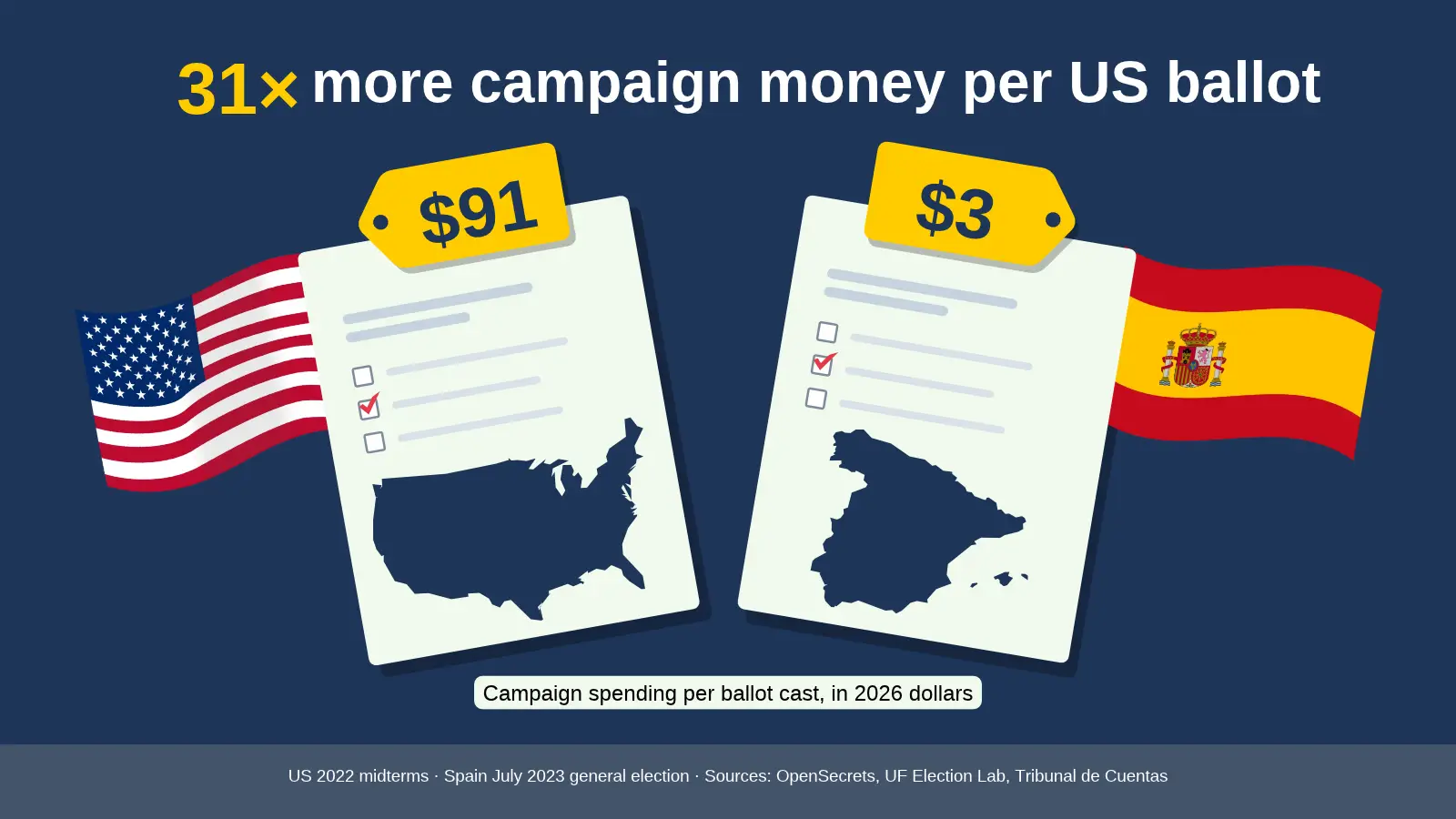
- US campaigns spend about 30 times more per ballot than campaigns in Spain, and over 20 times more if we don’t include super PACs.
- Spain has banned the parts that cost the most in the US, including TV ads.
Spain’s campaigns are cheap because the law bans the expensive parts
In the 2023 campaign, the winning party, Partido Popular (PP), spent about $23 million—less than what two average US Senate candidates raised in 2022.
Spain’s election campaign spending was about $74 million across all parties, or roughly one seventh of the Texas Senate race in the 2026 US midterms. Spanish electoral law prohibits buying ads on TV, and it limits the official campaign runtime to a maximum of 15 days.
There is a cap—€0.37 per resident (about 43 cents), but even the big parties never come close to it. The real cap is what parties aren’t allowed to buy.
For Spaniards, ads aren’t the biggest expense, it’s letters, which made up roughly 40% of what the two biggest parties spent in 2023.
Why US campaigns can’t be capped
Spain’s caps can’t simply be copy-pasted into American elections. Either the US constitution would have to be amended, or the Supreme Court would have to reverse itself—it classified limits on campaign spending as a threat to free speech in Buckley v. Valeo in 1976.
Much of the US campaign spending is what Spain bans: TV ads. This cycle, political ad spending hit a record $11 billion. And the race never really stops, since there are no official start dates, so House members, who run every two years, never stop the spending.
In Spain, a party can get a maximum of €50,000 (about $58,000) a year from any one person, and it isn’t allowed to take money from companies. Elon Musk alone sent $445 million to Republican-aligned PACs.
Take out the super PACs, and the gap is still huge
Our Spanish numbers only cover what parties spent, and Spain has nothing like super PACs, so to make things fair, let’s take the US outside groups out, too.
But even then, the 2022 US midterm ballot still cost $67. At Spain’s price per ballot, roughly $3, the midterms would have cost $330 million, not $8 billion (over $10 billion in today’s dollars).
Spanish taxpayers pick up the bill
It might seem odd, but it’s the Spanish taxpayers who pay for the campaigns—the state pays parties for every seat and every vote they win, plus about 20 cents per voter for campaign letters.
For the two biggest parties, this formula amounts to more than their spending, but the state doesn’t let parties profit on campaigns. So, the parties get a refund amounting to their total campaign bill.
In 2023, PP and PSOE took close to €12 million each in loans, mostly paid back with subsidies. The auditor has since proposed cutting six parties’ subsidies, including a €7,000 fine to PSOE for €3,500 spending on banned TV ads.
The same rules will apply for the incoming November 29 election. The total spending is usually communicated about 20 months after the campaigns are run, so the 2026 bill will only be known in 2028.
How we did the math
We took the cost of the US 2022 congressional races, adjusted for inflation ($10.2B), and divided it by 112M ballots, which gives $91 per ballot.
The Spanish auditor accepted €58M in spending in the July 2023 election. We adjusted this for inflation (×1.105, INE) and converted at the rate of €1 = $1.1505. We then divided by 24.95M votes cast, which gives $2.96 per ballot.
At Spain’s cost per ballot, the US midterms would have cost $2.96 × 112M ballots ≈ $330M.
Sources
loading