Friday: The most common 13th of the month?
Want more stories like this?
Follow Omni on Google.


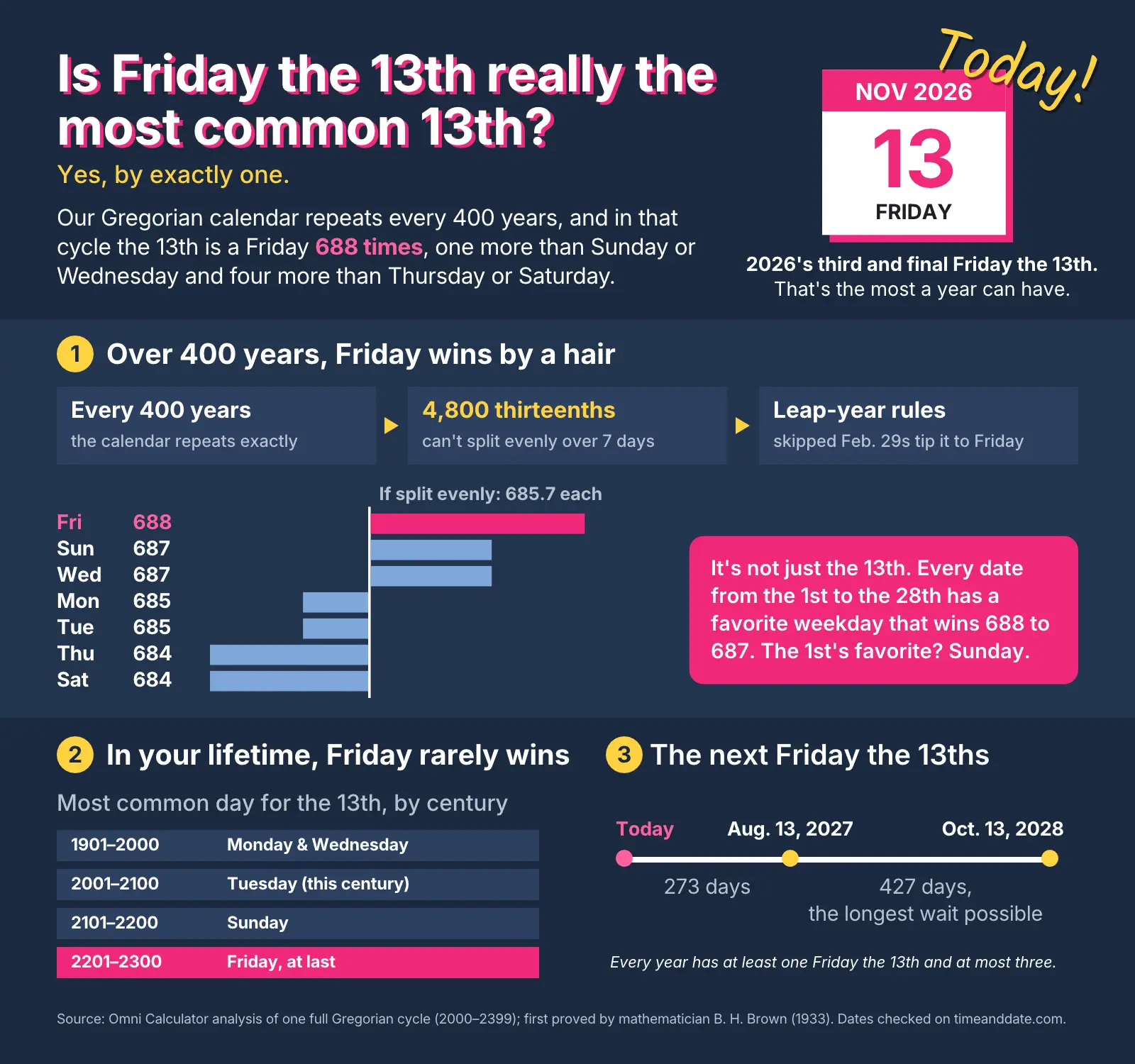
Friday, November 13, 2026, is the year’s third and last Friday the 13th. Math says the 13th lands on a Friday more often than on any other day, by exactly one.
Key takeaways
- Over 400 years, the 13th is a Friday 688 times, a Sunday or Wednesday 687 times, and a Thursday or Saturday 684 times.
- Every date from the 1st to the 28th has a favorite weekday that wins 688 to 687.
- Over shorter spans, Friday doesn’t win. From 2026 to 2036 it’s tied for last.
One out of 4,800
There are 4,800 13th days of the month in any 400-year cycle of the Gregorian calendar. If they were split evenly, each weekday would get about 685.7 of them.
Friday gets 688, about two more than an even split. Then, there are Sunday and Wednesday, with 687 each, Monday and Tuesday with 685. Finally, Thursday and Saturday get 684—just four fewer than Friday.
So, if we pick a 13th at random from the 4,800, Friday is barely the most likely pick. It is the most common, but not by a long shot, and this result was first proved by mathematician B. H. Brown in 1933.
Why the calendar doesn’t split evenly
The Gregorian calendar repeats exactly every 400 years—the same configuration of 146,097 days, or 20,871 weeks. Because the cycle is a whole number of weeks, the pattern of weekdays repeats exactly. But 4,800 months can’t be split evenly among seven days, so some weekdays must get more 13ths than others.
The winner is decided by leap years.
In short, every fourth year is a leap year, except round century years unless the year is divisible by 400 (by that rule, 2000 was a leap year, but 2100 won’t be). It’s those skipped days that decide on the final count of the most popular 13ths.
But the 13th isn’t special—every day between the 1st and 28th has a “favorite” weekday, and that favorite always wins 688 to 687. For example, the most common 1st of the month is Sunday.
Friday doesn’t (usually) win in the span of a lifetime
Over the next 11 years (2026–2036), Tuesday and Thursday get 20 thirteenths each. Friday gets 18, tied with Monday and Wednesday for the fewest. The same goes for the entire century (2001–2100): the 13th is most often a Tuesday, 173 times. Friday gets 172, tied with Saturday and Sunday.
A single century is only a quarter of the cycle, so the lead moves from day to day. In the 20th century (1901–2000), Monday and Wednesday led with 173 each.
In fact, of the four centuries in the cycle, Friday leads in only one (2201–2300, with 173). And across every 11-year period in the cycle, Friday comes out on top alone only about 6% of the time.
When will the next Friday the 13ths happen?
Every year gets a minimum of one and a maximum of three Friday the 13ths. Over 400 years:
- 171 years have one;
- 170 years have two;
- 59 years have three.
2026 happens to have three—in February, March, and November. The 28-day gap between February and March was the shortest possible.
After November 13, 2026, the next one isn’t until August 2027. Then comes the longest wait possible: 427 days till October 13, 2028.
Check it yourself using a date calculator.
Sources
loading