The U.S. Attracted 83% of Private AI Funding. Can China Keep Up?
Want more stories like this?
Follow Omni on Google.


For every $100 invested privately in AI worldwide in 2025, nearly $83 went to American companies. China attracted less than $4.
Yet on one widely followed AI ranking, the leading models from both countries are much closer than the investment numbers suggest.
We compared private investment figures from Stanford University's 2026 AI Index with its rankings of leading American and Chinese AI models to see how the financial race compares with actual model performance.
Key Takeaways
- U.S. companies attracted nearly 83% of worldwide private AI investment in 2025.
- Private AI investment per person was 95 times higher in the U.S. than in China.
- The leading U.S. and Chinese AI models were separated by just 39 Arena rating points in March 2026.
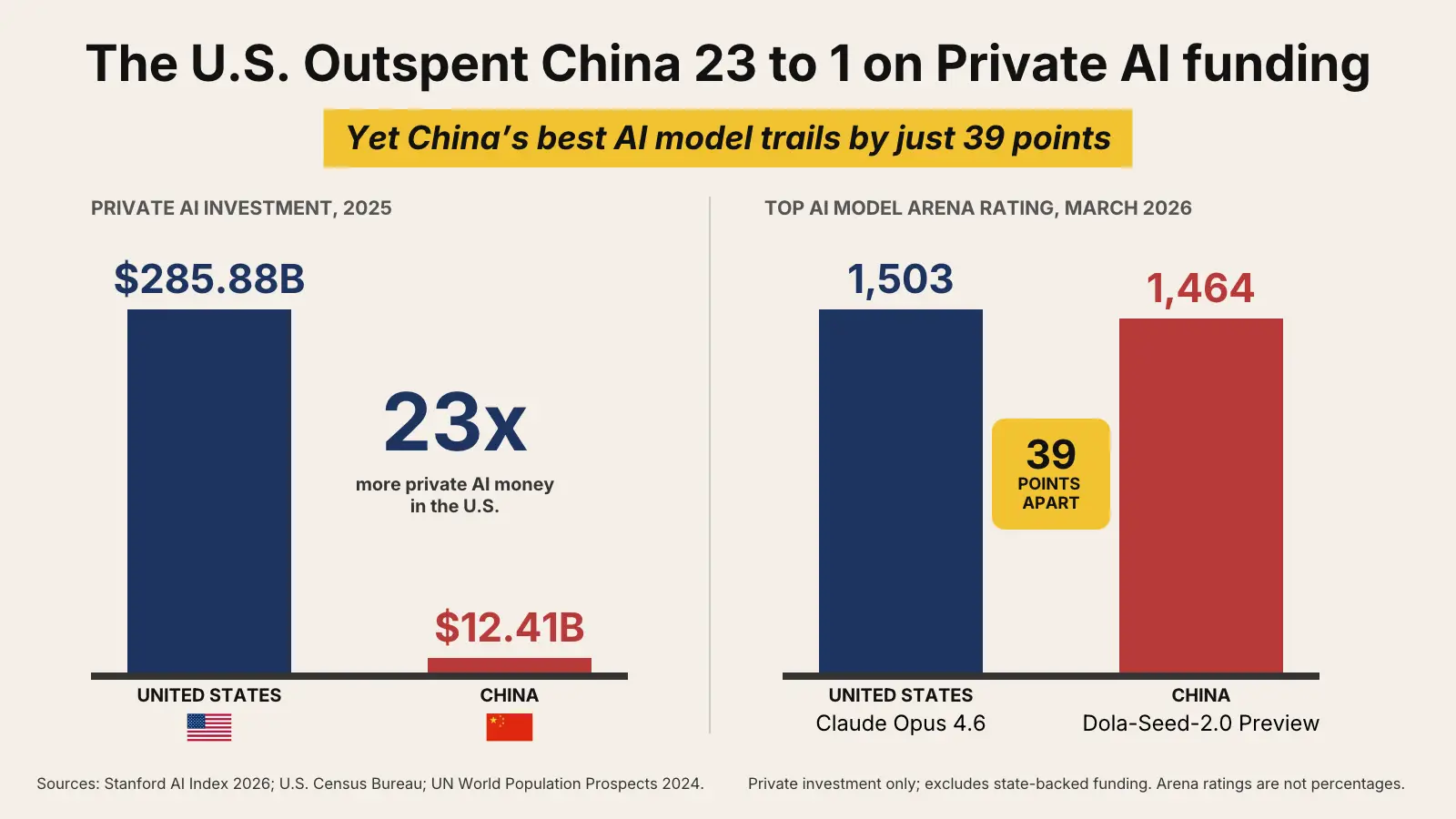
America attracted $285.9 billion. China received $12.4 billion.
According to Stanford University's 2026 AI Index, private investors poured $344.66 billion into AI companies worldwide in 2025.
American companies attracted $285.88 billion of that money. China's share was $12.41 billion, while Europe received $20.92 billion. Put another way, the United States attracted 23 times as much private AI investment as China.
The difference also shows up in the number of companies receiving funding for the first time. In 2025, the U.S. had 1,953 newly funded AI companies, compared with 161 in China.
These investments help companies hire researchers, develop new AI tools, and expand their businesses. And some individual deals are enormous.
In March 2025, OpenAI announced a $40 billion funding round. This single deal was worth more than three times the total private AI investment recorded for China during the entire year.
The gap jumps to 95 times when we compare investment per person
China has more than four times as many people as the United States. So what happens when we adjust the investment figures for population?
Using mid-2025 population estimates, we calculated:
- United States: $836.43 in private AI investment per resident.
- China: $8.76 in private AI investment per resident.
That's approximately 95 times more private AI investment per person in the U.S.
Of course, this doesn't mean every American invested $836 in AI, or that each Chinese resident invested $8.76. We simply divided each country's total private AI investment by its population to make the comparison.
But are American AI models further ahead than China's?
Even though the U.S. attracts far more private funding, the leading Chinese AI models have remained serious competitors.
In March 2026, the highest-rated American model, Claude Opus 4.6, had a score of 1,503 on the Arena leaderboard. The leading Chinese model, Dola-Seed-2.0 Preview, scored 1,464. The difference was just 39 rating points.
Arena ranks AI models in part by allowing people to compare answers to the same questions without initially knowing which model produced them. Users choose their preferred answers, and those choices help determine the ratings.
A 39-point difference doesn't mean the models perform equally well across the board. Some are better at writing, others at coding, math, or more complicated tasks. Still, the rankings show that leading Chinese AI models can compete closely with their American counterparts.
Chinese AI models have come even closer to their American rivals before. In February 2025, its DeepSeek-R1 model came within just five Arena points of the highest-rated American model.
Why the investment figures don't give the full picture
The $285.88 billion versus $12.41 billion comparison only covers private investment in AI companies. It doesn't represent everything the two countries spend on artificial intelligence.
China, for example, has substantial government-backed funding for AI development. According to Stanford, Chinese government guidance funds invested approximately $184 billion in AI companies between 2000 and 2023. This money isn't included in the 2025 private investment figures. It also covers 24 years, so it cannot be directly compared with a single year's investment.
How we calculated the figures
Investment data: Stanford AI Index 2026, based on 2025 private AI investment data from Quid.
Population data: U.S. Census Bureau, July 1, 2025 (341,784,857 residents), and UN World Population Prospects 2024, mid-2025 China estimate (1,416,096,094 residents). We divided each country's investment by its population to compare the results.
The U.S. share of worldwide private AI investment was calculated as $285.88 billion divided by $344.66 billion, giving approximately 82.95%.
Model comparison: Stanford AI Index 2026, Technical Performance, Figure 2.1.3, using Arena leaderboard ratings from March 2026. The 39-point gap is a difference in ratings, not a percentage-point difference in accuracy.
loading