Americans keep less than 11% of their savings in cash. In Japan, it's nearly 50%
• Finance
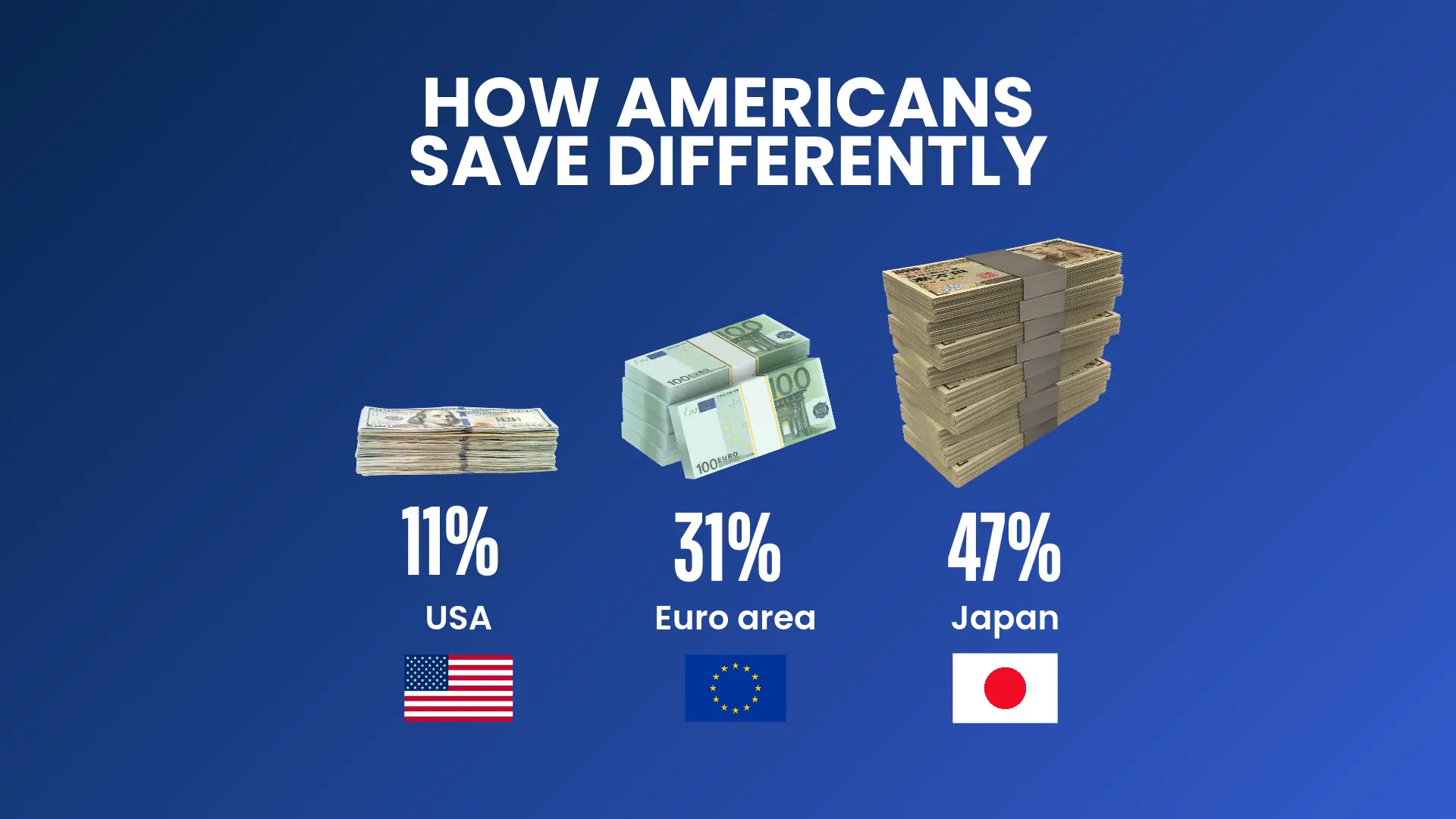
American households keep only 10.7% of their financial assets in cash and bank deposits, according to the Bank of Japan's latest comparison of household finances. Japanese households keep 47.2% there, and households in the euro area 31.1%. The money Americans don't leave in the bank goes into the stock market: 43.4% of US household financial assets are held in equity, compared with 16.7% in Japan.
Key takeaways
- Cash and deposits make up 10.7% of US household financial assets, 31.1% in the euro area and 47.2% in Japan.
- Equity makes up 43.4% in the US, 25.5% in the euro area and 16.7% in Japan.
- Americans also hold 13.3% in investment funds, compared with 12.1% in the euro area and 6.9% in Japan.
- The figures are as of the end of March 2026, from the Bank of Japan's August 2026 report.
Where households keep their money
The Bank of Japan regularly compares household finances in Japan, the United States and the euro area, using the same categories for all three. Here is how each one splits its financial assets, as of the end of March 2026:
| Share of household financial assets | United States | Euro area | Japan |
| Cash and deposits | 10.7% | 31.1% | 47.2% |
| Equity | 43.4% | 25.5% | 16.7% |
| Investment funds | 13.3% | 12.1% | 6.9% |
| Insurance, pensions and guarantees | 25.7% | 26.5% | 24.5% |
| Bonds (debt securities) | 4.3% | 2.8% | 1.5% |
| Other | 2.5% | 2.0% | 3.2% |
The three are almost identical in one row: insurance and pensions take about a quarter of household assets everywhere. The big difference is between the bank account and the stock market.
The US is the stock market outlier
Equity is the largest single item in American household portfolios, at 43.4%. In Japan, it's 16.7%. Add investment funds, many of which hold stocks, and the gap widens: US households hold 13.3% in funds, Japanese households 6.9%.
Japan sits at the opposite end. Nearly half of Japanese household financial assets, 47.2%, are in cash and bank deposits, compared with 10.7% in the US. Japanese households held a total of 2,386 trillion yen in financial assets at the end of March 2026.
The euro area falls in between. European households keep 31.1% of their financial assets in cash and deposits and 25.5% in equity.
Owning stocks is also widespread in the US. According to Gallup, 62% of American adults owned stock in 2025, counting shares held through mutual funds and retirement accounts such as 401(k)s.
What the difference means
A bigger stock share cuts both ways. When markets rise, households with more in equity see their wealth grow faster than those holding cash. When markets fall, they feel the losses more. Money in bank deposits is stable, but it earns little and can lose purchasing power when inflation outpaces interest rates.
The figures describe totals for each region, not typical households. Individual savers' portfolios can look very different from these national averages.
Methodology
All shares of household financial assets come from the Bank of Japan's Flow of Funds: Overview of Japan, the United States, and the Euro Area, published August 2026, with data as of the end of March 2026. Financial assets exclude homes and other real estate. Stock ownership among US adults comes from Gallup (April 2025 survey).

loading

Loading