Table of contents
Be Careful: AI Tax Calculation Risk Hits Up to 78% Incorrect Answers
Report Highlights
As the 2026 tax season reaches its peak, a new report (1) reveals that 26% of Americans, more than 1 in 4, are now using AI to help file their tax returns. However, new proprietary data from the ORCA V2 Benchmark (Omni Research on Calculation in AI) suggests this trend may lead to a wave of IRS audits and financial errors. Our research found that in the Finance & Economics domain, leading AI models are “unstable” up to 78% of the time, frequently providing different incorrect answers to the same financial prompts and underestimating long-term savings by as much as 40%.
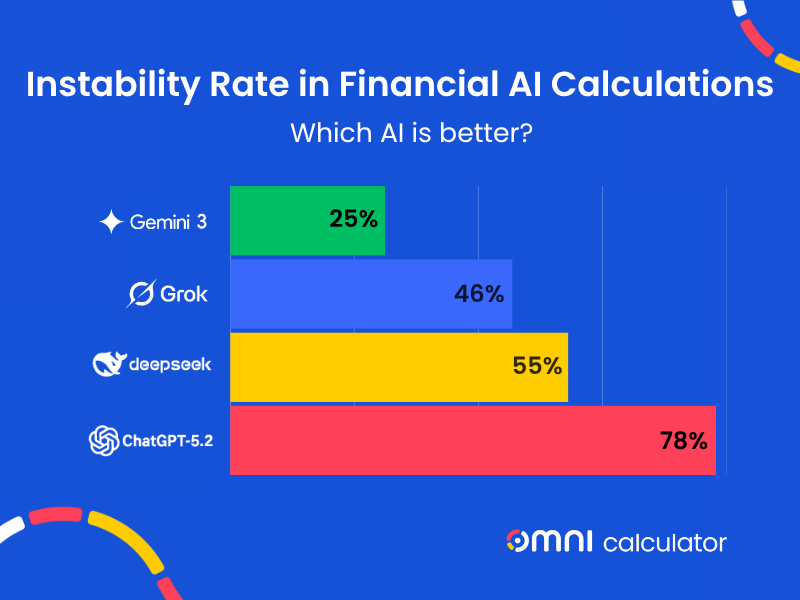
The most alarming discovery in the ORCA 2.0 update is the Instability Metric. This measures how often an AI model provides a different wrong answer when asked the same (or similar) question again.
-
Finance is the most unstable domain: In the Finance & Economics sector, ChatGPT showed a 78.30% instability rate. The most widely used tool in the workplace is also the most volatile. There is a nearly 4-in-5 chance that if ChatGPT gives you a wrong financial answer, it will give you a completely different wrong answer the moment you ask it to double-check.
-
DeepSeek (55%) and Grok (46%): These models hover near a "coin-flip" of reliability. Relying on them for tax adjustments or payroll logic is effectively gambling with corporate compliance.
-
Gemini (25%): While appearing more stable, a 1-in-4 instability rate still represents a catastrophic failure rate for any financial auditing process.
"Relying on AI for tax calculations is essentially financial Russian Roulette, and as you can see, our data shows these models give different wrong answers fairly often, which is a direct path to a nightmare IRS audit." - Dawid Siuda, Financial Expert at Omni Calculator
- Why this matters for taxes: If you ask ChatGPT for a tax deduction calculation and it gives you the wrong answer, there is nearly an 80% chance it will give you a completely different wrong answer if you ask it to double-check. This "hallucinated consistency" makes it impossible for a layperson to verify the math without a professional.
184% overestimation in compounded tax scenario
We asked all models, “If income tax is 12% and I invest $68,000 with a 9% annual return over 5.25 years, how much do I earn after tax?”
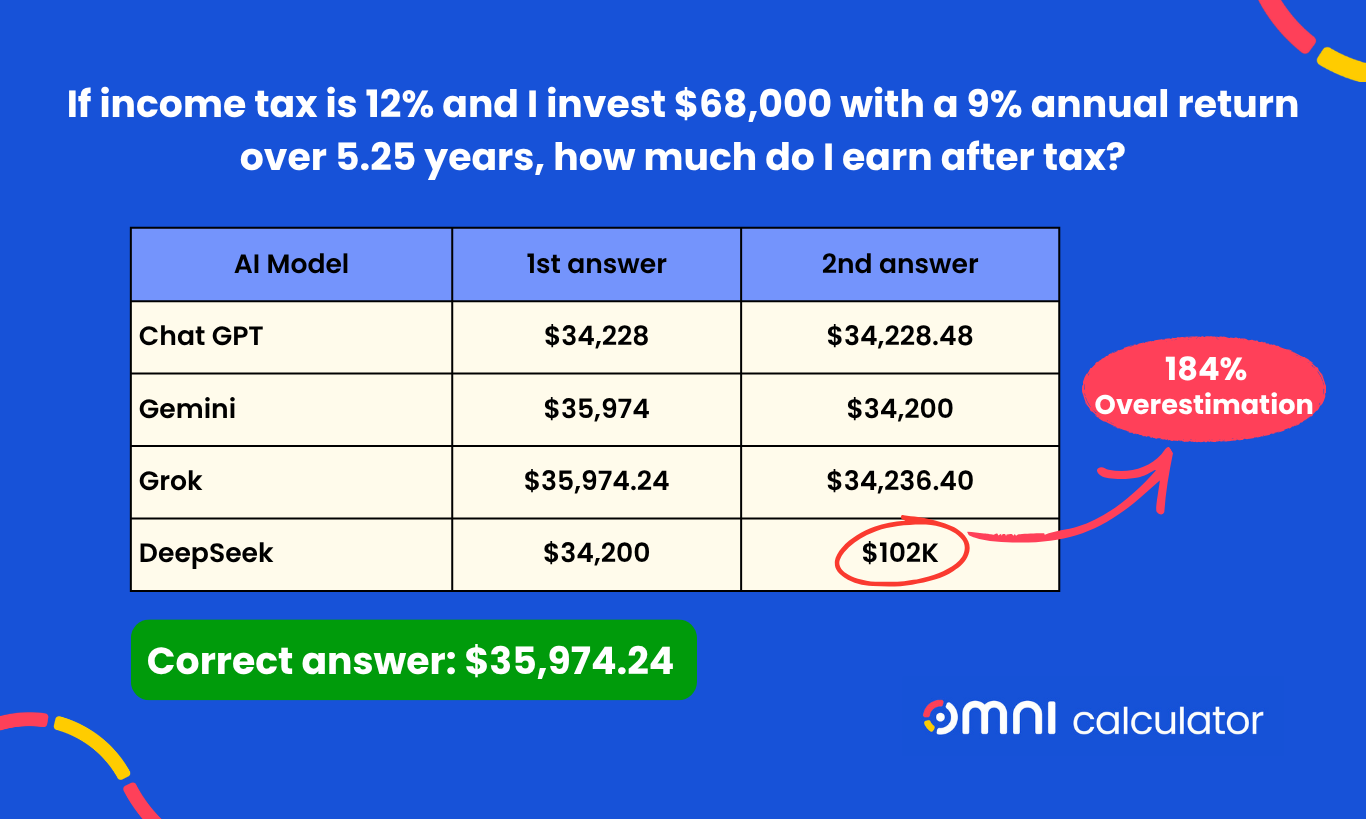
The errors of the responses to this prompt are not uniformly distributed. Models like ChatGPT, Gemini, Grok, and Claude show moderate but persistent deviations (≈4%-6%), which can still materially impact financial planning accuracy. However, DeepSeek exhibits a structural failure on rerun, producing a result (~$102K) that is approximately 184% higher than the correct answer, indicating a breakdown in consistent compounding logic.
The $400,000 “Retirement Gap”
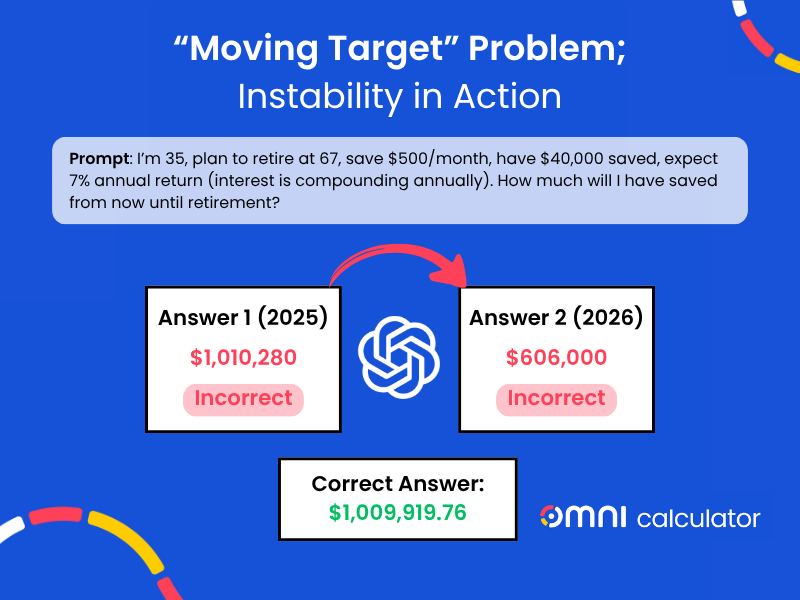
To test the real-world impact, we ran a standard retirement savings prompt (a 35-year-old saving $500/month with a 7% return for 32 years).
- The Correct Answer: $1,009,919.76
- ChatGPT-5.2’s Answer: $606,000
- The Error: A 40% discrepancy. If a taxpayer relied on this for long-term financial planning or calculating tax-deferred growth, the real-world consequences would be devastating.
- Precision Failures: Even when models like DeepSeek or Grok were "close," they struggled with monthly compounding interest, often missing the mark by several hundred dollars, a margin of error the IRS does not accept.
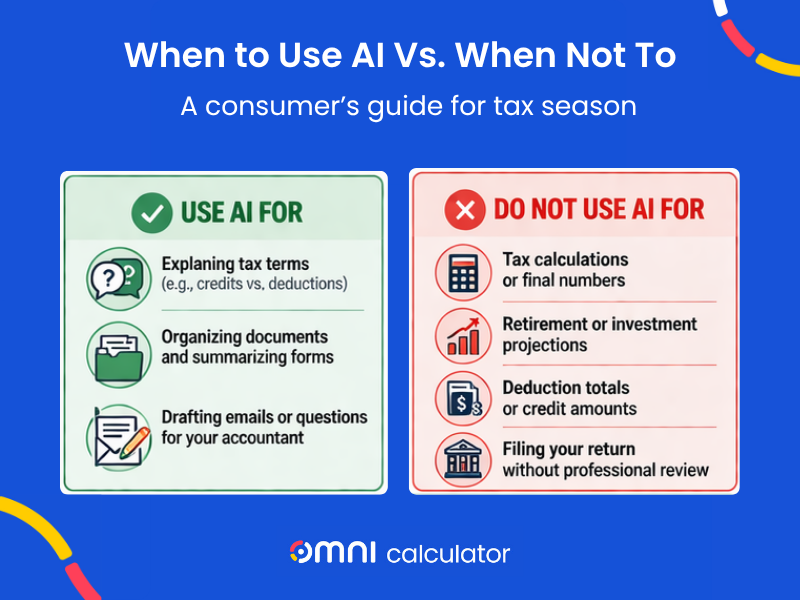
- Treat AI as a “Thesaurus,” not a “Calculator”: Use AI to explain tax terms (e.g., “What is the difference between a credit and a deduction?”), but never use it to calculate the final numbers.
- The “Human-in-the-Loop” Rule: If you use AI to organize documents (as suggested by Adobe), always have a human or professional accountant verify the final filing.
- Verify with Dedicated Tools: Use verified, logic-based calculators (like those at Omni Calculator) that use hard-coded mathematical formulas rather than probabilistic language patterns.