Is an AI computer worth it instead of ChatGPT? We did the math
Want more stories like this?
Follow Omni on Google.


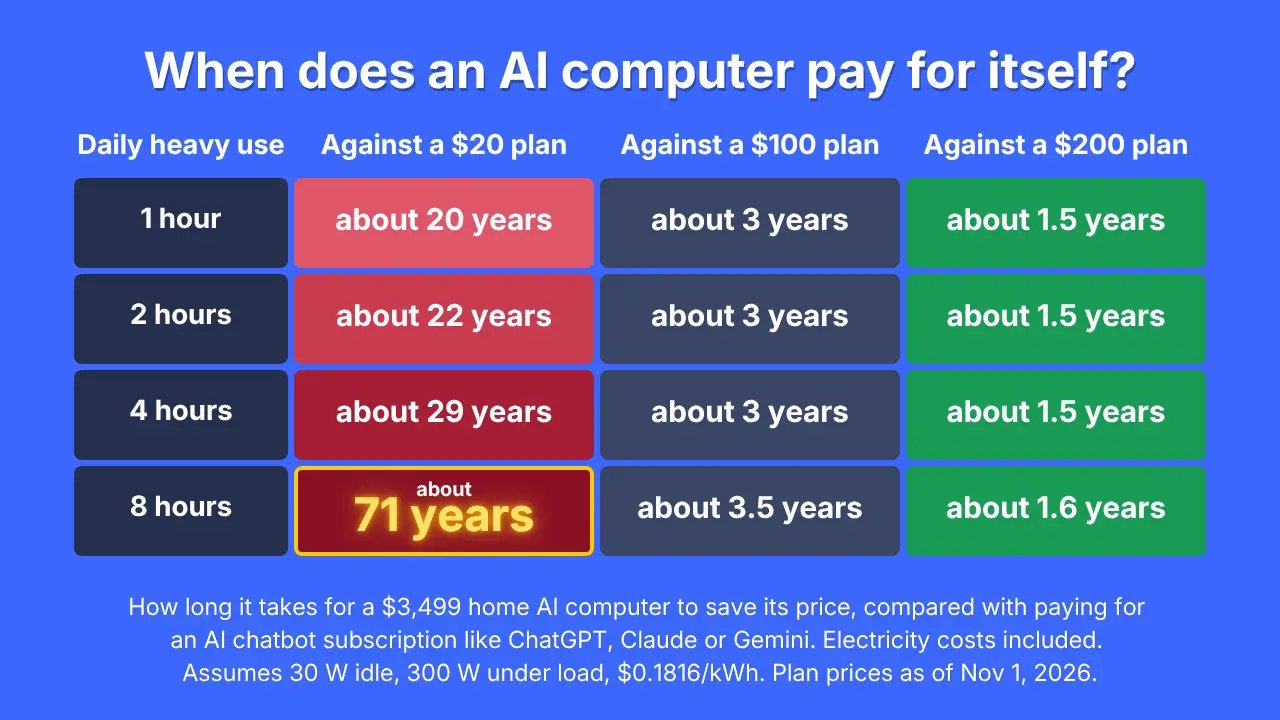
If you pay $20 a month for an AI chatbot, buying a $3,499 computer to run AI at home instead would take about 20 years to pay for itself, and the power bill is the reason.
Key takeaways
- For one kind of user, the machine pays for itself in about a year and a half.
- The more you use it, the longer it takes to break even on a cheap plan.
- Saving money isn't the main reason people buy one.
The math
Personal AI computers are having a moment. In October, a startup called Ghost unveiled Core, a $3,499 screenless computer built to run AI models at home instead of in the cloud. It's an easy pitch: pay once, and stop paying a monthly subscription.
But a computer that runs AI isn't free to run. When it's working hard on an AI task, a powerful small PC like this can draw around 300 watts. Left on all day, it still sips around 30 watts at rest. At the average US home electricity price of about 18 cents per kilowatt-hour, that works out to:
- 1 hour of heavy use a day: about $5.50 a month
- 2 hours a day: about $7
- 4 hours a day: about $10
- 8 hours a day: about $16
That's the catch for anyone on a $20 plan like ChatGPT Plus, Claude Pro or Google AI Pro. The machine doesn't save you $20 a month. It saves you $20 minus the power bill, which can leave only a few dollars.
On the graphic at the beginning of this article, you can see that the pattern is the opposite of what you might expect. On a cheap plan, using the machine more makes it a worse deal, because every extra hour adds to the electricity bill while the subscription you're replacing stays at $20. For a heavy user, the power bill eats up almost the entire saving.
The picture flips for people on the top tiers, such as Claude Max or ChatGPT Pro at $100, or Claude Ultra and Google AI Ultra at about $200. There, electricity barely makes a dent, and the machine pays for itself in one and a half to three and a half years.
What you actually get for the money
The comparison above is only about cost, and that leaves out a big difference. A home machine runs smaller, open AI models. The newest and most capable models from OpenAI, Anthropic and Google live in those companies' data centers and are only available through their apps and subscriptions. So a $3,499 computer and a $20 plan aren't buying the same thing.
That's why most people who buy a local AI machine aren't doing it to save money. The real draws are privacy, since your files and conversations never leave the house, and the freedom to use it as much as you like without hitting usage limits or waiting for your quota to reset.
There's also the question of how long the machine stays useful. AI models are growing fast, and a computer that handles today's open models comfortably may struggle with the ones that come out in three or four years. That matters for the payback math. Even the best case above, about a year and a half against a $200 plan, assumes the machine keeps up the whole time.
So who comes out ahead? On a $20 plan, almost nobody, at least on cost alone. On a $100 or $200 plan, and with work that a smaller model can handle, the numbers start to make sense.
Methodology
The machine price is Ghost Core's launch price of $3,499. Ghost doesn't publish power figures, so the model assumes typical numbers for a high-end small AI computer, about 30 watts at rest and 300 watts under heavy AI work, left on all day. Electricity is priced at 18.16 cents per kilowatt-hour, the US average residential price for August 2026 from the Energy Information Administration. Plan prices are US list prices as of November 1, 2026, before tax. Payback time is the machine price divided by the monthly subscription minus the monthly electricity cost. The model leaves out resale value, repairs and price changes.
loading