Calculated: The No. 1 Reason Your Flight Is Late
Want more stories like this?
Follow Omni on Google.


If your flight gets delayed, you’ll probably blame the weather or air traffic control. But government data suggests the no. 1 cause of flight delays is neither of those.
Key takeaways
- The no. 1 cause of flight delays is the plane arriving late from its previous flight (about 4 in 10 delays).
- Problems within the airline, like crew shortages and luggage issues, cause about 3 in 10 delays.
- Weather conditions play a role in about 3 in 10 delays, though officially, “extreme weather” is only responsible for about 4% of delayed flights.
One late arrival can push back an entire day of flights
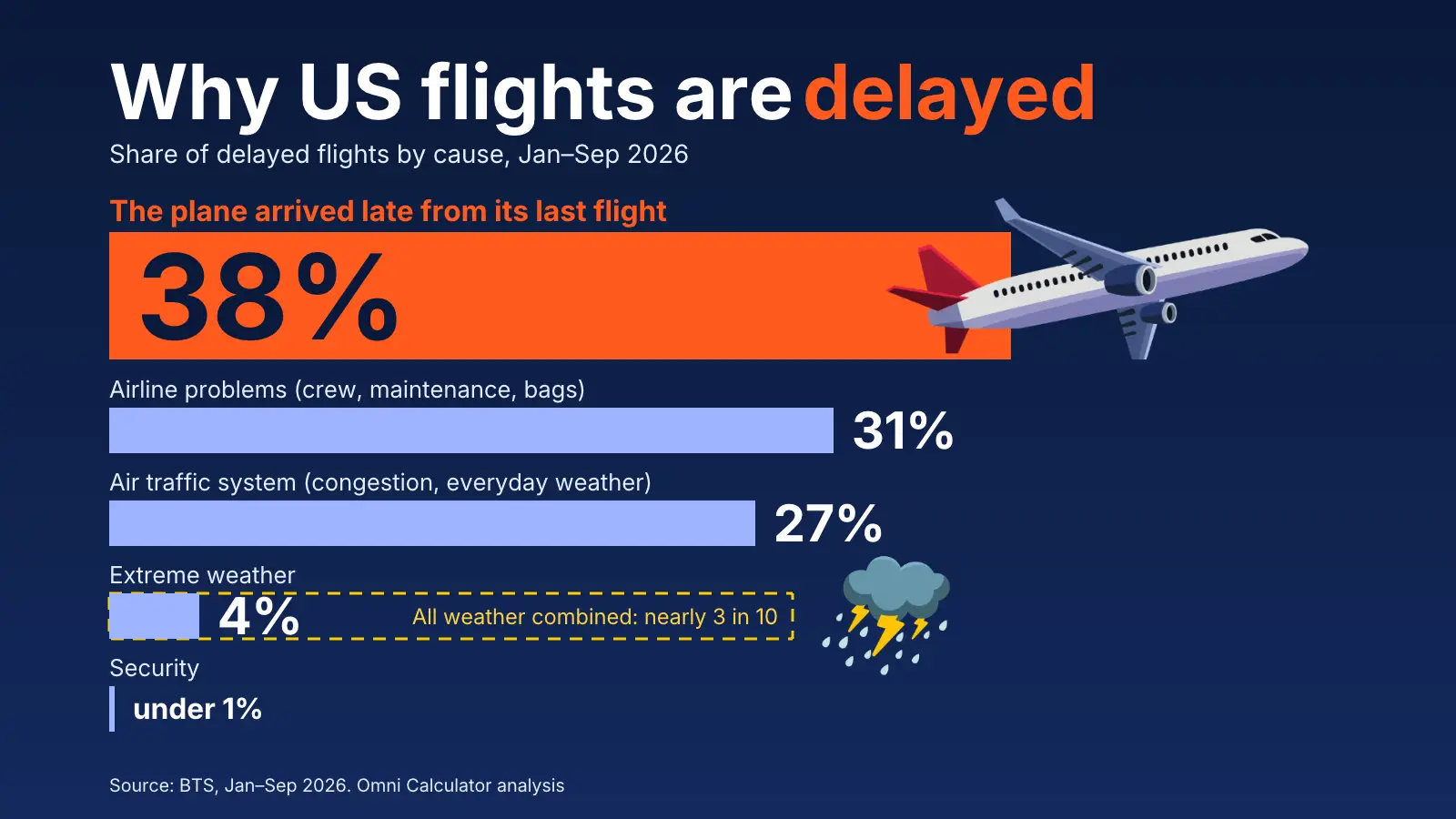
The one thing that causes the most delays has nothing to do with your flight. The plane simply wasn’t there on time. About 4 in 10 delayed flights from January to September 2026 were late because the plane arrived late from its previous leg.
Using a plane just a handful of times a day would be extremely inefficient for the airlines, so they try to use it as much as possible, with short breaks in-between. The disadvantage is that with these tight turnarounds, a delay at the beginning of the day can ripple into every flight scheduled for that plane for the rest of the day.
Then, there are issues related to airline operations, responsible for about 3 in 10 delays. These are often due to crew shortages, surprise repairs, and cleaning, refueling or luggage loading that runs long. The air traffic control (ATC) system is responsible for another quarter of delays, including those caused by everyday weather, crowded airports, and heavy air traffic.
It wasn’t always this way. In 2004, the first full year airlines reported delay causes, the air traffic system and late planes each caused about a third of delays. Now, late planes are well ahead.
A late arrival also has a cause, but airlines don’t report what caused that first delay. It could be a storm, heavy traffic, slow ground operations, or all of the above.
Weather is a much bigger cause than its 4% label
Weather causes only about 4% of delays. Officially, anyway. That statistic covers “extreme weather”: hurricanes, blizzards, tornadoes. The everyday thunderstorm that backs up arrivals gets logged as an air traffic control problem.
Let’s twist things up and add the everyday storms back in, plus the weather that caused planes to be late early on, and the weather was actually behind nearly 3 in 10 delayed flights in 2025.
What this means for your Thanksgiving flight
Last Thanksgiving was a rough one for travelers. Barely 3 out of 4 flights arrived on time in November 2025, compared with about 85% the November before. Why? The government shutdown dragged on, and then the FAA stepped in with flight cuts.
As for this year, from January through September 2026, more than 1 in 5 flights arrived at least 15 minutes behind schedule.
How this Thanksgiving will treat travelers this year remains a mystery—but air traffic control is the concern after a few rough months. In August, a communications failure grounded flights across the Midwest; in September, Philadelphia and Newark lost radar and radio for hours; and November saw the first nationwide ground stop since 2023.
And delays spread. After the Philadelphia outage, planes and crews weren’t where they were supposed to be, so nearly 100 more flights were canceled by midday the next day.
That's why an early flight is your safest bet. The later you fly, the more trips your plane has already made, and the more chances one of them runs late.
How we did the math
We used Bureau of Transportation Statistics (BTS) data concerning causes of flight delays of 15+ minutes between Jan and Sep 2026. BTS gives each cause as a share of all flights, and we converted these into shares of delayed flights.
Sources
Most Read


loading