Where do under-35s still buy homes?
Want more stories like this?
Follow Omni on Google.


A household under 35 in West Virginia is about twice as likely to own its home as one in California. What separates them is how many years of pay a house costs.
Key takeaways
- West Virginia and Michigan have the highest share of young homeowners. California has the lowest of any state.
- A typical home costs less than 3 years of income in West Virginia, and more than 7 in California.
- Saving for a down payment takes about 15 years in California, versus under 6 in West Virginia.
The states where young households still own
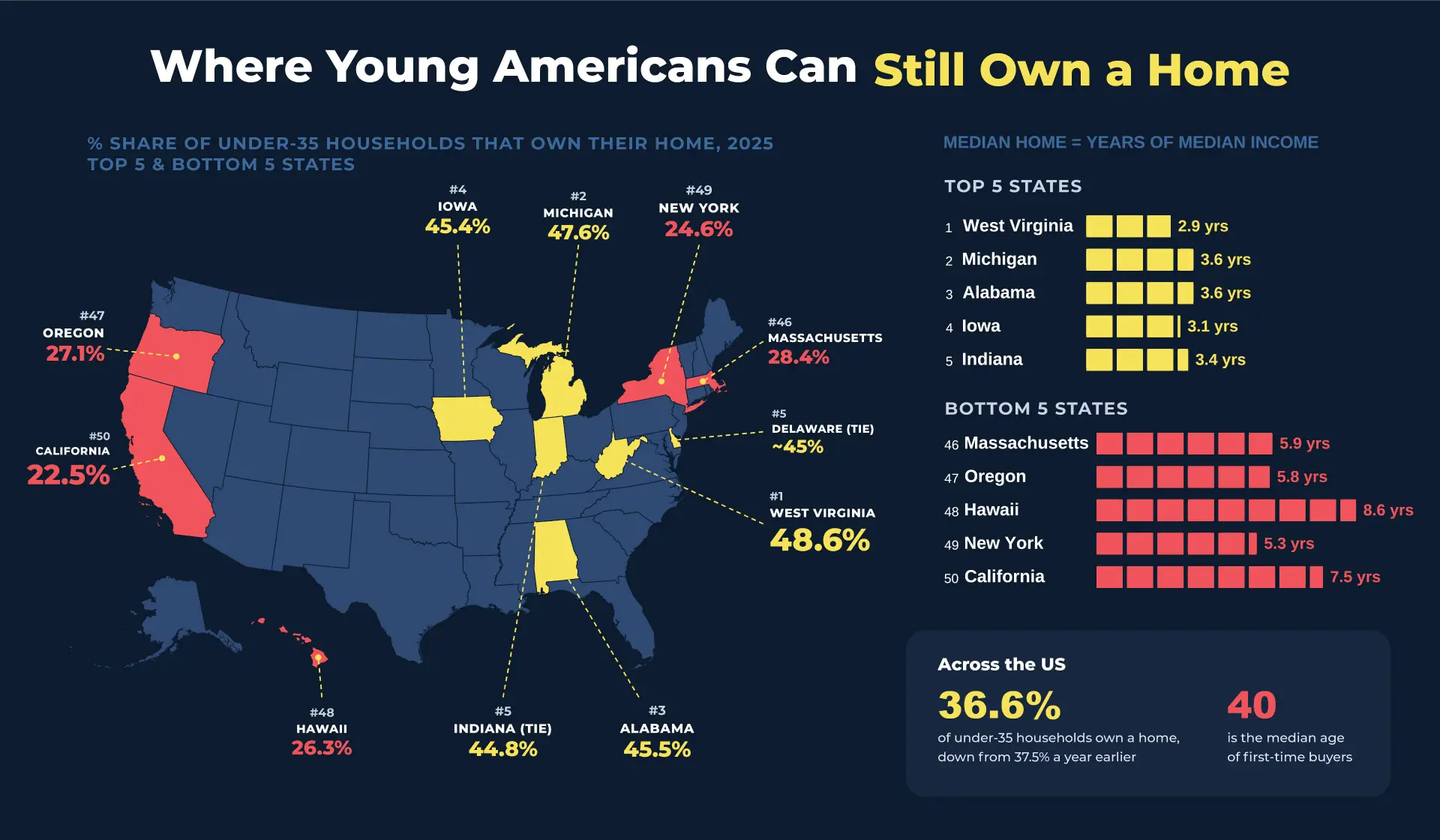
West Virginia and Michigan top the list, with nearly half of young households owning their home (48.6% and 47.6%). Alabama, Iowa and Indiana follow, each at around 45%, with Delaware just a hair behind Indiana.
The key in all five is cheap housing. A typical West Virginia home is worth about $176,000—that's less than three years of what a typical household there earns.
None of the top five needs more than 3.6 years of income to buy a typical home. At the bottom of the list, it's more than 5 years in every state. Cheap homes aren't the only route, though. In Delaware (about 45%) and New Hampshire (about 43%), young households own at nearly top-five rates, even though a home there costs 4 to 5 years of income.
And it isn't a one-time anomaly: West Virginia also led in 2024, at 49.5%.
Where young households are least likely to own
California has the lowest share of under-35 homeowners: 22.5%, or fewer than 1 in 4 households. A typical home in California is worth about $771,000, while the typical household earns $102,000 a year. So, the house costs them 7.5 years of income.
Right above California are New York, Hawaii, Oregon and Massachusetts. In Oregon and Massachusetts, a typical home costs close to 6 years of income; in New York, just over 5.
Hawaii is the most expensive state of all, at 8.6 years of income. Yet 26.3% of its young households own, more than in New York or California.
How long it takes to save for a down payment
Say a household saves a tenth of its income every year. How long will it take them to accumulate enough for a 20% down payment for a typical house?
The answer: under 6 years in West Virginia, but about 15 in California. In Hawaii, it takes even longer: about 17 years. The math assumes savings earn no interest, prices stay flat, and the household earns its state’s median income.
And that’s a best-case scenario: households headed by someone under 25 earn far less than the median (about $48,000 a year nationally, versus $85,000), and they’d be saving while paying rent.
The bigger picture
Nationally, 36.6% of under-35 households owned a home in the third quarter of 2026, down from 37.5% a year earlier. That's a little over half the overall US homeownership rate of 65.5%.
Buyers are getting older, too. First-time buyers made up 22% of home purchases in the year to June 2026. Their median age was 40, according to the National Association of Realtors’ 2026 Profile of Home Buyers and Sellers.
A record 10% of first-time buyers used an inheritance toward their down payment.
Put that next to our down-payment estimate. Someone who starts saving at 25 would have 20% down at about 31 in West Virginia, but not until about 40 in California.
Every year prices outpace savings, those ages move further out.
Methodology
Young homeownership: Share of households headed by someone under 35 that own their home: owner-occupied units ÷ all occupied units with a householder under 35. Source: Census Bureau, American Community Survey (ACS) 2025 1-year estimates, released Oct 29, 2026, table B25007. Years of income: Median home value (table B25077, as estimated by owners) ÷ median household income for all ages (table B19013), by state. The down payment estimate assumes no interest on savings, no change in home prices and no existing savings. Income by age: National median household income by age of the householder (table B19049), 2025. National figures: Census Bureau, Housing Vacancy Survey, Q3 2026. Note: Washington, D.C. is excluded from the state rankings.
Sources
loading