How many people one lawmaker represents, by country
• Finance
Want more stories like this?
Follow Omni on Google.


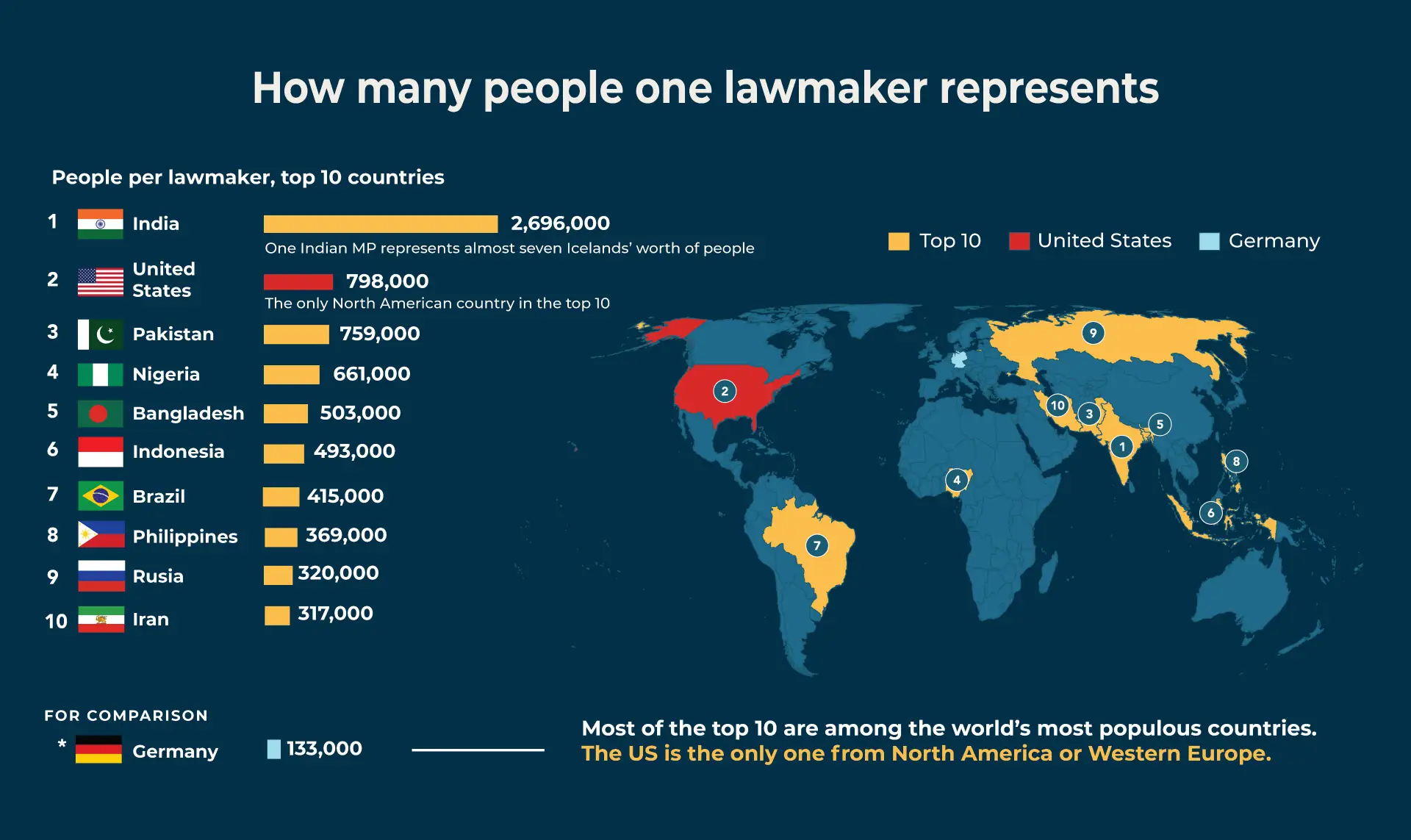
Each member of the US House of Representatives speaks for about 798,000 people, more than a national lawmaker in any other large country except India.
Key takeaways
- A US representative has about six times as many constituents as a German one.
- The reason goes back more than a century, to a number that never changed.
- To match its old ratio, the House would need more seats than the German and British parliaments combined.
The ranking
We took every country with more than 50 million people and divided its population by the number of seats in its directly elected lower or only chamber of parliament. The result is how many people one lawmaker represents, on average.
India is far ahead of everyone, with about 2.7 million people per member of its Lok Sabha. Then comes the United States. Pakistan is close behind, at about 759,000, followed by Nigeria at about 661,000.
At the other end, lawmakers in Europe's biggest countries represent far fewer people. A member of Germany's Bundestag speaks for about 133,000, a French deputy for about 116,000, and a British MP for about 108,000. A US House member has about seven times as many constituents as a British one.
| Rank | Country | People per lawmaker |
| 1 | India | 2,696,000 |
| 2 | United States | 798,000 |
| 3 | Pakistan | 759,000 |
| 4 | Nigeria | 661,000 |
| 5 | Bangladesh | 503,000 |
| 6 | Indonesia | 493,000 |
| 7 | Brazil | 415,000 |
| 8 | Philippines | 369,000 |
| 9 | Russia | 320,000 |
| 10 | Iran | 317,000 |
| 11 | Colombia | 282,000 |
| 12 | Japan | 265,000 |
| 13 | Mexico | 264,000 |
| 14 | Ethiopia | 247,000 |
| 15 | DR Congo | 226,000 |
| 16 | Vietnam | 204,000 |
| 17 | Egypt | 198,000 |
| 18 | Tanzania | 181,000 |
| 19 | South Korea | 173,000 |
| 20 | Kenya | 166,000 |
| 21 | South Africa | 162,000 |
| 22 | Italy | 148,000 |
| 23 | Turkey | 147,000 |
| 24 | Thailand | 144,000 |
| 25 | Germany | 133,000 |
| 26 | France | 116,000 |
| 27 | United Kingdom | 108,000 |
| 28 | Uganda | 96,000 |
Why: a House frozen at 435 seats
For most of American history, the House grew along with the country. After almost every census, Congress added seats. That stopped after the 1910 Census. A 1911 law set the size at 435 seats, starting with the Congress that met in 1913, and a 1929 law made the cap permanent. Apart from a short-lived bump to 437 seats when Alaska and Hawaii joined the union, it hasn't changed since.
The population has kept growing, though. According to the Census Bureau's apportionment data, the average House seat stood for 210,328 people after the 1910 Census. After the 2020 Census, it was 761,169, about 3.6 times as many. Since then, each census has only moved seats between states.
What if the House had kept its 1910 ratio? Based on the 2020 Census count, it would need about 1,574 members today. That's more than Germany's Bundestag and Britain's House of Commons put together, which have 1,280 seats between them.
The gaps inside the country are big too. Because every state gets at least one seat and seats can't be split, some districts are much larger than others. Delaware, with a single representative, had the most people per seat after the 2020 Census, at 990,837.
Methodology
The ranking covers every country with more than 50 million people in 2025, using population estimates from the United Nations' World Population Prospects 2024, rounded to the nearest million. Each population is divided by the number of seats in the country's lower or only chamber, as listed by the Inter-Parliamentary Union, and rounded to the nearest thousand. Only chambers whose members are directly elected and that are currently sitting are included, which leaves out China, Myanmar and Sudan. The historical figures and the 1,574-seat estimate use the Census Bureau's apportionment data, which measure a different population count than the UN estimates and are not directly comparable with the ranking.
Most Read
loading