
Omni Calculator logo

Table of contents

1. Testing AI on calculator builds

Which AI Chatbot Builds the Best Calculator?

Report Highlights

We’ve all seen the headlines about how AI is going to replace developers, or how it can instantly solve your math homework. Recently, things took a massive turn. Major AI chatbots stopped just spitting out text answers and started building functional, interactive mini-software right inside the chat window. If you ask for a tool to calculate your monthly mortgage or figure out your hydration needs, it doesn’t just give you a static formula anymore. It hands you a working calculator with inputs, sliders, and submit buttons. So, we decided to put them to the test.

At Omni Calculator, we know a thing or two about building math tools. Our site features thousands of calculators built by real experts, rigorously peer-reviewed, and thoroughly tested. We wanted to see if the newest generation of AI flagships, Claude Sonnet 4.6, Gemini 3.1 Pro, and ChatGPT 5.5, could actually replicate what we do.

We picked 20 real calculators from our website, ranging from simple conversions to highly advanced physics and finance models. Then, we hit the AI chatbots with a single prompt to recreate them and compared the results to our expert-verified versions, and tried to fix any bugs with exactly one follow-up prompt.

The results were completely unexpected, especially if you remember our last ORCA research.

Not too long ago, we published the ORCA Benchmark, where we exhaustively tested how well large language models (LLMs) handle raw mathematical logic. Back then, the core question was: Can the AI do the math in the background and give you the right number? But the tech moved fast. Today, we are on a completely different level. We aren’t asking AI to just do a calculation - we are asking it to act as a product manager, a frontend developer, and a QA engineer all at once. We want a custom-made software tool that is generated in seconds.

To see how they stacked up, we assigned difficulty levels to our 20 test calculators (Easy, Medium, Hard) based on how complex it would be for a human to decode the requirements and build the logic. We scored the chatbots on two main things:

  • Accuracy and Precision - Does the math actually work when compared to a trusted, human-verified source?
  • Design and UX: - Is it intuitive? Does it look broken? Are there guardrails to prevent you from entering negative values where they don't make sense?

We also introduced a strict penalty: negative points for "convincing hallucinations." If a chatbot built a gorgeous, perfectly functional UI that looked incredibly professional, but stealthily gave the user the completely wrong mathematical result, we penalized it heavily. Why? Because a user with no way to verify the math is going to trust that clean interface blindly, and getting a confident, wrong answer is infinitely worse than the tool just crashing.

When we look at the final leaderboard, the numbers tell a wild story, especially when you compare them directly to what we found in our older ORCA mathematical tests.
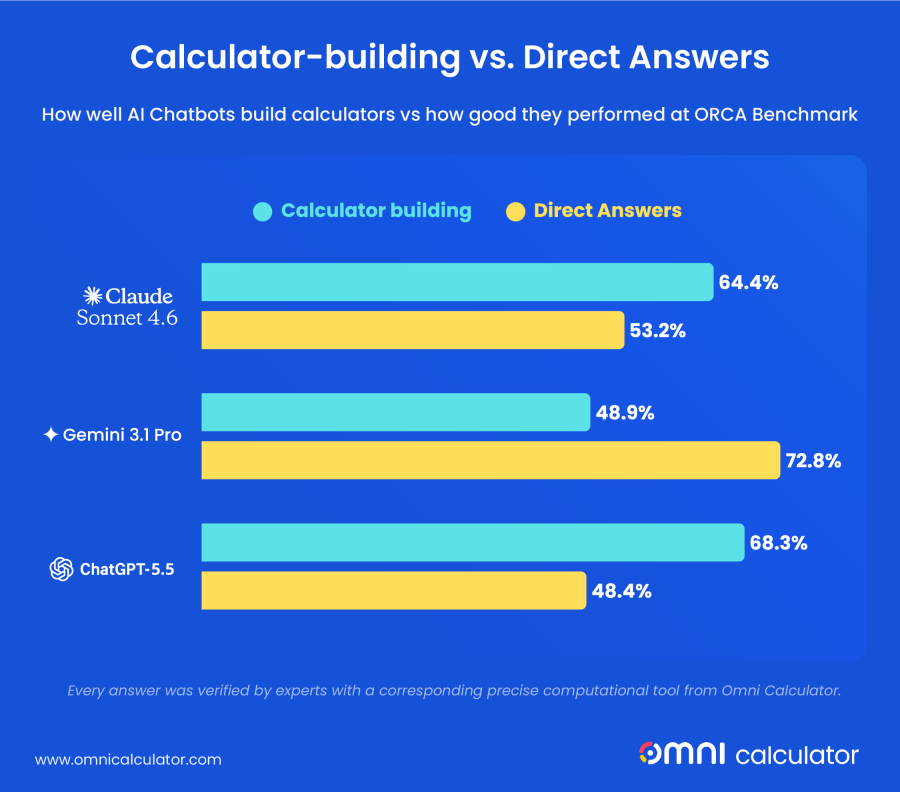
Diagram showing AI chatbots performance

Look at Gemini. It absolutely dominated the pure math testing in the ORCA reports, yet it completely underdelivered here, coming in last at under 50%. Meanwhile, ChatGPT was the underdog in raw math accuracy but ended up winning the calculator creation challenge.

Why does this happen? Because building a tool requires a completely different skillset than solving an equation. Gemini might know the math, but it gets entirely overwhelmed when it has to package that math into a usable interface. ChatGPT, on the other hand, might struggle with standalone complex logic, but its software-generation pipeline is highly robust and predictable.

When we break the data down by prompt complexity, the gap gets even clearer:
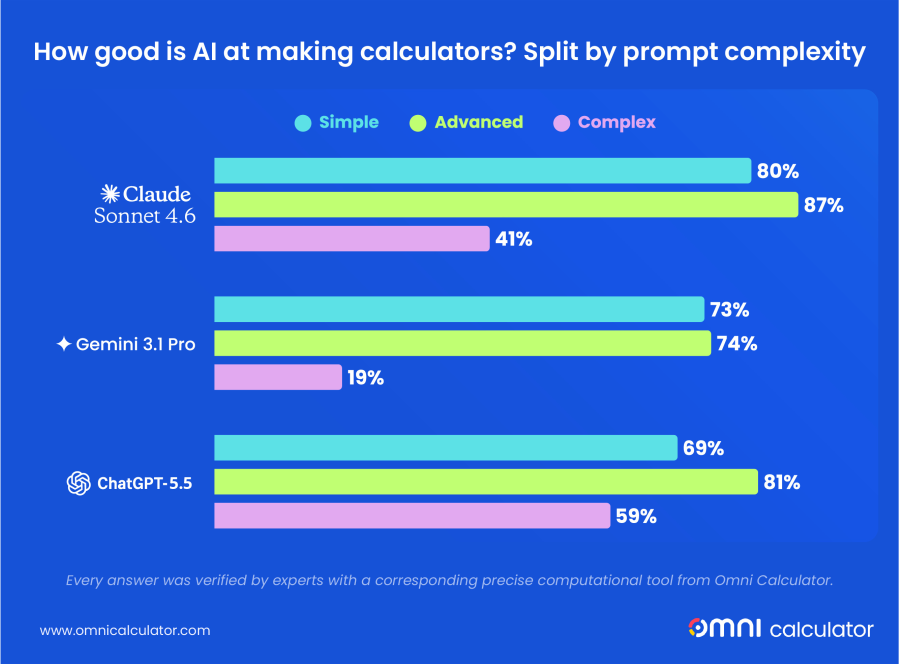
Diagram showing AI chatbots performance

All three models do pretty well when you ask them for something basic or slightly advanced. They can handle a few variables and a standard formula. But look at the Complex column. When handed a massive prompt with multiple overlapping variables and equations to decode from plain human language, Gemini completely gave up (19%). Claude struggled heavily (41%). However, ChatGPT built its entire lead here, hitting a 59% success rate. It rarely got things completely wrong on complex prompts; instead, it usually just made minor, fixable mistakes.

To show you exactly how different these user experiences are, we used the exact same prompt across all three: "Create CTR (Click-Through Rate) Calculator", and the results were compared to our maginificent CTR Calculator. Here is how they handled it.
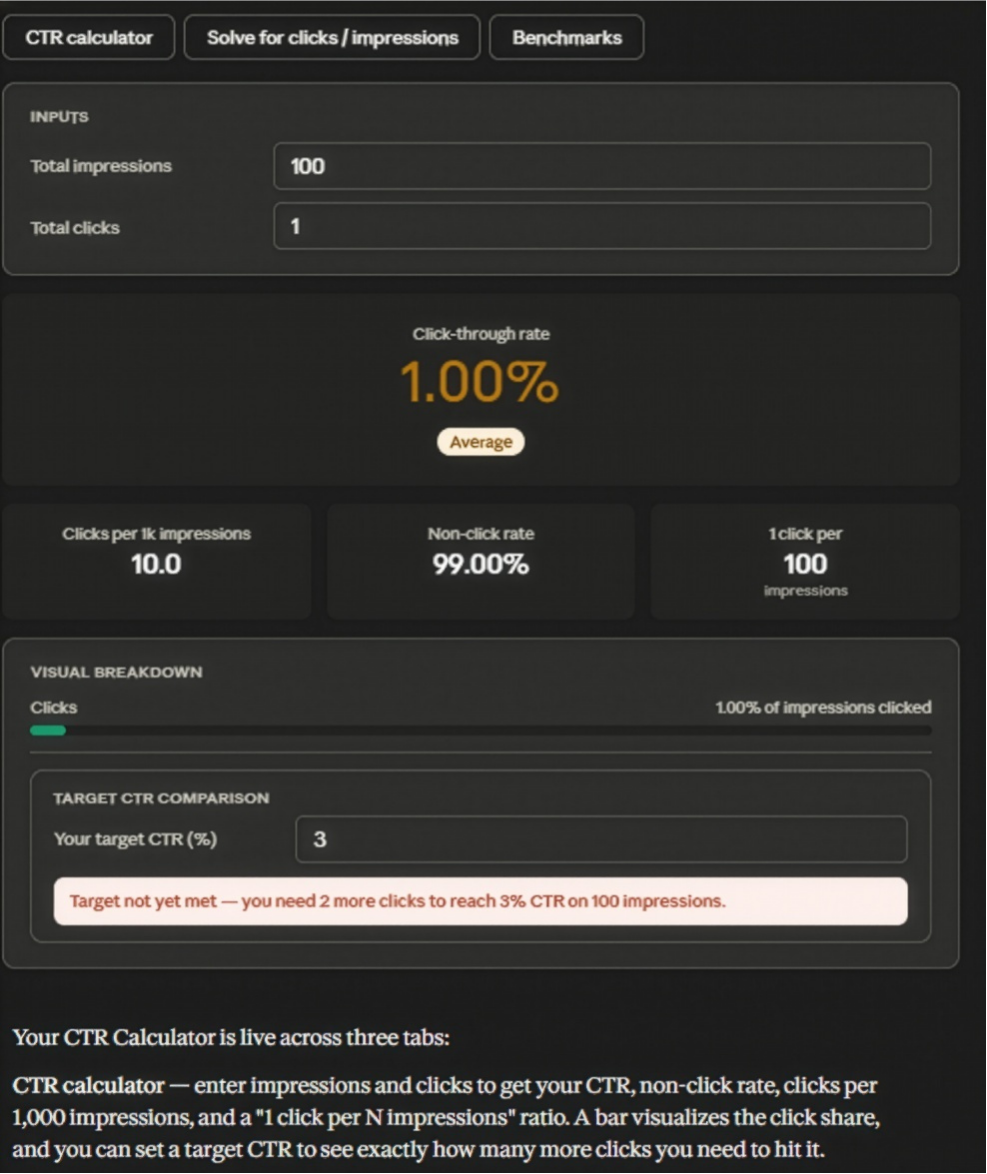
A calculator made in Claude Sonnet
Claude Sonnet 4.6

Claude Sonnet 4.6

Claude is by far the most impressive model to actually look at. Every time you ask it for a tool, it tries to create a unique, bespoke piece of design. If the tool needs charts or visual feedback, Claude builds them. When it's done, it even writes a nice, clean article below the tool to give you context on what the metrics mean.
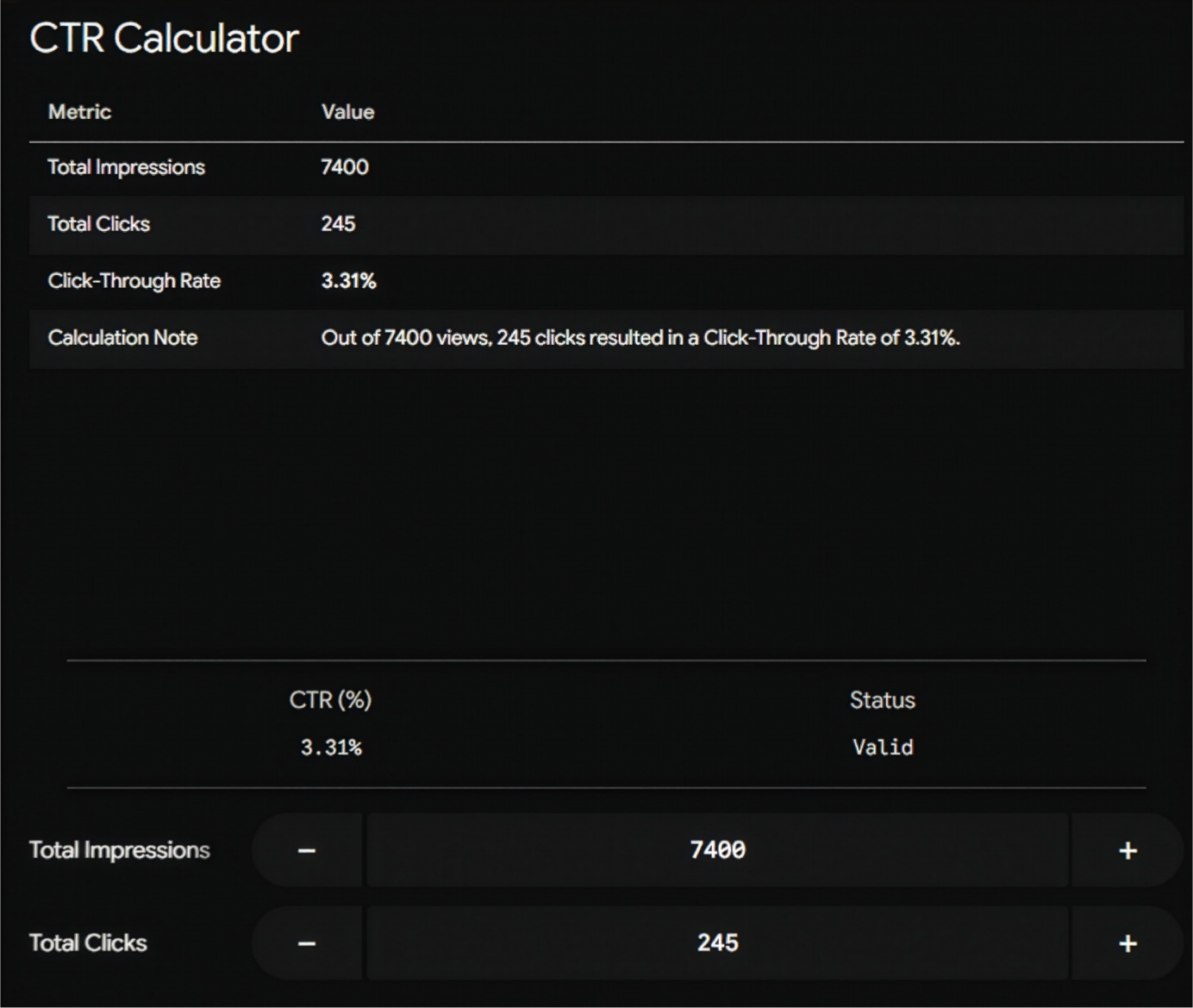
Calculator made in Gemini 3.1 Pro
Gemini 3.1 Pro

Gemini 3.1 Pro

Testing Gemini was genuinely frustrating. The layout it uses to render calculators is completely non-intuitive. Instead of a clean app, it often forces the tool into a rigid structure that resembles a clunky spreadsheet table.

This wasn't a one-off issue. Throughout our testing, Gemini kept making bizarre design choices. Sometimes the input fields were so small you couldn't even see the numbers you typed. Other times, it left out typing entirely and forced you to click "+" and "-" buttons repeatedly to change values by 1, and you couldn't even click and hold! Clicking a button 150 times just to input a baseline data point is ridiculous.
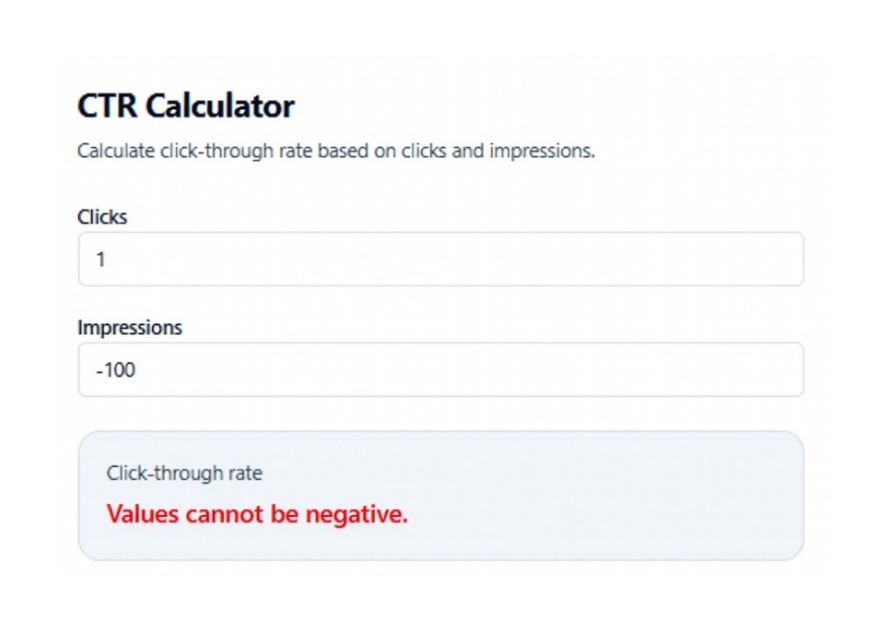
Calculator made in ChatGPT 5.5
ChatGPT 5.5

ChatGPT 5.5

ChatGPT took a completely different route. It uses a very clean, modular, and simple layout. In fact, it looks incredibly similar to the structure we use at Omni Calculator. Because it relies on this predictable, adaptable framework, it rarely makes massive design blunders. While it lacked the flashy visual graphs that Claude generated, its clean design made it the absolute easiest and most intuitive tool to actually use.

We also wanted to see if the chatbots favored specific subjects. This is just our initial batch of data, and we plan on diving way deeper into massive testing volumes for specific industries soon, but the early trends are glaring.
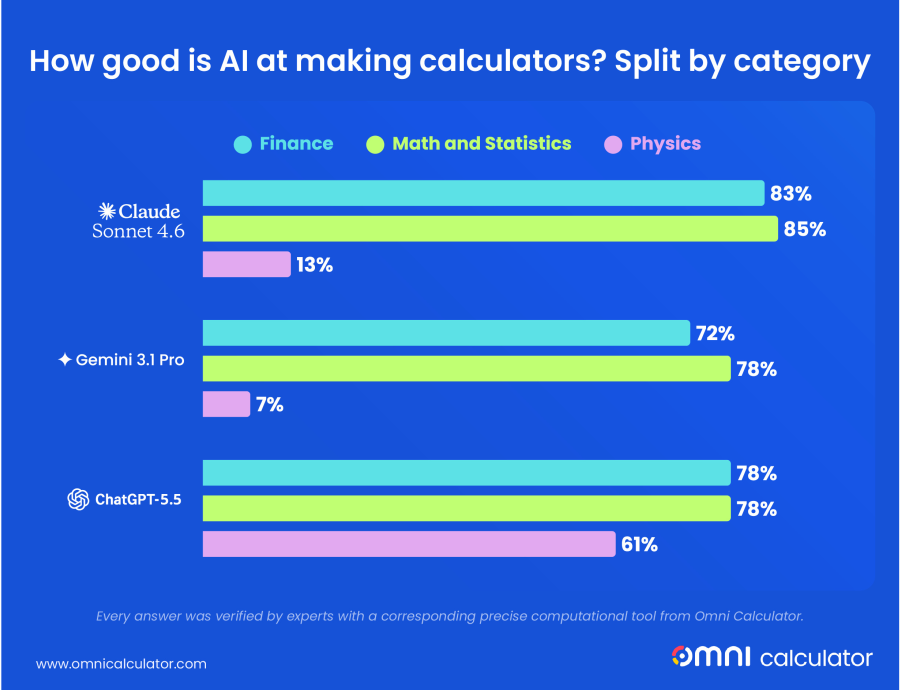
Diagram showing AI chatbots performance

Finance and Math are relatively safe zones. The formulas are structured, and all three models perform respectably. But look at Physics.

Claude and Gemini suffered an absolute meltdown here, falling to 13% and 7% respectively. Physics calculators are a nightmare for AI because they involve a massive mix of constants, shifting data sets, missing variables, and complex unit conversions. Claude and Gemini completely tripped over these requirements. ChatGPT’s simple, rigid layout allowed it to stay grounded, pulling off a 61% success rate while the others completely broke down.

Being able to spin up a calculator in a chat window is an amazing feature, but our research highlighted a dangerous flaw in current AI behavior.

When handed highly complex prompts, these models get overwhelmed. But instead of pausing to ask the user for clarification about a confusing variable, the AI will try to build the calculator regardless. It prioritizes delivering a finished product over telling you the truth.

  • ChatGPT - Wrong math 10% of the time on complex prompts.
  • Claude - Did the same thing 10% of the time.
  • Gemini - Confidently incorrect tool, a massive 20% of the time.

Think about that. With Gemini, if you are generating complex tools, 1 out of every 5 calculators it builds will look perfectly fine and run smoothly, while handing you a completely wrong mathematical result. If you are using that tool to study for an engineering exam, calculate your business runway, or figure out a chemical mixture, the real-world consequences are serious. There’s a clear logistical bottleneck here, too. We did all this research on premium, paid accounts. Even though we were paying subscribers, the token usage required to generate these interactive interfaces was so high that we constantly hit usage limits on both Gemini and Claude, forcing us to sit and wait for hours for our accounts to reset just to finish our tests. If you are trying to use these for free, your access will be heavily restricted.

An AI's ability to instantly spin up a custom tool is incredibly cool, and it's a massive glimpse into the future of software. ChatGPT is currently the most reliable choice if you need something complex, while Claude is excellent if you want something visually striking. Gemini has the raw math skills, but it's currently no better than ChatGPT or Claude, and its UI execution makes it almost unusable for some cases right now. But the biggest takeaway is caution. A slick, professional-looking interface is no longer proof that the underlying logic is correct. Until AI learns to stop guessing and start asking for clarification when a prompt gets too complicated, trusted, human-verified, and expert-reviewed sources are still vastly superior. At least with a human-made tool, someone actually checked the math before handing you the answers.

🙋 At Omni, we've been working on something exciting: OCB, the Omni Calculator Builder. OCB combines the speed of AI with the credibility of expert curation, high-quality data, and full manual editing capabilities. It recently entered public testing, and you are able to try it out for yourself now!

Authors of the report

Ask the authors for a quote

Copyrights