
Omni Calculator logo

Table of contents

1. The Hype vs. The Hard Data

Is Claude really the best? We tested its capabilities against its competitors

Report Highlights

For the past three years, the AI world has been a two-horse race. It was ChatGPT versus the world, with Claude occasionally stepping in as the sophisticated alternative. But in early 2026, the ground shifted. If you’ve spent any time on tech Twitter or LinkedIn recently, you’ve seen the “QuitGPT” movement in full swing.

The catalysts were loud: OpenAI’s massive defense contract with the Pentagon sparked a privacy exodus, while Anthropic’s “principled AI” marketing hit a fever pitch. But while everyone is arguing about ethics and corporate deals, we decided to look at something far more objective: Who is actually getting the answers right?

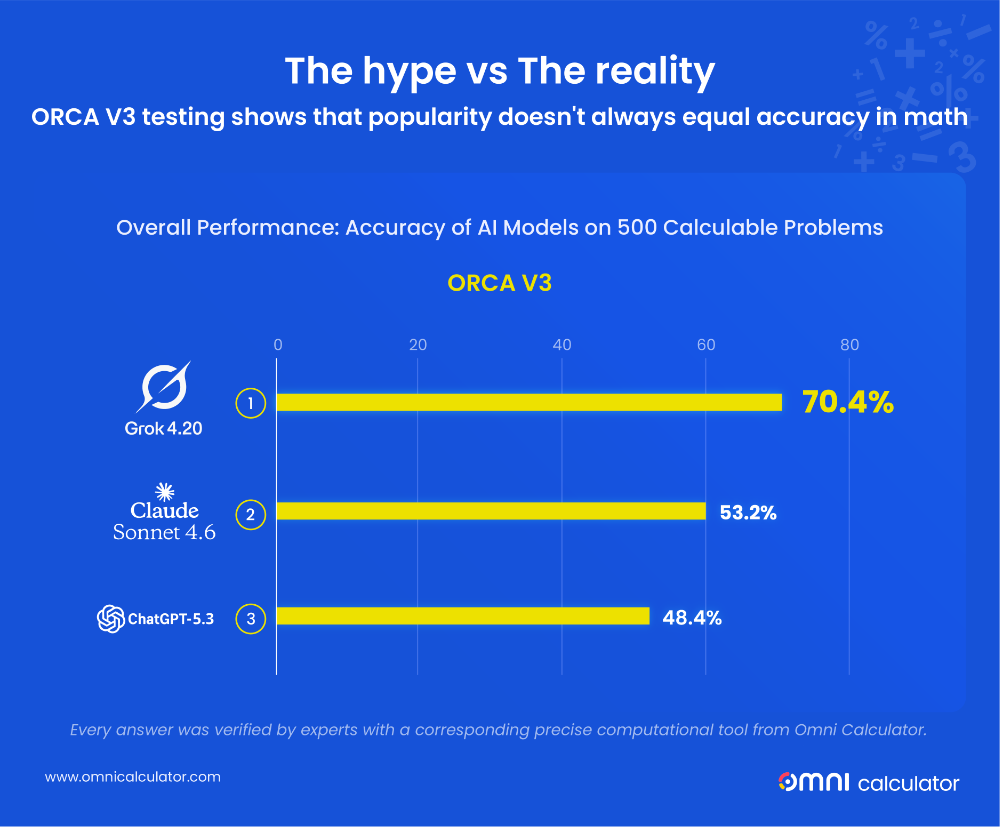
In our third iteration of the ORCA (Omni Research on Calculation in AI) Benchmark (V3), we put the three titans of the free-to-use tier, ChatGPT 5.3, Claude Sonnet 4.6, and Grok 4.2, through a grueling mathematical and logical gauntlet. The results suggest that the internet hype might be looking in the wrong direction.

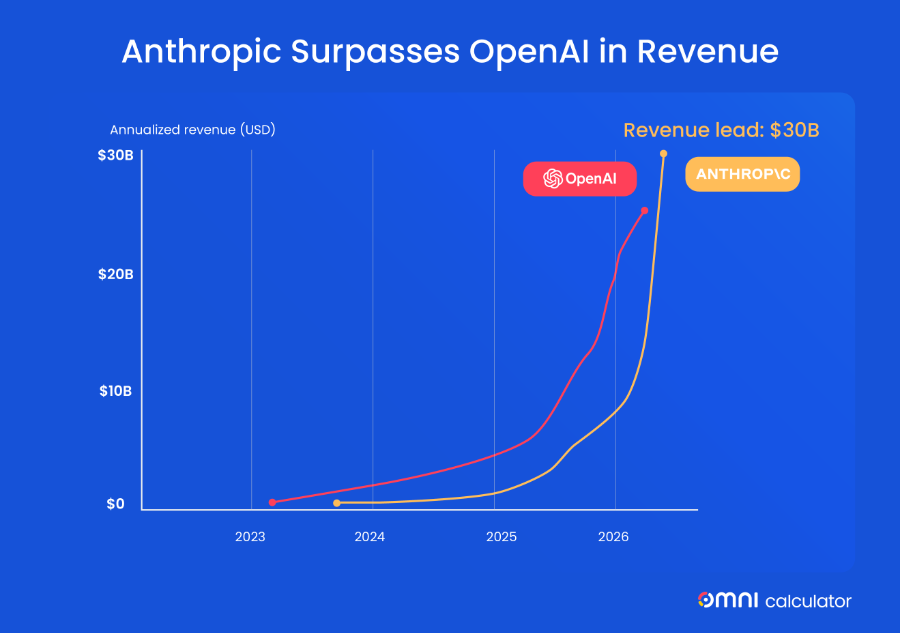
The “switch to Claude” narrative is currently fueled by vibes. Users claim Claude feels more human, less preachy, and better at following instructions. Anthropic has leaned into this, and it’s working; they recently hit a $30 billion revenue run rate, finally leapfrogging OpenAI’s $25 billion.

However, when we move away from prose and into the world of raw logic, the story changes. The ORCA V3 benchmark specifically targets math capabilities because math doesn’t have an opinion. It is either correct or it isn’t.
An infographic showing how often an AI second-guesses it's logic

Our data shows a widening chasm between the models. While the crowd is migrating to Claude for its writing style, they might be unknowingly sacrificing a massive amount of logical processing power.

If you haven’t checked in on xAI’s Grok recently, you’re missing the biggest comeback in AI history. In ORCA V1, Grok was often dismissed as a personality-first bot. By V3, it has become a precision tool.

Grok 4.20 didn’t just win; it dominated with an accuracy rate of 70.4%. What’s more impressive is how it won:

  • Calculation Precision: It reduced raw calculation errors by 40.8% compared to V2.
  • Rounding Consistency: It cut rounding issues by 22.2%.
  • Technical Gains: It is the first model in our testing history to seriously threaten the lead held by Gemini 3 Flash.

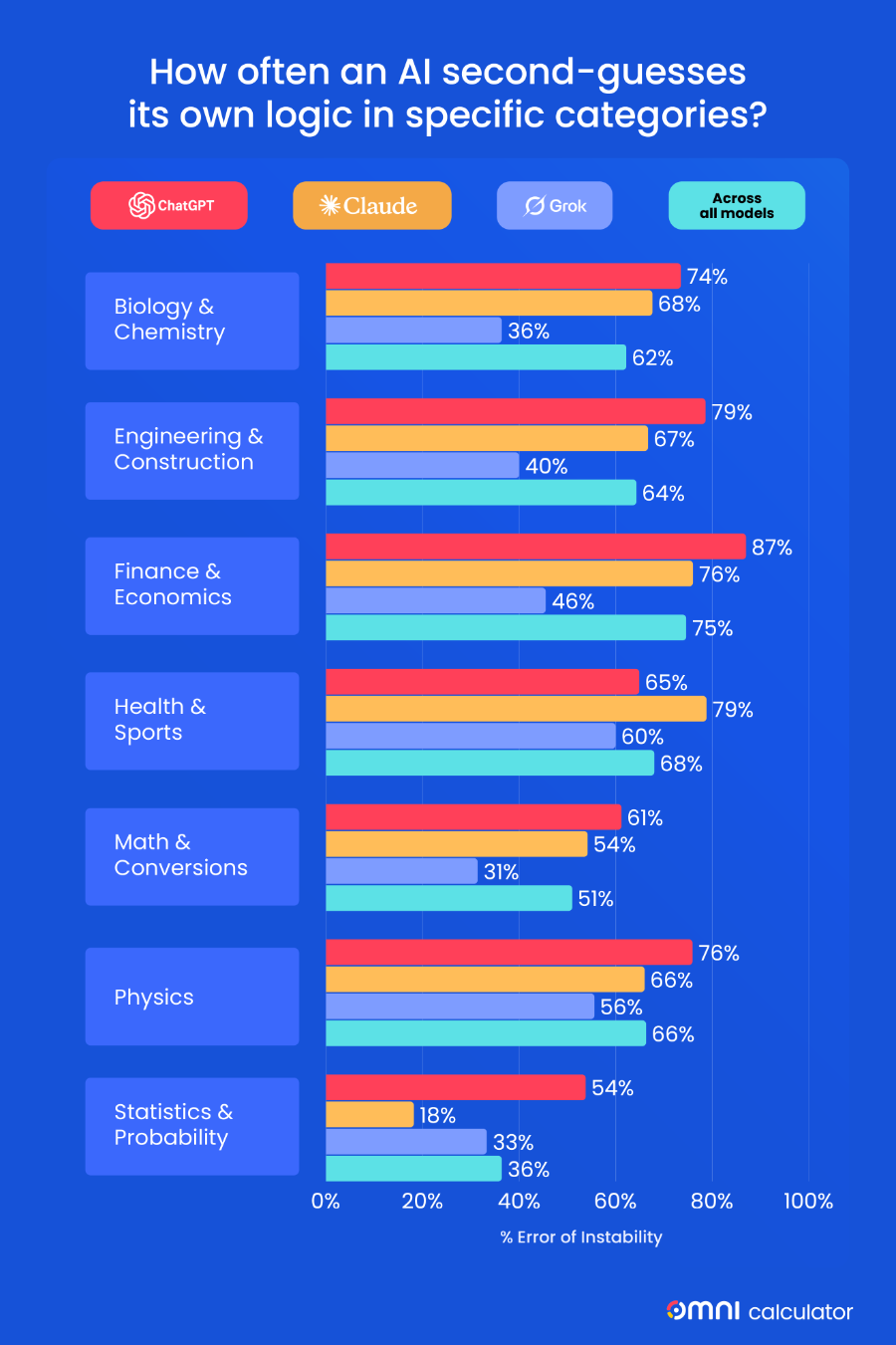
One of the most frustrating things about using an AI is when it gives you a correct answer, then changes its mind if you ask, “Are you sure?” We call this the Instability Metric.

In ORCA V3, we tracked how often a model “waffles” or changes a correct logic path into a wrong one. The industry average for models like Claude and ChatGPT is currently sitting between 60% and 65%. This means they are fundamentally unsure of their logic.

Grok 4.20 is different. Its instability has plummeted to 33.1%.

When Grok gives you a mathematical proof or a logic puzzle solution, it sticks to it. This reliability is arguably more important for a free-tier user than a slight increase in conversational flair. It saves the user time spent double-checking work that the AI should have handled correctly the first time.
An infographic comparing instability of AI models

For years, OpenAI was the gold standard. However, our ORCA V3 data shows that, for the free-to-use tier, the innovation has plateaued. ChatGPT 5.3 scored a 48.4%, which is essentially a regression to its earlier performance levels.

While OpenAI is clearly pouring its best resources into its paid thinking models, the free version feels like it’s being held back. Our error analysis showed:

  • Method Errors: ChatGPT’s formula and method errors increased significantly.
  • Safety Friction: A noticeable amount of failures came from the model being too cautious, leading to refusals or deflections on technical questions it should be able to answer.

It’s not that ChatGPT is getting dumber; rather, it isn’t evolving as quickly as its competitors. For a user who just wants the best tool for their homework or coding project, “staying the same” is equivalent to falling behind.

The reason you’re seeing so many “Why I’m Switching to Claude” articles isn’t just about performance; it’s about the money and the ethics behind it.

Anthropic recently made waves by hitting $30 billion in annualized revenue, finally passing OpenAI’s $25 billion. That is a massive shift. Anthropic has less debt and has positioned itself as the “Safe” and “Enterprise-Ready” choice. By refusing the Pentagon deal that OpenAI signed in early 2026, they captured the “Privacy-First” market share.
An infographic showing Anthropic and OpenAI revenue.

This financial stability allows Anthropic to offer a much better free experience. While OpenAI is tightening the belt on free users to push them toward $20/month subscriptions, Anthropic is using its massive revenue to subsidize a high-quality free tier to lure more users into its ecosystem.

Not all AI models are created equal, and “the best” depends entirely on your specific needs. Here is how the big three stack up based on the ORCA V3 technical data and our manual testing.

  • For the Technical Power User: If you are solving calculus, writing complex logic, or need a “stable” partner for coding, Grok 4.2 is the clear winner. It is currently the most capable free tool for raw logic.
  • For the Creative and Professional: If your goal is nuanced writing, email drafting, or summarizing long documents without “AI-isms,” Claude 4.6 is your best bet. It strikes the best balance between human-like tone and improved technical skills (+8pp since V1).
  • For the Casual Generalist: If you just need a quick answer about a recipe or a movie, and you’re already used to the interface, ChatGPT 5.3 remains a solid choice, even if it isn’t the fastest or smartest anymore.

One of the biggest factors in switching AI models is simply how many prompts you can send before the AI tells you to pay up. In 2026, the limits have changed.

Model

Free Cap (Global Avg)

Pro Price

Key Pro Features

ChatGPT 5.3

10 msgs / 5 hrs

$20 / mo

Canvas & Advanced Voice Mode

Claude 4.6

dynamic / 5 hrs

$20 / mo

Claude Code

Grok 4.2

10 msgs / 2 hrs

$30 / mo

Real-time X search & Multi-agent mode

The shift in 2026 has moved away from how many total messages you get toward how quickly you can get back to work after hitting a wall. For a student or developer working through a complex problem, the five-hour reset window used by OpenAI and Anthropic is a significant productivity hurdle. If you exhaust your ten-message limit on ChatGPT 5.3 at 10:00 AM, you are effectively locked out of high-reasoning capabilities until mid-afternoon.

Plus, the quality of the safety net varies wildly between these providers once those limits are reached. When you hit the cap on:

  • ChatGPT — the system automatically downgrades you to a “mini” version of the model.
  • Claude 4.6 — takes a different approach by using a variable limit based on current server demand, meaning your message cap can shrink unexpectedly during peak hours. This uncertainty makes it difficult for users to rely on Claude for tight deadlines or intensive research sessions where they might need dozens of consistent, high-quality responses in a single sitting.
  • Grok 4.2 — has positioned itself as the sprint tool for the free user by offering a significantly shorter recovery time.

For someone using AI for free, this frequency is the most important metric because it essentially doubles or triples the amount of high-level logic you can access in a 24-hour period. Grok’s 2-hour reset window is currently the most aggressive free offering on the market, allowing you to cycle through your prompts much faster than ChatGPT, and it’s much more predictable than Claude’s system.

Our third iteration of the ORCA Benchmark has produced the most surprising results to date. It is important to note that this is not due to bias or brand preference; in our previous two tests, the rankings looked very different.

Claude 4.6 is currently the “it” model, and for good reason. Anthropic has successfully positioned itself as the ethical alternative, notably passing OpenAI in revenue with a $30 billion run rate. This financial success is built on a reputation for safety and a refusal to engage in defense contracts, such as the Pentagon deal. In our testing, Claude showed a stable result in math with 53.2% accuracy, but its real strength remains its nuanced writing and conversational “human” feel, which isn’t an aspect we’re testing in our benchmark.

ChatGPT 5.3 has the largest ecosystem and the most history, making it a reliable, all-around assistant. However, for free users, the innovation has hit a wall. Scoring 48.4% in math, the model has largely plateaued since our earlier tests this and last year.

The most significant shift in our benchmark is Grok 4.2. While Grok didn’t even stand out in our previous tests, it has a new high with 70.4% math accuracy. It isn’t just about getting the right answer; it’s about consistency, and what really stood out for this model — precision. Grok 4.2 is extremely precise with both big and small numbers — something other models struggle a lot with. Grok’s logic instability dropped to 33.1%, meaning it doesn’t second-guess itself as much as others. If your work is technical, mathematical, or logic-heavy, the data shows that Grok, alongside equally impressive Gemini, is currently the most capable brain for a free user.

Authors of the report

Ask the authors for a quote

Copyrights