
How to Sew a Circle Skirt — Tips for Cutting and Sewing Your Circle Skirt
Learning how to sew a circle skirt is not complicated, but when something goes wrong, it usually starts with one of these moments:
- How to fold the circle skirt fabric: The fold determines where the straight grain lands, and with it, where your zipper will go.
- Grain line and selvedge: Why fabric orientation matters and what happens when you ignore it.
- Marking the pattern: How to cut a circle in fabric without a paper pattern.
- Sewing curved seams: Why they behave differently from straight seams and how to keep them from going wavy.
- Hemming: Why you should hang a circle skirt before hemming it.
🙋 If you haven’t made your structural decisions yet (pockets, closure, waistband), start with reading “decisions you must make before cutting your circle skirt” first. Those choices directly affect how you fold and cut.
The fold is the first real decision in how to make a circle skirt. The fold determines how many pieces you’ll cut and how the pattern fits within your fabric width. There are three approaches:
Cutting a full circle in one piece (requires wide fabric)
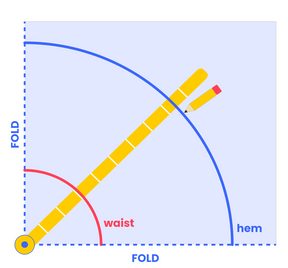
Fold your circle skirt fabric in half lengthwise, then in half again crosswise. Four layers total, with the two folded edges meeting at one corner. Pin that corner, mark a quarter-circle arc from waist opening to hem edge, and cut. Before unfolding, mark the fold lines as they show the grain direction and will help you position the zipper later.
Cutting two half-circles (the most common method)
Fold each fabric section in half once (two layers), pin the folded corner, and mark and cut a half-circle arc on each piece. The two pieces join at the side seams. This is also where the zipper or pockets will go.
Cutting in panels (three or more pieces)
Cut each panel individually without folding the fabric. This approach gives the most control over grain placement and is the most practical option when your fabric width is limited. When laying out panels, try to keep at least one edge of each piece aligned with the grain.
✂️ Which method applies to you?
If your total radius is larger than half your fabric width, you cannot cut a full circle in one piece.
🙋 Not sure which circle type to make? Start with reading “Choosing the right circle skirt: quarter, half, three-quarter, or full circle?”
One more thing before you cut: if your fabric has a print, check that the design falls where you want it before cutting. Stripes, plaids, and large motifs can shift dramatically when the fabric is unfolded. And if your fabric has a nap or sheen (like velvet or satin), make sure you cut all pieces in the same direction. Different cut directions catch light differently and can look like color variations in the finished skirt.
When you fold the fabric to cut, the folded edge runs parallel to the selvedge and lands on the straight grain. The straight grain runs along the length of the fabric, in the same direction as the selvedge. That fold line, once the piece is opened up, becomes the center front (or center back) of the skirt. It is the middle of the piece, not a seam. The side seams, where the front and back pieces join, also run along the straight grain.
Where your zipper goes depends on how you cut. Two half-circles give you two side seams; the zipper usually goes into the left one. One half-circle (front) plus two quarter-circles (back) gives you a center-back seam for the zipper, with the side seams free for pockets.
Either way, the seam carrying the zipper needs to be on the straight grain. A zipper sewn on the bias is much harder to control as the fabric stretches under the presser foot, and the finished zipper ends up pulling or rippling regardless of how carefully you work. The same applies to pocket bags.
Align the fold edge parallel to the selvedge. The center of each piece lands on the straight grain, and so will your side seams. Getting grain placement right is one of the key steps in how to sew a circle skirt that hangs well and holds its shape.
Cutting a circle in fabric doesn’t require a printed pattern sheet as part of how to make a circle skirt. The method works like a compass: a fixed center point, a constant radius, and an arc traced. All you need is a tape measure, chalk (or a fabric marker), and a pin.
Here’s how it works:
- Pin one end of the tape measure to the fold corner of your fabric.
- Hold the chalk at the total radius (TR) mark and pivot, drawing the outer arc. This line marks your hem edge.
- Move the chalk to the waist radius mark and repeat. This line marks the waist opening.
- Cut along both arcs.
 |
|---|
View image fullscreen. |
A tape measure is the easiest tool for cutting a circle in fabric because the measurements are already on it. But you may also use a string for this, with the length of the TR, then just pivot, and draw.
✂️ The total radius (TR)
To calculate the total radius, use:
TR = Waist radius + Skirt length + Hem allowance
For a full breakdown of the calculation, see our fabric math for circle skirts article, or if you want instant results, check our circle skirt calculator.
Using the calculator to plan your skirt?
Create a free account to find it again quickly next time, along with any other Omni calculators you’ve used 😎
Even if your seams are placed on the straight grain, a circle skirt always includes bias sections, especially along the waistline and hem. Bias stretches easily. If you treat it the same as straight-grain fabric, the fabric will stretch and lose its shape while you sew.
Some tips that can help:
Avoid pulling the fabric
The feed dogs, the small metal teeth under the presser foot that advance the fabric, will move it through at the right pace. Even slight tension from your hands can stretch bias sections and create ripples that don’t disappear after pressing.
Use more pins than you think you need
Bias edges don’t stay in place on their own. Pin from the center outward, keeping the fabric relaxed as you position it.
Work in small sections
Instead of sewing long seams in one pass, pause frequently to realign the fabric. This method keeps the pieces from drifting out of position.
Consider washable glue for control
A thin line within the seam allowance can hold layers in place more evenly than pins alone, especially on unstable areas.
Clip the seam allowance after sewing
Make small cuts into the seam allowance, stopping just before the stitch line, so curved seams can open and lie flat without pulling or puckering. This technique is especially useful along the waist seam, where the curve is tightest.
These tips can make a real difference when you learn how to sew a circle skirt with bias sections involved.
The last stage of how to sew a circle skirt is also the most commonly skipped. Before choosing how to hem a circle skirt, hang the assembled skirt for at least 24 hours before marking the hemline.
Once the skirt is assembled, gravity pulls on the bias sections, causing the fabric to stretch. Full circles have the most bias and stretch the most; quarter circles are much more stable. Whatever the type, let the fabric settle completely before you mark or cut.
The best way to mark the hem is either on a dress form or while wearing the skirt: have someone mark a line parallel to the floor while you stand still. If you don’t have a dress form or a helper, hanging the skirt on a regular hanger works too, but a body shape gives a more accurate result.
Either way, do it while the skirt is hanging freely. A measurement taken flat on a table ignores the bias stretch, and the hem will be uneven when worn.
Here are some finish options for how to hem a circle skirt:
Hem finish | Best for | Notes |
|---|---|---|
Narrow machine hem | Lightweight fabrics | Requires two narrow folds; press each fold well |
Bias tape | Any fabric weight | Covers the raw edge cleanly; handles curves naturally |
Serged + folded | Medium to heavy fabrics | Fast and durable |
Hand-rolled hem | Sheers and delicates | Most invisible; most time-consuming |
Whichever method you choose for how to hem a circle skirt, mark the hemline while it’s hanging. Not before.
From prep to finish:
☐ Prewash if the fabric might shrink
☐ Fold so the folded edge aligns with the selvage
☐ Plan zipper and pocket placement before cutting
☐ Press the fabric before marking: wrinkles shift measurements
☐ Check print or nap direction before cutting
☐ Mark waist opening and hem edge before cutting
☐ Use sharp scissors or a rotary cutter, as dull blades drag on curves
☐ Pin curved seams from the center outward and sew in small sections
☐ Hang the assembled skirt before hemming and mark the hem while it’s hanging
Once the hem is done, you know how to make a circle skirt from fabric to finish.
This article was written by Gabriela Diaz and reviewed by Steven Wooding.