Omni Calculator logo

Fabric math for circle skirts: How much fabric do you really need?

Unlike straight or gathered skirts, circle skirts are cut from a circular shape, and the fuller the circle, the more total fabric area the pattern requires. A quarter circle uses a fraction of what a full circle needs, for the same waist size and length.

The difference between types is real and worth knowing before you shop. For the same waist and length, a full circle can require more than twice the fabric area of a quarter circle, and that gap grows with longer skirts. This significant difference is why you decide the skirt type before buying fabric for a circle skirt.

Fabric width is the exact point where some DIY sewists can get stuck. When you draft a circle skirt, you don’t just measure the length; you first calculate the waist radius, then add the skirt length and seam allowances. Think of this final measurement as your total radius (TR):

TR = Waist radius + Skirt length + Hem allowance

The most common fabric widths are 120 cm and 140 cm. Here’s how that plays out by fabric width:

Fabric width

Folded width

Fits TR up to

90 cm (35")

45 cm

~43 cm

120 cm (47")

60 cm

~57 cm

140 cm (60")

70 cm

~67 cm

The total radius measurement must physically fit within the fabric width. So, if your TR is 80 cm, but your fabric is only 140 cm wide (70 cm when folded), it physically won’t fit 😭

What do we do here? Settle for shorter skirts? Abandon the project? Maybe it’s not as straightforward as we’d like, but the solution is simple: adapt your pattern layout.

Some typical workarounds:

1. The two half-circles trick

The most common solution is to cut two half-circles and sew them together along the sides. This method actually solves multiple problems at once because side seams make it easier to insert pockets or a zipper.
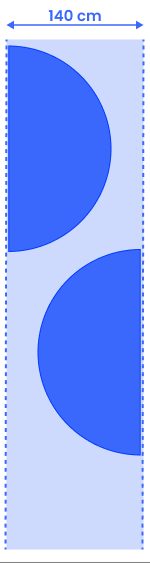
Two half-circle pattern pieces laid vertically along a 140 cm wide fabric roll, one on each side.

2. Divide it even more

Another option is dividing the skirt into panels (like a pizza). This approach reduces layout restrictions and can even give you more control over the fit and the flare.
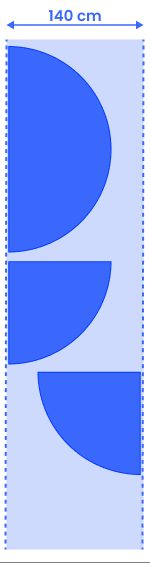
Full circle skirt cutting layout showing one half-circle and two quarter-circle pieces along a 140 cm wide fabric roll.

3. Change the skirt type

If you’re short on fabric, the quickest fix is to switch to a different skirt type. Switching from a full circle to a half-circle instantly reduces the width you need, or from a half-circle to a quarter.

✂️ Keep in mind the bias stretch
The more your pattern pieces lie on the bias, the more the fabric will drape and stretch over time. Using more panels keeps more of the pattern on the straight grain, giving the skirt greater
stability and a more predictable hem.

Let’s get practical. Imagine you want a floor-length (maxi) full circle skirt. This step-by-step example shows you exactly how much fabric you need for a circle skirt — and why the circle skirt measurements may surprise you.

Step 1: Gather your measurements for your circle skirt

For this example, let’s use these example measurements:

  • Waist circumference: 80 cm
  • Desired length: 100 cm (maxi length)
  • Hem allowance: 2 cm

Step 2: Calculate the waist radius

For a full circle, we use the formula:

Radius=Waist/(2×π)2 cm=80 cm/(2×π)2 cm=12.7 cm2 cm=10.7 cm\begin{aligned} \text{Radius} &= \text{Waist} / (2 \times \pi) - 2\text{ cm}\\ &= 80\text{ cm} / (2 \times \pi) - 2\text{ cm}\\ &= 12.7\text{ cm} - 2\text{ cm}\\ &= \mathbf{10.7\text{ cm}} \end{aligned}

Let’s round it to 11 cm to be safe. This is the inner radius of your pattern. The  2 cm-\ 2\rm cm accounts for the seam allowance at the waistband, so you have enough fabric to fold and finish the edge cleanly.

Step 3: Find the total radius

Now we add everything up to see the size of our “fabric donut”:

 ⁣ ⁣ ⁣ ⁣ ⁣Total radius=Radius+Length+Hem=11 cm+100 cm+2 cm=113 cm\!\!\!\!\!\begin{aligned} \text{Total radius} &= \text{Radius} + \text{Length}+ \text{Hem}\\ &= 11\text{ cm} + 100\text{ cm} + 2\text{ cm}\\ &= \mathbf{113\text{ cm}} \end{aligned}

This result represents the total outer skirt radius, including the hem allowance. This is the most important circle skirt measurement for figuring out how much fabric you need.

Does it fit the fabric width? 🧐

If your fabric is 140 cm wide, and your TR is 113 cm, you have a problem.

  • A full circle needs TR × 2 (one for each side of the center).
  • 113 cm × 2 = 226 cm.

Since 226 cm is much wider than your 140 cm fabric, you cannot cut this as one single piece. You could use the two half-circles method we mentioned before.

Step 4: The final fabric count

Each half-circle fits in a rectangle of TR × 2TR. The long side (2TR = 226 cm) runs along the length of the fabric roll, and the short side (TR = 113 cm) fits within the 140 cm width. To make these two half-circles, you'll need to buy:

  • TR × 4
  • 113 cm × 4 = 452 cm.

Verdict: You need 4.52 meters of fabric.

💡 To skip the manual math entirely, use our circle skirt calculator; it handles all of this automatically.

Fabric yardage chart: comparing circle skirt types and lengths

These numbers change depending on skirt type and length. Assuming a waist of 80 cm, here are the total radius values for each case:

Total radius (TR) by skirt type and length

Skirt type

40 cm

60 cm

80 cm

100 cm

Full circle

52.7 cm

72.7 cm

92.7 cm

112.7 cm

Half circle

65.5 cm

85.5 cm

105.5 cm

125.5 cm

And here’s how that translates to fabric length, assuming 140 cm wide fabric:

Fabric length needed (140 cm wide fabric)

Skirt type

40 cm

60 cm

80 cm

100 cm

Full circle

1.05 m

1.45 m

3.71 m

4.51 m

Half circle

1.31 m

1.71 m

2.11 m

2.51 m

Note the jump in the full circle between 60 cm and 80 cm. At 40 cm, the diameter still fits within the 140 cm fabric width, so you only need 2TR of fabric. At 60 cm, it no longer fits, so you need to adapt your layout — cutting two half-circles is the most common solution, but not the only one.

For the half-circle, the TR fits within the fabric width for all lengths in this example, and the diameter runs along the length of the roll. That’s why the yardage increases steadily without any jumps.

Use this fabric yardage chart as a starting guide; your final fabric needs will depend on your circle skirt measurements.

💡 If you’re planning other sewing projects, the fabric calculator and roll length calculator can help you estimate fabric needs.

Before you go fabric shopping, run through this list. Each question affects how much fabric for a circle skirt you actually need to buy.

Question

Why it matters

Which circle type did I choose?

Determines your waist radius and total fabric area

What length am I making?

Directly affects your TR and whether the pattern fits your fabric width

What is the fabric width?

Controls whether you can cut in one piece or need to split the pattern

Will I line it?

Doubles your fabric estimate

Do I want structure or fluidity?

Circle skirt material affects fabric type choice, which affects cost and behavior

Do I care about print matching?

May require extra fabric to align at seams

Is my fabric directional, or does it have a nap?

Restricts layout direction and increases yardage

🙋 Once you’ve nailed your fabric math, the next step is preparing to cut. Head over to Decisions to make before cutting your circle skirt to make sure everything is ready before you pick up the scissors — and then Cutting and sewing your circle skirt like a pro to bring it all together.

🔎 For a skirt type alternative that uses fabric very differently, check out our pleated skirt calculator.

This article was written by Gabriela Diaz and reviewed by Steven Wooding.