Planning a Circle Skirt: Fabric Width, Pockets, Waistband, and Lining
A polished circle skirt, more than advanced sewing skill alone, is the result of decisions made calmly and strategically before the scissors ever touch the fabric.
Before cutting, pause. Decide on structure, seams, pockets, closure, waistband, lining, silhouette, and length. Once the fabric is cut, the margin for correction becomes very small. Many of those decisions cannot be reversed without compromising drape, balance, or finish.
This article focuses on those structural choices: the ones that determine whether your skirt looks intentional and polished, or improvised.
🙋 If you haven’t decided on your circle type yet, start with our article on choose the right circle skirt.
The first decision is structural: will the skirt be cut as a single piece, constructed with side seams, or divided into panels?
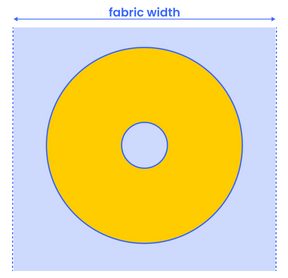
A one-piece circle skirt offers a clean, uninterrupted silhouette. However, it typically requires a back closure and limits the possibility of side seam pockets. It also demands enough fabric width to accommodate the full pattern shape, which is not always practical.
![]() |
|---|
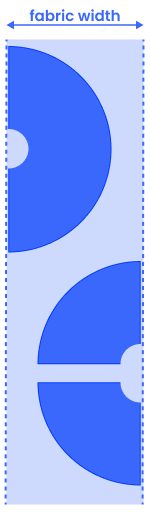
A circle skirt with side seams gives you more construction flexibility than a one-piece cut. It allows for easier zipper placement and enables in-seam pockets. It also gives you more control over fit adjustments during assembly.
![]() | ![]() |
|---|
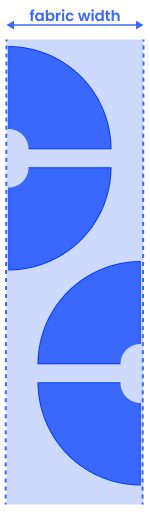
Paneled circle skirts are often the most practical solution when fabric width is limited. They also provide better control over fabric placement with directional prints or expensive materials. And while panels can work as a design feature, they are often a structural decision driven by fabric width.
This decision influences everything that follows, from pocket placement to waistband construction.
✂️ Fabric width check:
Before deciding on a structure, measure your fabric width and compare it to twice your skirt radius. If it does not fit as a single piece, side seams or panels become necessary.
Pockets are not an afterthought in a circle skirt. They must be planned before cutting because they alter the pattern shape and require seams to be inserted correctly.
Circle skirt pockets need side seams. If you cut a one-piece skirt and later decide you want pockets, you will need to modify or recut the garment.
There’s also a grain line issue. If you cut your circle first and then decide to divide it into panels, you'll need to locate the straight grain before cutting again. If you plan the panels before cutting, you can place each pattern piece deliberately so the seam lines align with the straight grain.
Bias sewing is something even experienced sewists avoid when possible. The fabric stretches as you sew, and the finished seam tends to go wavy, which on a structured piece looks unfinished or "homemade". Plan your panels before you cut, and you avoid the problem entirely.
✂️ Pockets decision:
- If you want pockets → You need side seams.
- If you want a seamless silhouette → Skip the pockets.
The type of closure depends on your structural layout.
A one-piece skirt typically requires a back zipper. If you include side seams, a side zipper becomes an option. An elastic waist eliminates the need for a zipper, but it alters the overall aesthetic and level of formality.
There are also hybrid options, such as a flat front waistband with elastic in the back. Each variation affects comfort, fit, and the finished skirt's polish.
Quick reference:
- One-piece skirt: back zipper or elastic waist.
- Side seams: side zipper or invisible zipper.
- Elastic waist: no zipper needed, but a more casual result.
- Hybrid waistband: structured front, elastic back.
The circle skirt waistband is one of the first details people notice, and it determines whether the skirt looks structured or casual.
-
A structured waistband usually requires interfacing to maintain shape. Without it, even well-sewn garments can look soft or unfinished at the waist.
-
An elastic waistband simplifies construction because it eliminates the zipper and the interfacing, and the waistband itself is quicker to assemble. The tradeoff is that it creates gathers and a more casual silhouette.
-
Hybrid waistbands sit somewhere in between: structured in the front, elastic in the back, which works well when you want comfort without losing polish.
Interfacing and lining are not the same thing, and understanding the difference before you cut can help you avoid the wrong choice for your fabric.
Interfacing
Interfacing adds structure to specific areas. In a circle skirt, it is most commonly used in the waistband to prevent it from collapsing. You can also interface the body of the skirt, which stiffens the fabric and gives it a more structured, couture feel. This technique is less common in everyday skirts, but worth knowing as an option.
Lining
Lining serves different purposes. It adds opacity to sheer fabrics, protects your skin from scratchy materials, protects the fabric from contact with skin and sweat, adds body to fabrics, and gives the inside of the skirt a clean, finished look by hiding the seams.
There are a few ways to approach circle skirt lining. You can cut the lining from the same pattern as your skirt, whether it’s a full, half, quarter, or three-quarter circle. That lining can be attached only at the waist, so both layers hang freely, or you can sew it to the outer fabric entirely.
✂️ Lining tip:
The lining should not be cut to the exact same size as the outer skirt. It needs a small amount of extra ease so it moves freely inside without pulling or puckering the outer fabric.
🔎 If you already own a slip or underskirt, you can skip the lining. This option also makes the skirt more versatile across seasons since you can layer or not, depending on the temperature.
Length affects how much fabric you need, how complex the hem will be, and how the skirt moves.
Hem yardage
To measure your desired length, hold a tape measure at your waist and let it hang down to where you want the hem to fall. That measurement, along with the waist radius and seam allowances, determines how much fabric you need. A longer skirt means a larger outer circumference, which means more hem to finish and more of that hem falling on the bias.
🙋 Knowing how to hem a circle skirt correctly starts with choosing the right finish for your fabric weight. Hemming a circle skirt is not the same as hemming a straight skirt.
Bias stretches
In a shorter skirt, the effect is more manageable, but in a longer one, it is more noticeable. Some sewists recommend letting the skirt hang on a dress form or hanger for at least 24 hours before marking and cutting the final hem, since the bias sections can drop between 1 and 2 inches. If you do this, mark the hem after hanging, not before.
🔎 Use a circle skirt fabric calculator to calculate exactly how much fabric your chosen length requires before you buy.
Use this as your planning checklist before touching the fabric:
☐ Structure: one piece, circle skirt with side seams, or panels?
☐ Circle skirt pockets: yes or no? (If yes, side seams required.)
☐ Closure: zipper (back or side) or elastic waistband?
☐ Circle skirt waistband: structured with interfacing, elastic, or hybrid?
☐ Interfacing: waistband only, or body of the skirt as well?
☐ Circle skirt lining: full circle lining, flat lining, or none?
☐ Length: final measurement decided and accounted for in fabric calculation?
Once these decisions are made, head to our article for cutting and sewing tips.
This article was written by Gabriela Diaz and reviewed by Steven Wooding.