
Choosing the right circle skirt type: quarter, half, three-quarter or full circle?
Maybe you’re about to start a new sewing project and have decided it’s finally time to try a DIY circle skirt. You search for a circle skirt sewing pattern and immediately find several options: quarter, half, three-quarter, and full. At first glance, they all seem like slight variations of the same idea, just with more or less fabric.
But they don’t look or behave the same. Each circle skirt type has its own geometry, and with it, a different visual effect, versatility, and overall feel. The amount of fabric for a circle skirt pattern varies with each version, which directly affects the volume, weight, how the skirt moves, and how wide or dramatic it appears on the body.
Before choosing a pattern or using a circle skirt calculator, you need to decide what kind of shape, volume, and feel you want your skirt to have, and what challenge level you want based on your expertise. Once that’s clear, everything else follows.
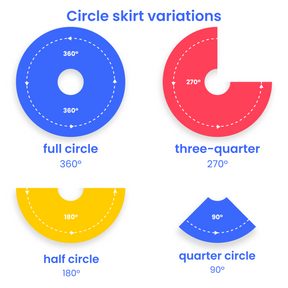
When we talk about quarter-, half-, three-quarter-, or full-circle skirts, we’re describing how the skirt is drafted. The name refers to the portion of a circle used to create the waist opening.
If you think in terms of a full circle being 360°, each circle skirt pattern simply uses a fraction of that circle:
- Quarter circle skirt: 90°
- Half circle skirt: 180°
- Three-quarter circle: 270°
- Full circle skirt: 360°
 |
View image fullscreen. |
So yes, more degrees create more flare and volume. The larger the portion of the circle, the more the skirt opens outward from the waist, creating a wider, more dramatic silhouette.
Not sure which circle skirt type is right for you yet? Keep reading — by the end of this guide, you’ll know exactly which one to pick for your circle skirt DIY project.
On paper, all circle skirt types start as variations of a circle. Once you wear them, however, they look, move, and feel very differently.
Type | Degrees | Volume level | Flare start | Movement | Everyday wear |
|---|---|---|---|---|---|
Quarter | 90° | Low | Near hips | Subtle | High (low maintenance) |
Half | 180° | Medium | Mid-hips | Soft | High (versatile) |
3/4 | 270° | Medium-High | Above hips | Flowing | Moderate (flowy) |
Full | 360° | High | At waist | Dramatic | Low (vintage look/statement) |
Each type of circle skirt pattern differs in multiple ways:
- Volume level: quarter circles have low volume, half and three-quarter skirts increase progressively, and full circles maximize fullness.
- Flare start: the point where the skirt begins to open changes the silhouette. From subtle flare near the hips in quarter skirts to dramatic flare starting at the waist in full circles.
- Movement: more fabric and higher flare points give flowing or dramatic motion, while smaller circles create subtle, controlled movement.
- Everyday wear: less fabric and subtler flare make quarter and half circles easier to wear daily, whereas full circles are best for special occasions due to their bold presence.
Now that you know how the patterns differ in cut, it’s time to see how they behave on the body. It’s a common idea to assume that more circle skirt material automatically means a more beautiful or flattering skirt. The image of a big, dramatic, princess-like silhouette can feel appealing. But more volume isn’t always more flattering, and it’s not always practical for your at-home circle skirts DIY project. Understanding how flare, waist placement, and fabric interact can help you choose the style that works best for you.
🙋 If you want to go deeper into the math behind each circle skirt type, check out our guide on Fabric math for circle skirts: how much fabric do you really need?
Geometry
A full-circle skirt spreads fabric evenly around the waist, so the flare starts right at the waistband. If your waist-to-hip transition is short, or your lower abdomen projects slightly, the extra fabric can create soft horizontal folds that add visual width.
Quarter- and half-circle skirts delay the flare. The fabric falls closer to the hips before opening, often creating a cleaner vertical line and a more controlled silhouette.
Waist placement
Waist height also plays a role. A higher waist starts the flare at a narrower point, increasing contrast, while a natural or slightly lower waist aligns the expansion closer to the upper hip. Small changes in placement can noticeably change the proportions of your skirt.
Fabric
Fabric choice is another key factor. Structured circle skirt materials like cotton, taffeta, or denim hold shape and create a more defined silhouette, while softer fabric for circle skirt projects like rayon, crepe, or chiffon drape more freely, reducing bulk and creating a softer flow. The same circle skirt sewing pattern can feel completely different depending on the material, so consider your fabric carefully when planning your project.
💡 The goal isn’t to use less fabric, it’s to pick the flare, placement, and fabric that achieve the look and balance you want. Planning with this in mind helps you avoid surprises and ensures your finished skirt behaves the way you imagined.
There’s one technical detail we can’t ignore: the bias stretch. Because circle skirts are cut from a circular shape, large sections of the fabric will end up being “on the bias” (diagonal to the grainline).
Fabric is naturally more elastic on the diagonal. This property means that once you hang your skirt, gravity will pull on those bias sections, causing them to stretch and become longer than the parts on the straight grain.
Full circle has the most bias sections, meaning it’s the most likely to “grow” and end up with an uneven hem.
💡 Pro tip: Let your circle skirt “rest” on a mannequin or hanger for at least 24 hours before hemming. This step allows the fabric to stretch as much as it wants before you level and cut the hem.
On the other hand, the quarter circle has very little bias, making it much more stable and easier to hem immediately.
🧵 Beginner friendly:
Start with a half-circle; it’s the perfect balance of “flare” and ease of sewing.
A common assumption is that more degrees always means buying more fabric. That’s mostly true, but incomplete. The actual yardage you need depends not just on the area of your pattern, but also on how it fits within the width of your fabric.
Fabric is sold in fixed widths, typically 110 cm, 120 cm, or 140 cm. Your pattern has to fit within that width. And depending on your total radius, the math can surprise you:
- If your total radius fits within half the fabric width: you can fold the fabric and cut the full pattern in one efficient block. In this case, a full circle may not require as much extra yardage as you’d expect.
- If your total radius exceeds half the fabric width: you’ll need to cut the pattern into 2, 3, or more separate pieces and use more linear yardage to accommodate them, regardless of how many degrees your skirt is.
✂️ Don't estimate by degrees alone
More degrees generally means more total fabric area, but actual yardage depends on your fabric width and how the pattern pieces lay out. Use the fabric calculator or roll length calculator to get an accurate estimate before buying.
Once you’ve chosen your circle skirt type, you can explore the decisions to make before cutting your circle skirt and tips and tricks for cutting and sewing your circle skirt.
Alright, so you’re here because you want to make a circle skirt, but you’re realizing quickly that there’s more to it than just unquestioningly picking a pattern. We’ve mentioned quarter, half, three-quarter, full, and that each behaves differently. Some add drama, others are more subtle, and some are perfect for everyday wear. Before calculating waist radius or fabric yardage, it helps to ask a few practical questions so you can pick a pattern that truly fits what you’re looking for.
Use the guide questions below to make your choice with confidence!
1. How much visible flare do you want?
- Minimal width and clean lines → Quarter circle
- Soft movement, versatile and wearable → Half circle
- Noticeable movement with more volume → Three-quarter circle
- Strong, vintage-inspired movement with dramatic volume → Full circle
2. Where will the skirt sit?
- High waist → Stronger contrast and emphasizes proportions
- Natural waist → Feels more balanced and easier to wear daily
3. What type of fabric are you planning to use?
- Structured → Sharper flare, more volume, defined silhouette
- Fluid → Softer drape, less visual bulk
4. Uniform flare all around, or more control over the shape?
- Uniform flare → Circle skirt
- Controlled shaping over abdomen → Consider panels or pleated skirts
5. Versatility: everyday wear or special occasions?
- Less volume → More versatile, easy for daily wear, less dramatic
- More volume → Better for events or statement pieces, adds drama
6. What’s your budget?
- More degrees generally means more total fabric area, but actual yardage depends on your fabric width and how the pattern pieces fit within it.
- Fabric type affects cost too: an inexpensive cotton keeps costs low even for a full circle, but premium fabrics make larger patterns significantly more expensive.
7. How much mobility do you need?
- Less fabric = More freedom? A full circle actually allows easy walking and spinning because the fabric falls freely; it’s tight cuts, like those in pencil skirts, that restrict movement.
- That said, a full circle can feel heavier and more voluminous to wear all day.
8. What’s your experience level?
- Folds hide mistakes: full circle volume camouflages uneven hem seams.
- The bias challenge: more fabric = more bias stretch, making it harder to level the hem.
- Project stamina: A full circle hem can be massive; it takes much more patience than a half or quarter circle.
This article was written by Gabriela Diaz and reviewed by Steven Wooding.