Logic and Venn Diagrams: How to Read and Understand Them Correctly
Do you ever feel lost trying to understand the differences and similarities between two or more statements? This is a logical problem that can be easily represented and understood using the famous Venn diagrams.
These diagrams are composed of intersecting circles, where each circle corresponds to a specific set of information. Are you searching for a tool dedicated to logic operations? Then, access our amazing truth table generator.
However, if you would like to learn more about Venn diagrams and their connections to Boolean logic, then keep reading this article. Here we will explore in detail the following subjects:
- What is a Venn diagram?
- How to create a Venn diagram — Examples of intersecting circles
- The four types of Venn diagrams
- How do I read a Venn diagram?
- What does ∩ mean in Venn diagrams?
- What is the difference between Euler and Venn diagrams?
- And much more.
So, let’s make some circles and show how logic can be simple and intuitive when we use the Venn diagrams.
💡 If you need to calculate values of a Venn diagram, check out the Venn diagram calculator, which supports two and three-set Venn diagrams.
As we mentioned, Venn diagrams are circles that represent logical relations among one or more sets. The diagrams were created by John Venn, an English mathematician and philosopher, in 1880. They were inspired by the famous Euler diagrams, developed by Leonhard Euler in 1768.
An interesting feature of Venn diagrams is the use of intersecting circles, as seen in the stained-glass window of Gonville and Caius College at Cambridge University.
![]() |
|---|
This intersection allows us to easily describe logical relations with diagrams, as we will show you with different examples.
Before going to the examples, let us present to you the elements that you may see in two-dimensional Venn diagrams:
- The Universe (U): It is represented as a rectangle around the diagrams, encompassing all the information they describe.
- The sets: the different circles in your diagram. Each set refers to specific information.
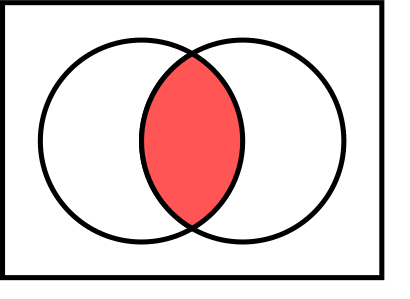
- The intersection (A∩B): The overlapping areas between the circles. In logic, this region corresponds to the AND operation.
- The union (A∪B): The area covered by both sets A and B. In logic, it is equivalent to the OR operation.
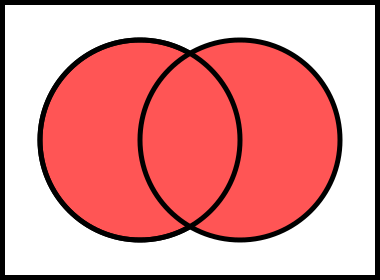
We can visualize examples of intersection and union diagrams in the figures below. There, the rectangle represents the Universe, and the regions in white, which are outside the sets, are equivalent to the NOT operation in Boolean logic. If Boolean logic seems Greek to you, check out our article “What is a Boolean Algebra?” to learn more about it.
In principle, the diagrams seem restricted to mathematical or theoretical purposes. However, as we will show you, you can apply the diagrams to different contexts of our daily lives.
🙋 You can master your abilities in logic by reading our articles: “What is a Logic Gate?” and “How to Make a Truth Table”.
Now that you know more about the Venn diagrams, let us show you some interesting examples.
Suppose you need to log in to one of your email accounts but do not remember the correct password. You can create several secure passwords, but it will be hard to memorise them if you use them just once or twice. Therefore, we can describe this problem as the following sets:
- A: the set of secure passwords;
- B: the set of passwords that you remember.
The intersection A∩B is the set of secure passwords you still remember. Unfortunately, in this case, you will likely need to create a new secure password to avoid having your account blocked.
Let’s see another practical example based on a dinner. Suppose that you want to make dinner and that you have three options:
- A: Use the ingredients that you have at home;
- B: Eat healthy food; or
- C: Eat something that you really like.
Then, if you decide to make a vegetable soup with chicken, you will have an intersection between the three circles. If you make a hot dog, then you have an intersection between A and C. However, if you decide to order a pizza, you are in a scenario that is only present in set C.
Of course, we can also have an example based on numbers. Given the sets:
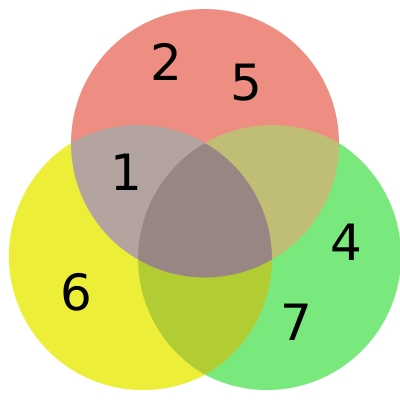
A={1,2,5}B={1,6}C={4,7}
By looking at these sets, we realise that the intersecting region is:
A∩B={1}
which is shown in the Venn diagram below. In this diagram, it is also possible to observe that the three circles overlap, despite having only one non-zero intersecting region. This is the main difference between the Euler and the Venn diagrams in representing sets.
As you can see, it is really easy to implement mathematics, logic, and Venn diagrams in our daily lives.
Maybe you have heard about the four types of Venn diagrams. Actually, this is referring to four logical relationships that the diagrams can illustrate. The logical arrangements are:
-
Subset: representing the statement that all A is B. So, if A is a small circle, you will draw it entirely inside a large circle B.
-
Disjoint: representing A is different from B. In this case, you will have two separate circles, one for A and the other for B. You can also draw the circles intersecting each other, but the overlap region needs to be empty, since A∩B = 0.
-
Overlap: stating that part of A is B. Therefore, you will draw two circles that are partially overlapped. This one is the classic example of a Venn diagram.
-
Exclusion: stating that part of A is not B. This type is quite similar to the overlap case, but you will focus on the part of A that is not part of B. In this case, you draw two intersecting circles, but highlight the section of A that is not overlapping B.
🙋 If you are looking for more tools on logic, access our logic gate calculator and possible combinations calculator
To read a Venn diagram, you first need to identify the different sets and regions of it. First, count the number of sets (“circles”); then you can see the overlapping and excluding regions. You also need to know the Universe of your diagram so you can better understand the features of each part.
The symbol ∩ means intersection. It denotes the overlapping region between two or more sets in a Venn diagram. You can think about it as the “football” or almond-shaped area between the circles. As an example, take A as the set of birds and B as the set of creatures that can fly. Then an eagle is in the intersection A∩B, a penguin is only part of the set A, and a bat is only in the set B.
The Euler and Venn diagrams are quite similar. In fact, Venn referred to his diagrams as Eulerian circles because they were inspired by the Euler diagrams. Both diagrams use circles to represent the different sets. The main difference between them is that the Venn diagrams admit all the logical intersections between sets, including those that are empty. In the case of the Euler diagrams, if A∩B = 0 then the two sets are drawn separated. That means that you never draw an intersection if that intersection doesn't exist in an Euler diagram.
This article was written by João Rafael Lucio dos Santos and reviewed by Steven Wooding.