
Credibility in Popularizing Science
Ever wondered what would actually happen to your body moving at the speed of light, or how many helium balloons it would take to lift you off the ground? Whether you’re trying to figure out the physics of everyday stuff, see how probable alien civilizations might be, or prove to your friend that the Earth really is round, we’re right there with you. If you’re curious about how the world works, our science team is here to help you figure it out. | |
At Omni, we try to translate complex academic research into something you can actually use. Science really doesn’t have to be intimidating or buried in dense jargon. We just want to make these concepts easy to grasp, fun to play with, and most importantly, accurate. | |
Our tools are built by a dedicated team of PhD-level researchers, active academics, and massive science enthusiasts. Thanks to them, you can trust that the math and the facts behind our calculators are completely solid. | |
We double-check everything we publish so that you can safely go down your next curiosity rabbit hole, actually learn something new, and easily dodge the scientific misinformation floating around online. |
Meet our team of experts in popularizing science:
 | João Rafael Lucio dos Santos, PhD |
João earned his doctorate from the University of Rochester. Now a university professor in Brazil, he brings extensive expertise in field theory, cosmology, and astrophysics to his science communication efforts. As creator of the warp speed calculator, he’s also popularized science fiction. | |
| |
 | Joanna Śmietańska-Nowak, PhD |
Joanna is a physics lecturer at AGH University of Kraków. Her diverse research experience spans protein crystallography, photocatalysis, and advanced energy storage systems, including supercapacitors and lithium-ion batteries. | |
| |
 | Hanna Pamuła, PhD |
Hanna serves as the Head of Calculators at Omni. She holds a doctorate in bioacoustics and mechanical engineering from AGH University, where she applies innovative machine learning techniques to detect and study bird calls. Her calculators include the plastic footprint calculator and meat footprint calculator. | |
| |
 | Dominik Czernia, PhD |
Dominik earned his doctorate in physics from the Institute of Nuclear Physics in Kraków. As a specialist in condensed matter physics, he focuses primarily on the fascinating and complex field of molecular magnetism. At Omni, he’s applied hard science to his humans vs. vampires and zombie invasion calculators. | |
| |
 | Anna Szczepanek, PhD |
Anna is a mathematician at the Jagiellonian University in Kraków. Bridging the gap between abstract numbers and the physical world, she focuses her academic research on mathematical physics and applied mathematics. She applied her math skills to help you create the perfect snowman in her snowman calculator. | |
| |
 | Álvaro Díez |
Álvaro is an eclectic physicist who earned his Bachelor's in Fundamental Physics from the University of Cantabria. Having completed a year-long internship at CERN, he now applies his diverse expertise to create engaging and accessible science calculators. He created our chilled drink calculator to reveal the everyday physics behind perfectly cooling your favorite beverages. | |
| |
 | Wojciech Sas, PhD |
Wojciech holds a doctorate from the Institute of Nuclear Physics PAN in Kraków. He currently works as a physicist in Zagreb, investigating how various materials behave under extreme conditions like low temperatures and high pressures. At Omni, he explored the physics of pancakes in his perfect pancake calculator. | |
Whenever major science journalists, educational sites, and digital media outlets need to explain tricky concepts or put numbers to the unimaginable, they can turn to Omni’s tools for help. We’re genuinely proud that some of the most trusted names in science communication regularly use our calculators to provide the math behind their articles. | |
By applying precise calculations to everyday contexts, we help these publishers share the fun side of science with millions of readers around the world. You can check out some of the places where our popular science tools have appeared in the media below. |
Science and Astronomy
From the dizzying scale of ultramassive black holes to the mind-bending theories of special relativity, the cosmos is full of wonders. Top publishers in this space trust Omni to help their audiences conceptualize the universe. Outlets like ScienceAlert, Space.com, Live Science, and Scientific American consistently feature our calculators to explain everything from the speed of light to the search for extraterrestrial intelligence. Here is where our tools have helped demystify the stars and the natural world: |
 | Science Alert | ||
 | Phys.org | ||
 | Universe Today | ||
 | Live Science | ||
 | Science News | ||
 | Scientific American | ||
 | New Scientist | ||
 | Popular Science | ||
 | Big Think | ||
Technology, Mechanics, and Engineering
Innovation drives the modern world, but the math behind groundbreaking engineering and everyday mechanics can be remarkably complex. Renowned publications, such as Popular Mechanics, Interesting Engineering, and TechCrunch, often link to Omni when they need to explain the incredible engineering required to drive a convertible at 282 MPH or to simulate virtual reality for livestock. We help quantify the technology that shapes our future. Explore where our engineering and mechanics tools have been featured: |
 | Interesting Engineering | ||
 | Popular Mechanics | ||
 | TechCrunch | ||
 | Futurism | ||
 | HowStuffWorks | ||
International Science Portals
Science is a universal language, and our commitment to popularizing it extends far beyond the English-speaking world. Respected international science portals turn to our tools to engage their local audiences with accurate, localized scientific data. Whether it’s Futura in France discussing the mathematical probability of alien civilizations, Spektrum in Germany analyzing the limits of human heat tolerance, or Xataka in Spain calculating literal geographic antipodes, Omni is a trusted global resource. Discover some of our international features here: |
 | Futura | ||
 | Spektrum | ||
 | Xataka |
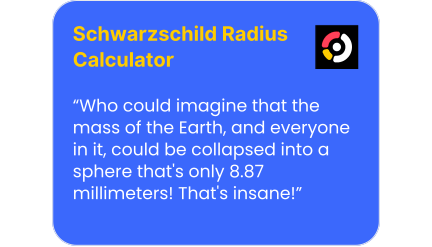
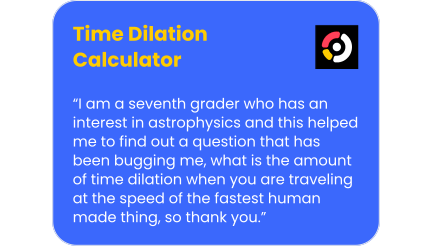
Science is at its absolute best when it is interactive, deeply personal, and highly engaging. Every single day, inquisitive minds from around the globe use our popular science calculators to settle friendly debates, explore fascinating what-if scenarios, and debunk pervasive internet myths. | |
Here is a selection of feedback from the curious individuals who use our popular science tools to explore the universe every day: |
 |  |  | ||
|---|---|---|---|---|
| ||||
 |  |  |