
Table of contents
The Mental Health Benefits of Having a Dog: A Guide for Humans
Report Highlights
The mental health benefits of having a dog go far beyond the simple joy of coming home to a wagging tail. While we’ve all heard that a dog is (wo)man’s best friend, understanding the health benefits of owning a dog requires looking at the quantitative data articles on dog owners and mental health that prove that our pets can indeed help with our mood and mental issues — and that’s exactly what we did in this article.
Whether you are interested in how dogs and mental health intersect or are specifically looking for how mental health service dogs work, we designed this guide to help you navigate the profound connection between our psychology and our pets.
Beyond the joy dogs bring to a home, there is ample rigorous scientific research supporting the mental health benefits of having a dog. Keep reading to explore how our four-legged friends become powerful allies in the fight against stress, anxiety, and depression.
One of the most notable contributions pets make to our lives is their ability to relieve anxiety. But are dogs good for mental health in a measurable, scientific way? Yes — Simply petting a dog or playing with it can trigger the release of endorphins and oxytocin, the feel-good hormones, while lowering cortisol levels, the stress hormone.
💡 While all dogs offer support, some breeds are biologically predisposed to higher levels of emotional intelligence and focus. Read our article: “Most Intelligent Dog Breeds: Where Does Your Pet Rank? (7 At-Home Tests)” to see how your dog’s cognitive strengths align with your mental health journey.
Beyond this hormonal surge, researchers are now discovering that our biological connection to dogs extends directly to the architecture of our brains. The fact that your dog helps you relieve anxiety isn’t just a feeling; it’s a neurological dance.
A 2024 study by researchers at the Chinese Academy of Sciences used electrodes to measure brain activity and discovered that dogs’ brains actually sync with ours when we gaze into their eyes. When you pet your dog or lock eyes with them, the frontal and parietal regions of both your brains begin to pulse in the same rhythm.
For those struggling with chronic tension, dogs and mental health go hand-in-hand because of this mirroring effect. The study found that the human brain actually initiates this neural sync, which then pulls the dog’s brain into the same state of emotional engagement. That’s why helper dogs for anxiety are so effective; they don’t just sit by you, they physically and neurologically plug into your nervous system, helping to pull you out of a fight or flight state.
🚨 New feature coming soon: Build the tools your dog needs
Soon, Omni registered users will be able to design, edit, and share custom calculators tailored to their dog's specific breed, age, and health journey (and more!). Sign up for an Omni Account now and never miss a beat in your dog’s wellbeing.
Living with a dog provides constant companionship, which is particularly beneficial for those who feel socially isolated. Dogs and depression are a major focus of quantitative data articles on dog owners and mental health, which consistently show that the unconditional love and loyalty dogs provide create a deep sense of security.
However, the benefit goes deeper than just feeling happy. A 2022 study used functional near-infrared spectroscopy (fNIRS) to prove that interacting with a dog significantly increases activity in the prefrontal cortex (i.e., the part of the brain responsible for executive functions like attention, planning, and emotional regulation). While a plush animal elicited some response, the study found that a live dog stimulated much higher brain activity, especially during active petting.
❗ Before rewarding your dog for being a good mental support, check our safety tools:
- 🍫 Dog chocolate toxicity calculator;
- 🍇 Dog raisin toxicity calculator; and
- 🧅 Dog onion Ttxicity calculator.
You can also head over to our related article: “How Much Chocolate is Toxic to Dogs? The “Hidden Danger” Kitchen Checklist”.
Because the mental health benefits of having a dog include providing a sense of purpose, they act as a ray of hope for those in a depressive episode. When a person is depressed, the prefrontal cortex can become underactive, leading to brain fog and rumination. The requirement to care for a dog, such as feeding, walking, and playing, forces the brain to engage with these executive tasks, essentially rewiring the brain to focus on the future and the needs of another living being. Dogs-and-depression studies suggest that this daily presence, combined with the tactile grounding of feeling a dog’s fur, can help break the cycle of emotional withdrawal.
🔎 While dogs bring us a ray of sunshine, we must remain vigilant about theirs. As dogs age, they may develop canine cognitive dysfunction, a condition similar to Alzheimer’s in humans. It’s a progressive decline that goes beyond normal aging. If you are worried about your senior pet, check our guide on “The Expected Lifespan of Dogs by Breed and Size: The Senior Dog Manifesto” and our dog quality of life calculator to monitor their mental decline.
For some, a standard pet isn’t enough to manage debilitating symptoms. This is where a service dog for mental health becomes essential. Unlike emotional support animals (ESAs), which provide comfort through presence, a service dog for anxiety or a service dog for PTSD is a working partner undergoing 12 to 24 months of rigorous, specialized training to perform mitigation tasks that directly combat psychiatric symptoms.
What are the benefits of owning a dog for psychiatric support?
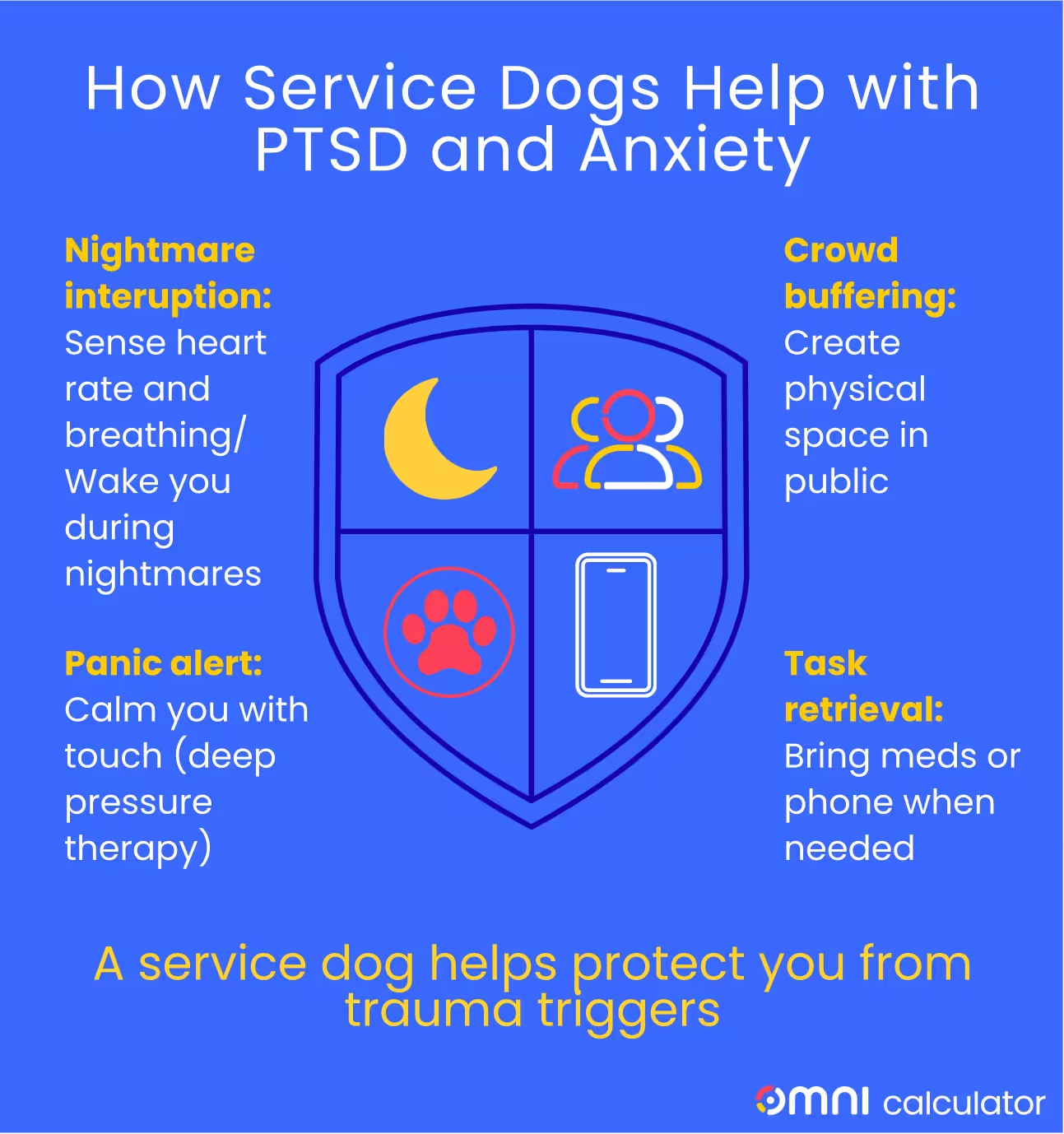
When asked about the benefits of owning a dog, many realize that mental health service dogs offer literal life-saving interventions. For those living with trauma, the intervention is often tactical rather than just emotional. So, what are the benefits of owning a dog for psychiatric support?
-
🛡️ Nightmare interruption: These dogs are trained to sense the subtle rise in heart rate and respiratory distress during sleep. The dog will physically nudge or lick their owner to wake them before a night terror fully takes hold.
-
🛡️ Crowd buffering: Often acting as stress and anxiety service dogs, they are trained to create physical space in crowded areas, reducing the owner’s hypervigilance and panic.
-
🛡️ Panic alert and grounding: They recognize early signs of distress, such as leg shaking or shortness of breath, and intervene with pawing or deep pressure therapy (DPT) to bring the person back to the present.
-
🛡️ Safety checks: A service dog for PTSD can clear a room or turn on lights before their owner enters, providing peace of mind in environments that feel unsafe.
-
🛡️ Task retrieval: They can fetch meds or a phone during an emergency.
If you are wondering how to get a service dog for depression and anxiety, the first step is obtaining a recommendation letter from a licensed mental health professional. Knowing how to get a service dog for depression and anxiety involves a commitment to ongoing training and a stable home environment. While service dogs for anxiety and stress require a significant financial and time investment, they offer incomparable freedom for those recovering from trauma.
💡 Best emotional support dog breeds for anxiety and depression
While any dog with the right temperament can be an ESA, certain breeds are frequently cited as the best emotional support dog breeds for anxiety and depression due to their high intelligence, intuition, and soft nature:
- 🐕 Labrador Retrievers and Golden Retrievers: Known for being highly intuitive and having a natural desire to work for their owners;
- 🐩 Poodles: Highly intelligent and hypoallergenic; and
- 🐕🦺 German Shepherds: Naturally protective and loyal.
The mental health benefits of having a dog extend deep into our social lives. Therapy dogs and anxiety programs often use the social catalyst effect to help people re-engage with the world, but for the average owner, the benefit happens right on the sidewalk.
Experts call this the social lubricant effect. A 2025 study published discusses the concept of anchored personal relationships to explain this effect. These are relationships that exist solely within a shared time and place, like seeing the same person every morning at the park.
The study found that dog ownership significantly increases these anchored connections, which are easier to maintain than traditional friendships because they carry lower social costs. For someone struggling with social anxiety, these low-pressure, dog-centered interactions act as a buffer against loneliness. Studies indicate that these interactions lower the social friction that often prevents people with anxiety from leaving their homes. These interactions can increase feelings of belonging and reduce loneliness.
Physical health benefits: Beyond the steps
Furthermore, the health benefits of owning a dog include a massive increase in physical activity. According to quantitative studies on dog owners and mental health, dog owners spend an average of 300 minutes per week walking, double the recommended minimum for humans. You can use our dog walking benefits calculator to see exactly how these walks impact your metabolic health.
This regular exercise is vital for managing separation anxiety in dogs and keeping your pet fit, but for humans, it also leads to:
- Lower blood pressure and reduced resting heart rate.
- A 24% reduced risk of all-cause mortality (overall benefit from owning a dog), particularly from cardiovascular issues.
- Enhanced social capital, where neighborhoods with many dog walkers report higher levels of trust and lower crime rates.
While we focus on the mental health benefits of having a dog for ourselves, we must consider the issue from the other side. Caring for your dog’s mental health is just as important as their physical well-being.
Can dogs sense depression and anxiety?
Absolutely, but it goes much deeper than just sensing a mood. Scientists at Linköping University in Sweden have discovered the first evidence of a sort of hormonal synchronization. By measuring cortisol (the stress hormone) stored in the hair of both humans and their dogs, researchers found that dogs’ long-term stress levels mirrored those of their owners. Whether in summer or winter, owners with high cortisol levels had dogs with high cortisol levels.
Depression in dogs: Signs and symptoms
Since dogs are so close to us, they too can suffer from depression. The signs and symptoms of depression in dogs are often similar to those seen in humans:
- Low activity levels and a sudden loss of interest in favorite games.
- Changes in eating or sleeping habits (sleeping more than usual or refusing treats).
- Separation anxiety in dogs, which can lead to destructive behavior or excessive howling when you leave, as they feel the stress of the departure.
Managing anxiety and stress in your pet
If your pet is struggling, you might consider anxiety medication for dogs after consulting a vet. For minor stress during travel or storms, some owners use a benadryl dosage for dogs calculator for temporary relief. However, always ensure you are providing a stable environment first; sometimes the best medicine is a calm owner. For more on the basics, read our article: “The First-Time Dog Owner's Health Essentials”.
This article was written by Claudia Herambourg and reviewed by Steven Wooding.