
Omni Calculator logo

Table of contents

1. Half of workers have caught a manager leaning on AI

Survey: Half of Workers Have Caught Their Bosses Using AI (2026)

Add as preferred on Google

Report Highlights

  • Half (50%) of workers say their manager has used AI to answer a question or make a decision they should have handled themselves, including 42% who say it's happened more than once.
  • More than two-thirds (68%) say AI-generated messages from a manager feel less personal.
  • Over 4 in 10 (42%) say a manager who relies on AI seems less competent.
  • When workers can spot it, the top giveaway is a message that doesn't sound like the manager (45%), followed by a generic or robotic tone (40%).

Managers using AI to handle their own work is something half of US workers say they've already seen. In our 2026 survey of 913 employees, half (50%) say their boss has used AI to answer a question or make a decision they should have handled themselves.

Many workers can sense it, too, and a sizable share say it makes a manager feel less personal and less competent.

To start, we asked workers whether their manager had ever turned to AI for a question or decision they should have handled themselves.

Half (50%) say it's happened at least once. That splits into 42% who say more than once and 8% who say just once.

A quarter (25%) say it has never happened.
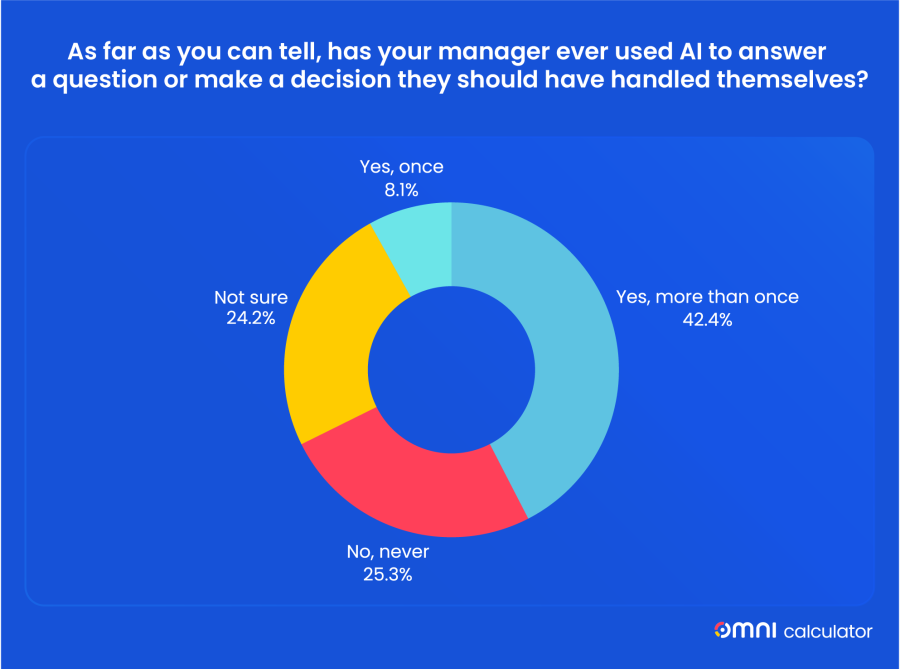
Donut chart showing 50% of workers say their manager has used AI for a question or decision they should have handled themselves
As far as you can tell, has your manager ever used AI (e.g., ChatGPT, Claude, or Gemini) to answer a question or make a decision they should have handled themselves?

If your manager’s recent feedback sounded a little too perfectly structured, you aren't alone.

Our data show that in the past year, 52% of workers have received an answer, decision, or piece of feedback that seemed to come from AI rather than their manager.

In the past 12 months, how often have you received an answer, decision, or piece of feedback from your manager that seemed to come from AI rather than from them?

Overall (2026)

Never

38%

A few times a month

15%

A few times a year

13%

Multiple times a week

12%

About once a week

12%

Not sure

10%

For 15%, it happens a few times a month, and 13% see it a few times a year. Another 12% field it multiple times a week, and 12% about once a week.

By contrast, 38% say it has never happened.

When managers do hand work to AI, two tasks lead: planning projects or workflows (35%) and day-to-day emails or chat messages (32%).

Writing a performance review or feedback follows at 27%, with setting strategy or goals at 26%.

Which of these has your manager handled using AI instead of doing it themselves?

Overall

Gen Z

Millennials

Gen X

Baby boomers

Planning projects or workflows

35%

40%

35%

33%

35%

None that I know of

34%

30%

32%

38%

33%

Day-to-day emails or chat messages

32%

38%

38%

26%

27%

Writing my performance review or feedback

27%

26%

31%

25%

24%

Setting strategy or goals

26%

26%

24%

26%

28%

Answering a work question I asked them

20%

25%

23%

15%

19%

Making a decision

18%

16%

23%

15%

19%

Resolving a conflict or sensitive issue

13%

15%

16%

10%

12%

Coaching or career advice

12%

16%

12%

10%

11%

Other

2%

3%

2%

3%

2%

Further down, 20% cite answering a work question they asked, 18% making a decision, 13% resolving a conflict or sensitive issue, and 12% coaching or career advice.

By generation, day-to-day emails or chat messages are cited by 38% of both Gen Z and millennials, compared with 26% of Gen X.

Answering a work question shows a similar split: 25% of Gen Z versus 15% of Gen X.

Next, we asked how often workers can spot AI in a manager's message.

It turns out more than half (52%) can, combining those who can sometimes (21%), usually (19%), or almost always (12%) tell.

When your manager sends you a message, how often can you tell it was written by AI?

Overall

Gen Z

Millennials

Gen X

Baby boomers

I can sometimes tell

21%

20%

19%

23%

19%

Not applicable

21%

23%

19%

22%

18%

I can usually tell

19%

15%

23%

16%

25%

I can never tell

17%

15%

16%

19%

15%

I can almost always tell

12%

17%

13%

9%

12%

I can rarely tell

10%

9%

9%

11%

11%

By generation, the share who can usually tell ranges from 15% of Gen Z to 25% of baby boomers.

What tips workers off is less about errors than about voice. The most common giveaway, cited by 45%, is a message that doesn't match the manager's normal tone, followed by a tone that sounds generic or robotic at 40%.
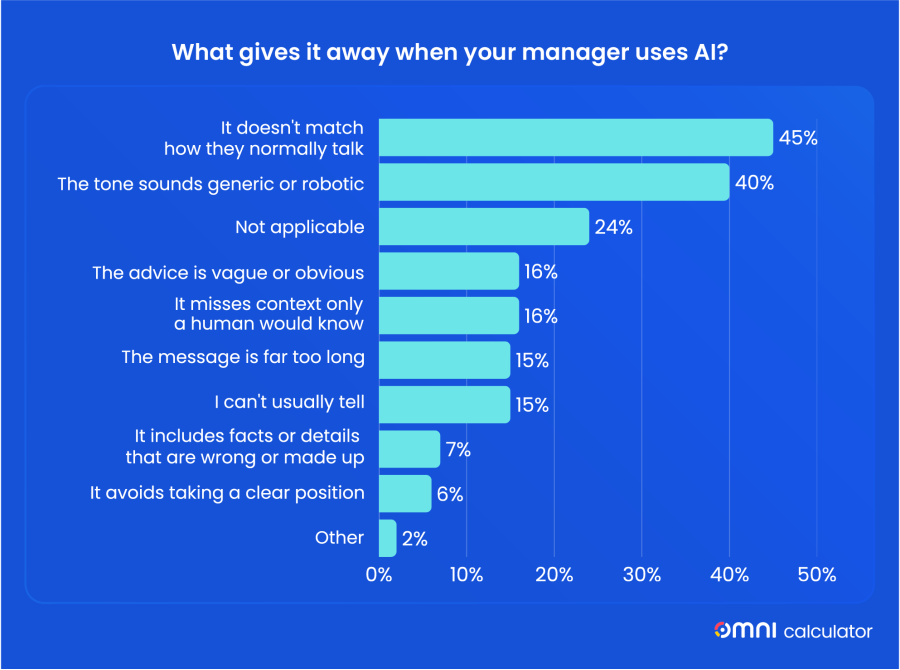
Horizontal bar chart showing the top giveaways that a manager's message was written by AI, led by 45% saying it doesn't match how they normally talk
What gives it away when your manager uses AI?

Further down, 16% point to advice that's vague or obvious, 16% to missing context only a human would know, and 15% to a message that's far too long.

When asked to estimate how much of their manager's typical week of messages is AI-written, 29% put it at about 1 in 10 and 17% at about 1 in 4. Combined, nearly 6 in 10 (58%) attribute at least some share to AI.

Think about everything your manager sends you in a typical week. Roughly what share of it do you think is written by AI?

Overall

Gen Z

Millennials

Gen X

Baby boomers

None of it

35%

38%

35%

37%

26%

About 1 in 10 (around 10%)

29%

31%

28%

27%

35%

About 1 in 4 (around 25%)

17%

19%

19%

17%

14%

About half (around 50%)

7%

4%

10%

6%

9%

Not sure

5%

2%

2%

8%

9%

About 3 in 4 (around 75%)

4%

4%

4%

4%

6%

Almost all of it (around 90% or more)

1%

2%

2%

1%

1%

About a third (35%) say none of it is AI-generated, though this varies by generation, ranging from 26% of baby boomers to 38% of Gen Z.

Whatever managers hand to AI largely stays off their teams' plates, with 64% saying it's had no effect on their workload.

Among the rest, 9% say it increased their workload a little, and 6% say it reduced it a little.

How has your manager's use of AI affected your own workload?

Overall (2026)

It has had no effect on my workload

64%

Not sure

18%

It has increased my workload a little

9%

It has reduced my workload a little

6%

It has reduced my workload a lot

3%

It has increased my workload a lot

1%

The same pattern holds for cleanup time, as 63% spend no time in a typical week cleaning up, correcting, or decoding AI-generated work from their manager.

In a typical week, how much time do you spend cleaning up, correcting, or decoding AI-generated work from your manager?

Overall (2026)

None

63%

Less than 30 minutes

20%

30 minutes to 1 hour

8%

1 to 3 hours

4%

Not sure

3%

3 to 5 hours

1%

More than 5 hours

1%

The 34% who do spend time skew low: 20% spend under 30 minutes, and 8% spend 30 minutes to an hour.

Finding out a manager uses AI triggers a near-even split in trust. Some 36% say the discovery makes them trust a manager's judgment less, while an almost equal 35% disagree, and 28% land in the middle.

Have a look:
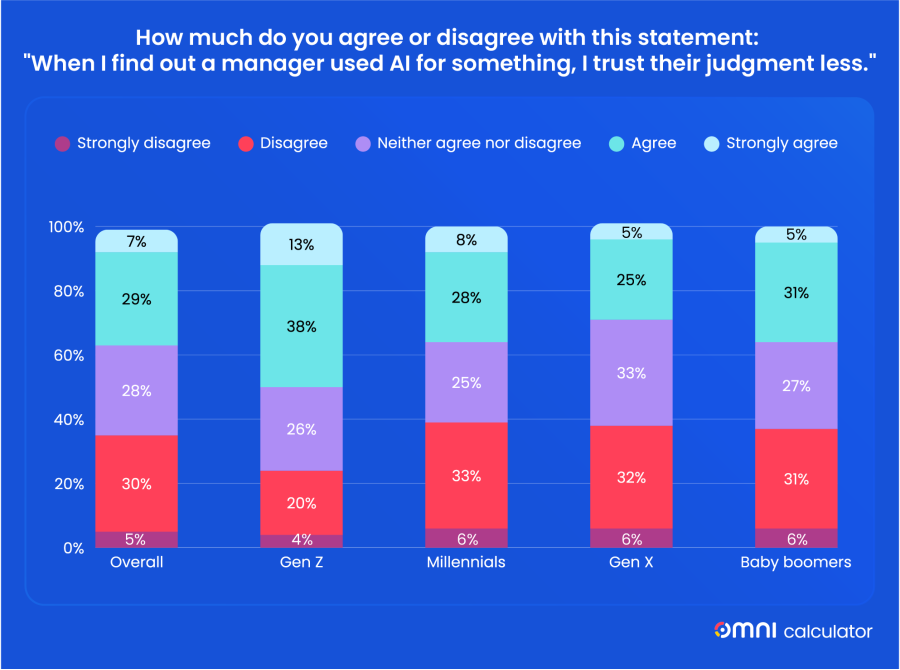
Stacked column chart showing agreement by generation that finding out a manager used AI lowers trust in their judgment, highest among Gen Z
How much do you agree or disagree with this statement: "When I find out a manager used AI for something, I trust their judgment less."

By generation, Gen Z is the most critical: 38% agree, versus 25% of Gen X, and a slim majority (51%) of Gen Z agree once strong agreement is added in.

Gen Z is also the least likely to disagree, at 20%, compared with 33% of millennials.

Turning to AI for assistance might be a smart productivity hack, but to more than 4 in 10 (42%), it signals a lack of competence.

How much do you agree or disagree with this statement: "A manager who relies on AI seems less competent to me."

Overall

Gen Z

Millennials

Gen X

Baby boomers

Agree

29%

34%

31%

25%

26%

Disagree

29%

16%

31%

37%

26%

Neither agree nor disagree

20%

16%

18%

21%

27%

Strongly agree

13%

24%

11%

9%

9%

Strongly disagree

9%

10%

9%

9%

12%

By generation, 58% of Gen Z agree, with 24% strongly agreeing, versus 34% of Gen X. Gen Z is also the least likely to disagree, at 16%, compared with 37% of Gen X.

As our final question, we asked workers to weigh in on the following statement: "AI-generated messages from a manager feel less personal."

This drew the firmest consensus in the study, with more than two-thirds (68%) agreeing, including 28% who strongly agree.

How much do you agree or disagree with this statement: "AI-generated messages from a manager feel less personal to me."

Overall

Gen Z

Millennials

Gen X

Baby boomers

Agree

40%

37%

38%

43%

42%

Strongly agree

28%

39%

29%

22%

26%

Neither agree nor disagree

16%

9%

17%

18%

20%

Disagree

11%

10%

12%

13%

9%

Strongly disagree

4%

5%

4%

4%

3%

By generation, Gen Z agrees most, at 76%, including 39% who strongly agree, the highest of any group.

Omni Calculator surveyed 913 US adults who are employed and report to a manager. Responses were collected between June 8 and June 15, 2026, using the Prolific online research platform, and the sample was balanced to match US Census proportions. A total of 954 responses were collected; after 41 that either exited at the screening question or failed an attention check were removed, 913 remained for analysis. All respondents were screened to ensure they were based in the United States and currently employed.

The final sample was 51% female, 48% male, and 1% another gender or undisclosed. By generation, Gen X (ages 46 to 61) made up 37%, millennials (ages 30 to 45) 31%, Gen Z (ages 18 to 29) 21%, and baby boomers (ages 62 and older) 12%. The most represented industries were healthcare or medical (14%), education (13%), finance, banking, or insurance (12%), and technology or software (11%). Results are reported at a 95% confidence level with a ±3% margin of error. Percentages are rounded to the nearest whole number and may not sum to exactly 100%. Questions that allowed more than one answer sum to more than 100%.

Omni Calculator helps over 15 million monthly users solve calculation problems through 3,800+ expert-reviewed tools.

The content in this article is for noncommercial use only. When sharing, please include a link back to Omni Calculator as the original source.

Need to run some quick numbers? Check out the calculators below for help with your pay, commute, and career moves.

Authors of the report

Ask the authors for a quote

Copyrights