Table of contents
73% of Employers Believe Pay Is Equal — Half of Employees Disagree
Report Highlights
Report Highlights
- 73% of employers believe pay is equal at their organization. Only 50% of employees agree.
- Only 11% of executives correctly identified March as the date women’s pay catches up to men’s, compared to 20% of employees — yet employers are more likely to feel confident in their answer (45% vs. 36%).
- Women are 9x more likely than men to say they personally earn less than the opposite gender in their own role (27% vs. 3%).
- Primary caregivers are 12 percentage points more likely than other women to say they personally earn less because of their gender (37% vs. 25%).
- Executives are 3x more optimistic that AI will help close the pay gap than employees are (33% vs. 11%).
- 49% of employers conduct no pay equity reviews at all, while 30% found a gap and did nothing.
- Executives underestimate how many employees would quietly accept unequal pay (8% predicted vs. 14% actual) and overestimate how many would report it formally (21% predicted vs. 14% actual).
- Women are twice as likely as men to use AI to actually draft a raise request, even though men use it more for research.
- Only 2% of employers would let AI make a final pay decision on its own.
Employees and employers are looking at the same workplace and seeing two different things.
This report draws on two parallel surveys conducted with mirrored methodologies: one of 808 employed US adults and one of 403 founders, CEOs, and C-suite executives. That design makes it possible to measure the gap between what leadership believes and what the workforce experiences directly, rather than assume it.
What the data shows isn’t simply “two groups disagree.” Across several of the questions in this report, the more senior, more confident group turns out to be the less accurate one — a pattern that shows up in what people believe about pay today, what they predict will happen when a gap is found, and what actually happens next.
💡 Use our Gender Wage Gap Calculator to see where your own pay sits against the numbers in this report.
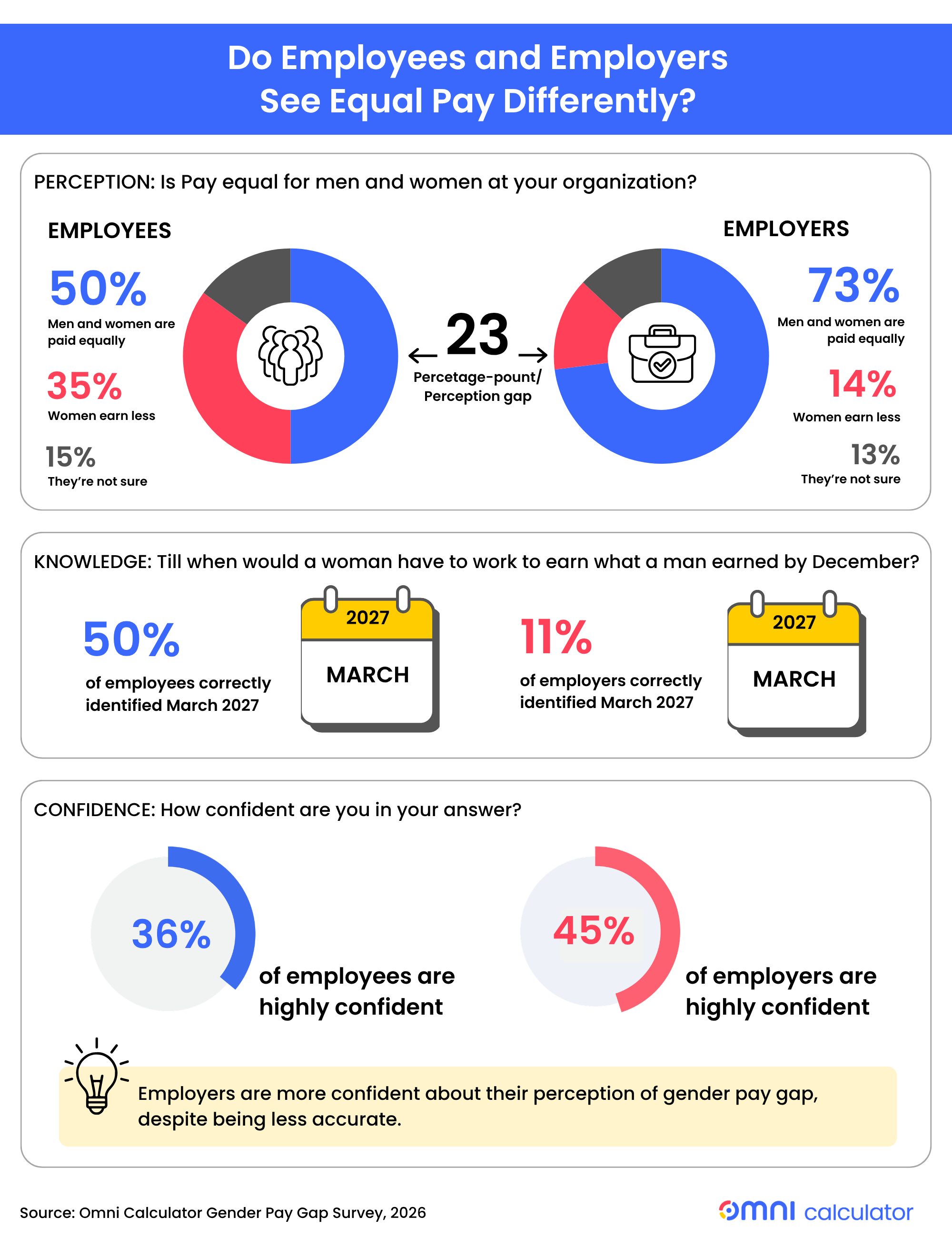
73% of executives believe men and women are paid equally at their organization. Only 50% of employees agree. That 23-point gap is the foundation on which the rest of this report is built.
The same pattern shows up inside the workforce, too. 69% of men believe pay is equal at their own company, compared to 43% of women, and women are about twice as likely to say pay isn’t equal (35% vs. 17%).
Men are more than four times as likely to reject the premise outright. Only 4% of women say they don’t believe a pay gap exists, compared to 18% of men.
And when we asked about their personal experience rather than their general belief, the gap widened even further: 27% of women say they personally earn less than a colleague of the opposite gender doing the same role, compared to just 3% of men — a 9x gap.
That gap is sharpest for primary caregivers specifically: among women, 37% of primary caregivers say they personally earn less because of their gender, compared to 25% of women without children and 25% of women who share caregiving equally. Caregiving distribution, not parenthood itself, appears to be driving the difference.
Underneath the belief gap lies a sharper, more specific finding: executives aren't just more likely to believe pay is fair; they're also more likely to be flat-out wrong about the actual number and more confident about it.
March is the correct answer to a simple question this survey asked both groups: if a man worked until December 31 to earn his annual salary, how far into the next year would a woman need to work to earn the same amount? The real US gender pay gap is 17.9% — the same figure used in Omni’s own Gender Wage Gap Calculator — which means a woman would need to work until roughly mid March to match a man's full-year earnings.
Women need to work roughly 65 additional days to match what men earned by December 31 and Only 20% of employees correctly estimated this.
What makes this more than a simple knowledge gap is what happened when both groups were asked how confident they felt in their answer.
45% of executives rated themselves highly confident, compared to just 36% of employees. This is a confidence-accuracy gap, not a claim about a broader psychological pattern: the group that was less likely to know the real number was more likely to say it had gotten it right.
Employers and employees also diverge on why the gap exists at all.
Reason | Employees | Employers |
|---|---|---|
Employers paying women less for the same work | 39% | 33% |
Differences in hours worked (childcare/family) | 15% | 20% |
Weak laws or enforcement | 15% | 16% |
Negotiation differences | 14% | 12% |
I don’t believe a gap exists | 7% | 11% |
Not sure | 9% | 8% |
Employees are more likely to point directly at their employer; executives are more likely to shift the explanation toward hours and caregiving, and more likely to deny that a gap exists entirely (11% vs. 7%).
Executives were asked to predict what employees at their company would do if they discovered a gender pay gap. Employees were asked separately what they would actually do themselves.
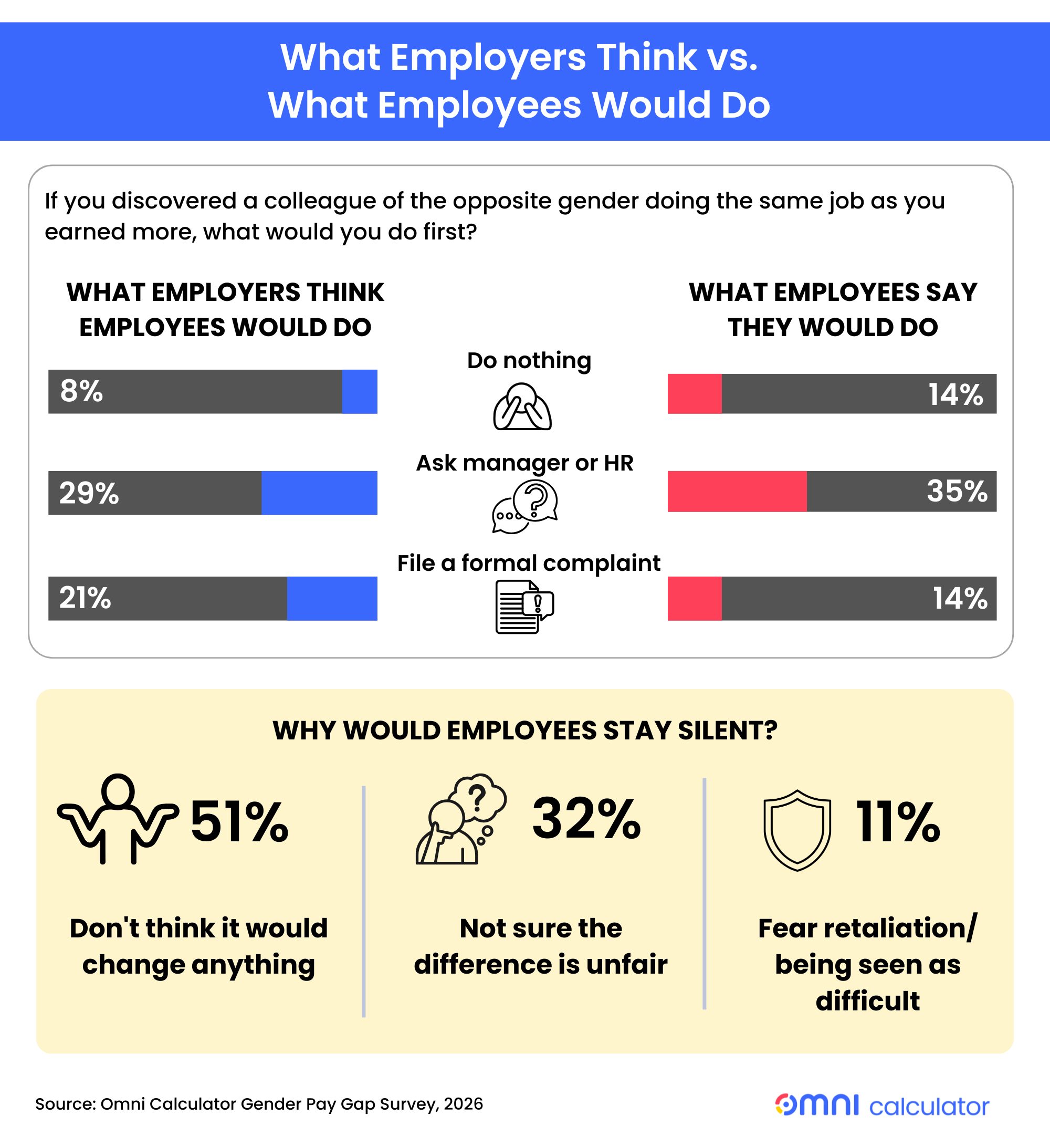
Employers overestimate how many employees would escalate through formal channels — predicting 21% would report formally, when only 14% say they actually would — and underestimate how many would simply stay quiet, predicting roughly half the real rate (8% vs. 14%). They also underestimate direct negotiation itself (29% predicted vs. 35% actual).
Men are notably more likely to say they’d do nothing than women — 28% vs. 9%. That runs counter to the assumption employers seem to be making, and it’s worth noting as its own finding.
Among employees who said they’d do nothing, the most common reasons were: 51% said “I don’t think it would change anything,” 32% said “I’m not sure it’s actually unfair — there could be a legitimate reason,” and 11% cited fear of retaliation or being seen as difficult. That’s mostly resignation and uncertainty, not indifference.
Half of employees who’d stay silent about a pay gap don’t think speaking up would change anything.
There's a documented reason this matters beyond the individual: research suggests women who don't believe their own pay is affected by the gap are less likely to negotiate, which helps the gap persist [1].
Employers were also asked directly about their own internal processes. Three separate practices stand out in how inconsistently pay equity gets handled.
Nearly half of employers (49%) conduct no pay equity review at all — only 25% review annually, and another 10% review less often than that.
Only 16% of employers have ever adjusted anyone’s pay after a review found a discrepancy. 30% found a gap and made no change. 32% say they’ve never found one at all.
Salary transparency follows a similar pattern of reluctance. Executives are roughly twice as likely as employees to say transparency wouldn’t help (23% vs. 11%), and in practice, 49% of employers share no salary ranges at all, whether internally or publicly.
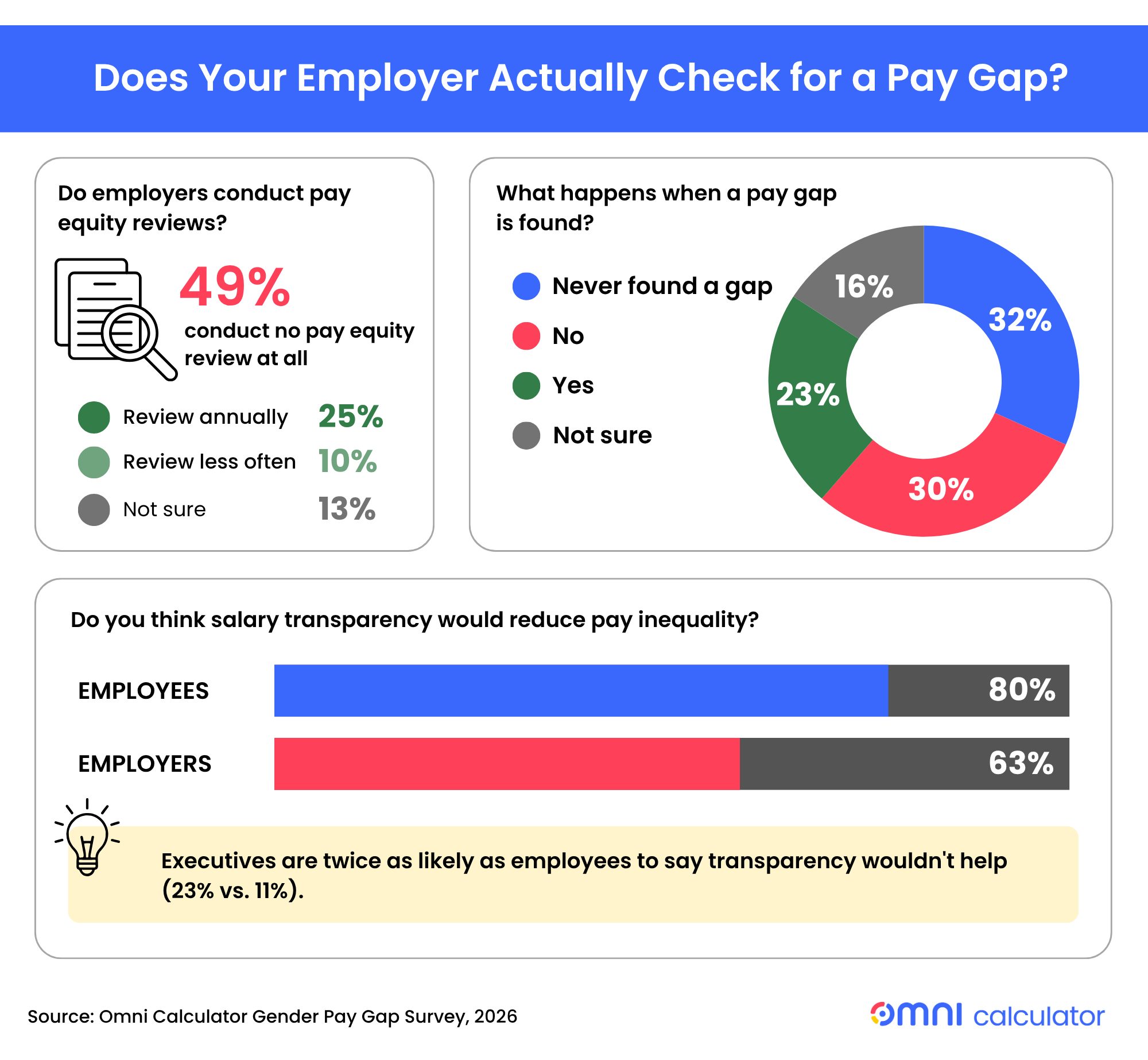
Women see more value in transparency than men do, both as employees and as executives. Among employees, 82% of women say transparency would help, compared to 74% of men. Among employers, the same pattern holds at a smaller scale — 68% of women vs. 58% of men.
Leadership composition is associated with both how salary ranges are shared and how much value executives see in sharing them. On disclosure itself, the pattern approaches but doesn’t clear standard statistical significance (p = 0.0563): employers with mostly male leadership are most likely to share no ranges at all (55% “No”), compared to 43% at companies with roughly equal leadership. In contrast, more equal-led companies are also the most likely to publish ranges openly (17% vs. 14% for male-led and 8% for female-led).
Are salary ranges shared? | Mostly male leadership | Mostly female leadership | Roughly equal leadership |
|---|---|---|---|
No | 55% | 47% | 43% |
Yes, internally only | 27% | 34% | 33% |
Yes, publicly | 14% | 8% | 17% |
Not sure | 4% | 11% | 7% |
Executives at mostly female-led companies overwhelmingly support transparency (76% “Yes”), while executives at mostly male-led companies are the most skeptical (32% “No”). This belief that transparency would even help is a much stronger split than the disclosure practices themselves.
Would transparency reduce pay inequality? | Mostly male leadership | Mostly female leadership | Roughly equal leadership |
|---|---|---|---|
Yes | 53% | 76% | 63% |
No | 32% | 14% | 20% |
Not sure | 15% | 10% | 17% |
AI optimism. Executives are far more optimistic than employees that AI will help close the gender pay gap; 33% of employers say so, compared to 11% of employees.
But that optimism comes against a growing body of evidence that AI can reproduce existing workplace biases. Concerns about AI reinforcing existing workplace inequalities are not new. Research and reporting have highlighted the risk that AI-based workplace systems can reproduce or amplify gender bias, particularly when they are trained on historical data [3].
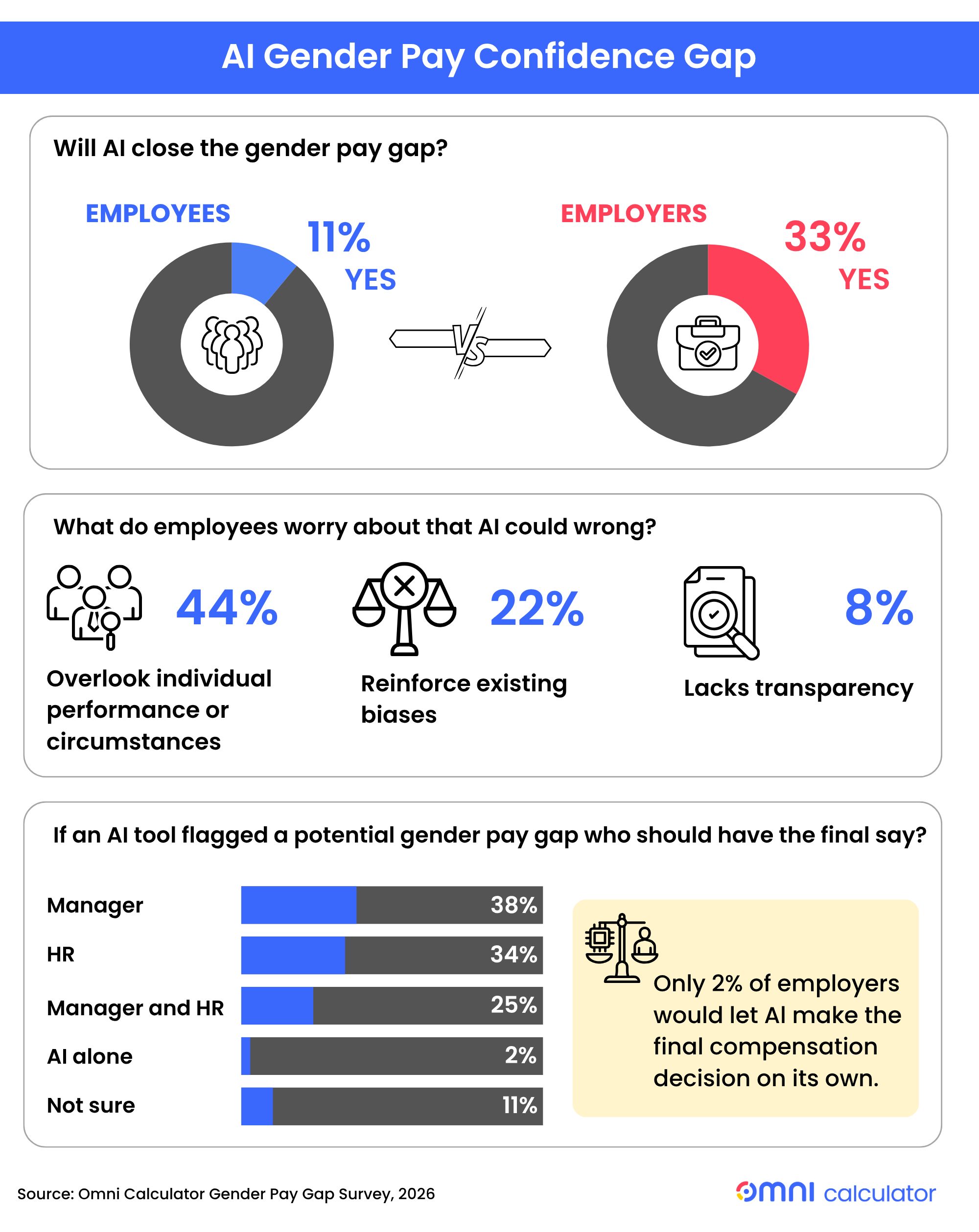
Concerns about AI.
Employees who don’t trust AI to be fair point to specific mechanisms, not just general unease.
That skepticism isn’t coming from nowhere. A March 2026 investigation found that LLMs, when asked to recommend a salary target, suggested lower numbers for female personas than for otherwise identical male personas [4]. Combined with employees’ own concerns above, this gives the “AI could reinforce bias” worry a documented basis, not just a hypothetical one.
People are already using AI for salary decisions.
Roughly a third of employees (34%) have used an AI tool for at least one salary-related task: estimating fair pay, preparing for a negotiation, or drafting a raise request. Adoption is far from even: 45% of high earners ($100,000+) have used AI for this, compared to just 29% of those earning under $60,000. Tech workers lead by industry (50% adoption), while Consumer Goods, Retail & Industrial trail well behind (just 24%). Hybrid workers are the most likely to have used AI this way (42%), notably ahead of both fully remote and fully on-site employees. Adoption itself is also uneven across genders before any bias in the tools even enters the picture: Lean In's own research found men use generative AI at work daily at meaningfully higher rates than women — 33% vs. 27% [5].
That gap doesn't hold for every task, though. Men in our own survey were more likely to use AI for the research stage — estimating fair pay (14% vs. 10%) and preparing for the negotiation itself (14% vs. 10%) — but women were twice as likely to use AI specifically to draft the raise request or negotiation email (6% vs. 3%).
This caution isn’t unique to compensation. In a separate Omni Calculator survey on general AI use at work, women were also significantly more likely than men to limit AI to minor tasks only (47% vs. 37%). In comparison, men were more willing to accept AI’s occasional mistakes in exchange for saving time (33% vs. 23%).
Employers are already using AI in compensation.
25% of employers say their company already uses AI or algorithmic tools to help set salaries, benchmark pay, or approve raises. Among those who do, more say they manually check the tool’s recommendations (15%) than say they fully trust it (10%) — suggesting even early adopters aren’t handing over full confidence yet.
Who gets the final say?
When asked who should have the final decision if an AI tool's pay recommendation differed from a manager's, employers split mainly between the manager (38%) and HR (34%), with only 15% preferring a combination of both. Just 2% would let AI decide on its own. The split is gendered, too: women favor HR oversight more than men do (42% vs. 26%), while men favor manager discretion more than women do (44% vs. 32%).
AI and future access to high-paying roles.
Employees and employers see very different levels of risk here. 40% of employees are personally concerned that AI-driven automation could affect their own job security or pay, a concern that’s highest in Tech (57%) and lowest in Consumer/Retail (31%). Executives, asked the structural version of the same question, are far less concerned: only 17% say yes, and 54% say no.
Employees are also far more likely than employers to hold any negative view about AI’s effect on the pay gap. Combining “could unintentionally reinforce the gap” (26%) and “will actively worsen it” (5%) puts 31% of employees in some negative camp, compared to just 9% of employers who chose “widen it.”
These questions weren’t worded identically: the employee figure combines two separate negative options, the employer figure is a single one, but the direction is the same.
Every finding in this report leads back to the same question: what does this actually cost, in dollars, for one person?
In the US, women earn 17.9% less than men on average. That places the US behind most of Western Europe — the UK sits at 12.9%, France at 11.8%, and Belgium at just 0.7% — but ahead of South Korea (27.7%), Japan (20.1%), and Israel (23.4%).
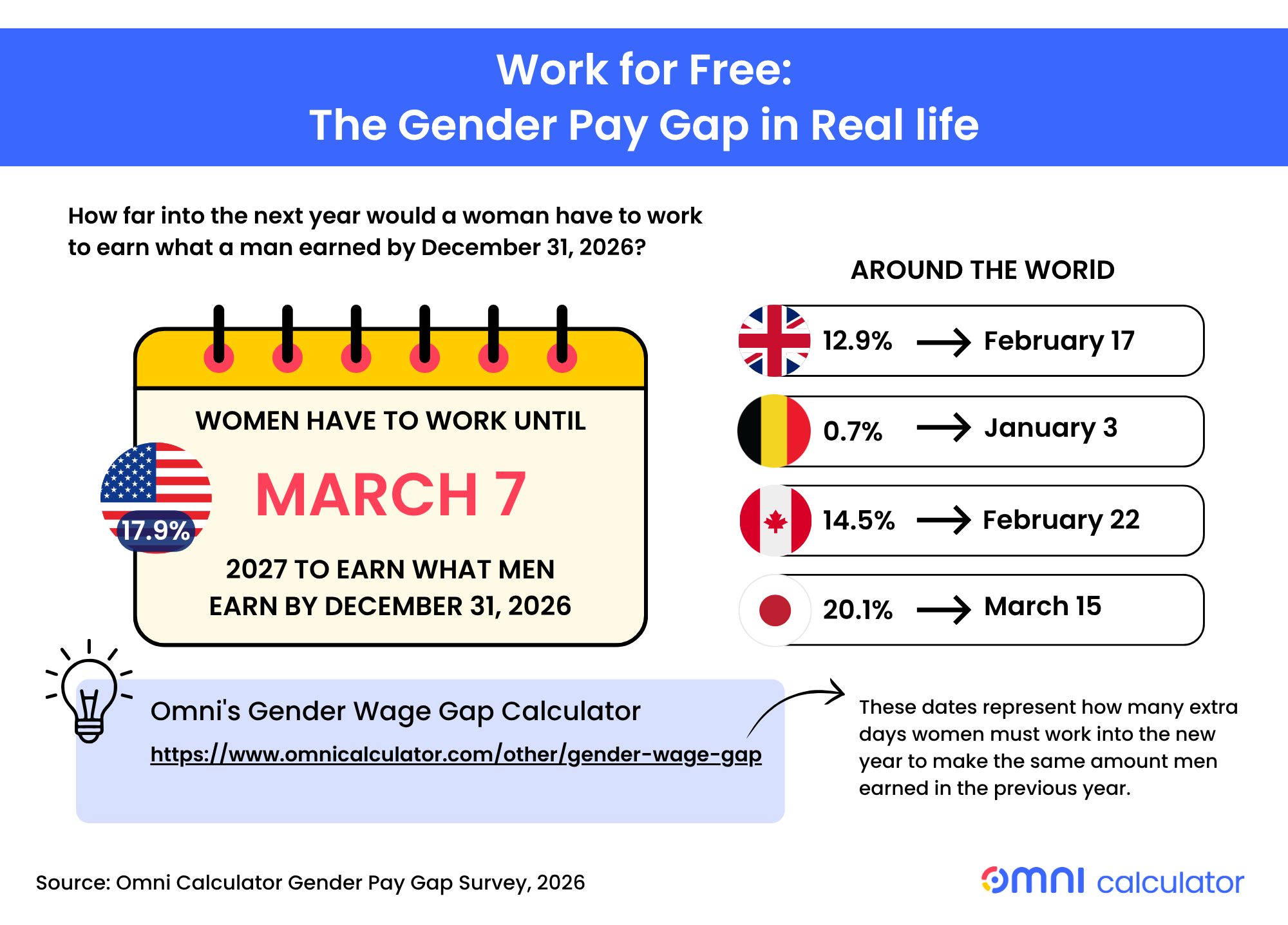
Use our Gender Wage Gap Calculator to enter your own salary and see two numbers: where you actually stand, and what you’d earn on average if you were the opposite gender. It’s the same “days worked for free” math behind this report’s central accuracy question — except this time, it’s your own answer, not a guess.
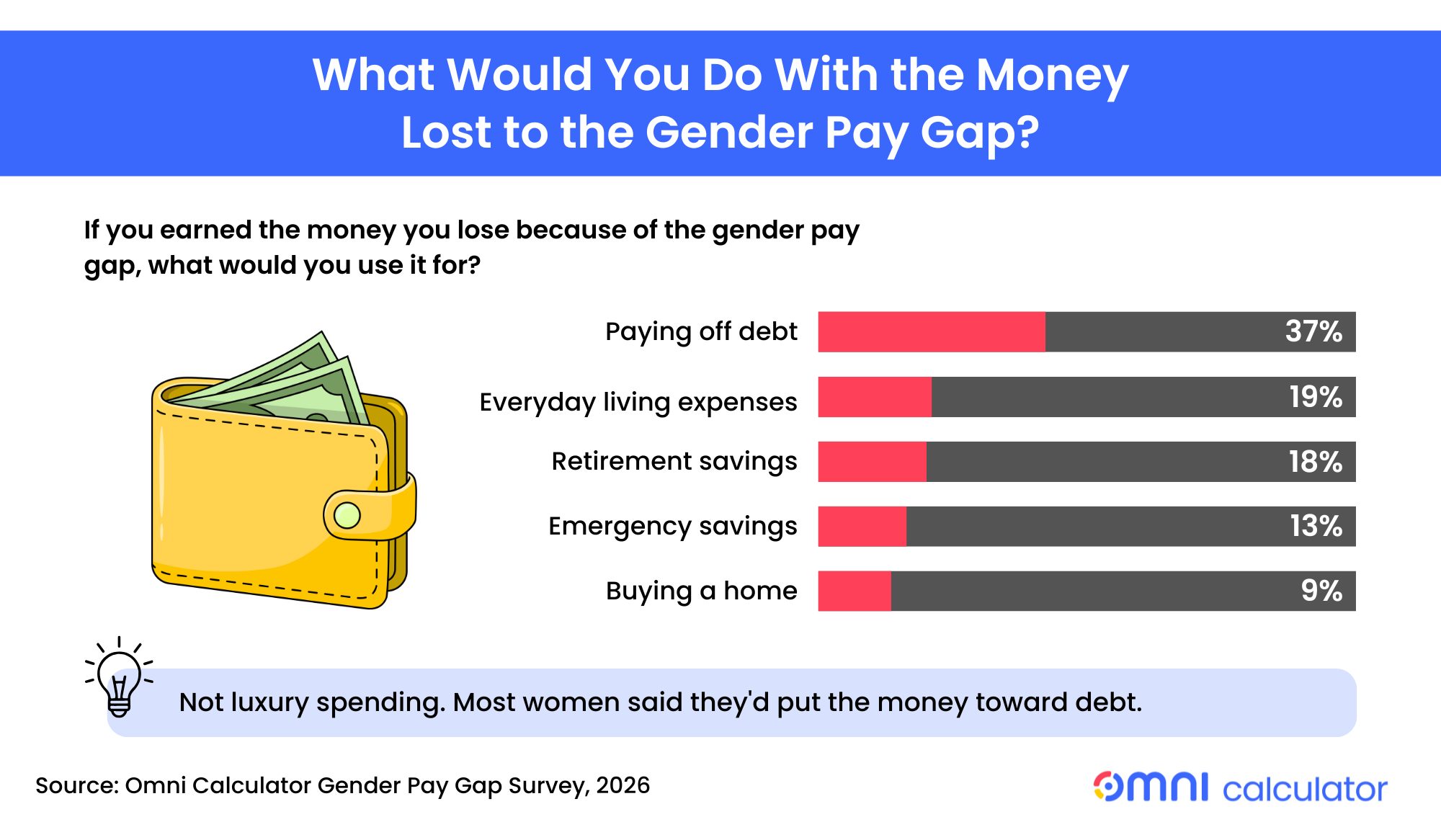
So what would that money actually go toward? We asked employees the same question, and luxury spending wasn’t high on the list.