

The resistor voltage drop calculator helps you accurately calculate the voltage drop in your circuit. In this tool, you will find three calculators that can help you determine the voltage drop across a resistor, the voltage drop in a two-resistor voltage divider, and the required drop resistance.
Keep reading our article, where we will approach the following subjects:
- What is the voltage drop through a resistor?
- How to calculate voltage drop across a resistor.
- What is the resistor needed to drop 12V to 5V?
- And much more.
So, let’s understand how to drop the voltage and avoid damaging your circuit.
What is the voltage drop through a resistor?
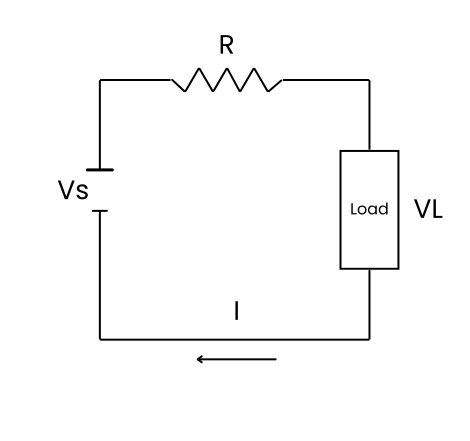
When a load draws less voltage than the source provides, you can place one resistor — or an equivalent one from a string connected in series or parallel — to absorb the difference. The resistor drops the extra voltage across its terminals, so the load receives only the voltage it needs to work properly.
This is the role of a voltage drop, which follows from the famous Ohm’s law. Check out our Ohm’s law calculator to learn more about this topic.
How to calculate voltage drop across a resistor
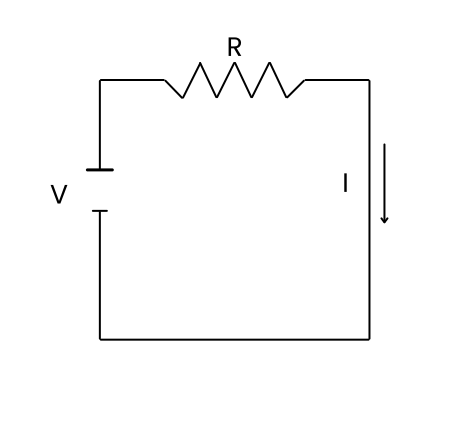
To compute the voltage drop, you just need to use Ohm’s law. In this case, you can consider a simple circuit consisting of a source connected in series with a single resistor. Therefore, the formula for the voltage drop across a resistor is:
where:
- — Resistance of your dropping resistor;
- — Voltage supplied by the source; and
- — Current.
You can also measure this voltage drop in the real world using a multimeter. To do that, set the multimeter to voltage mode and connect it in parallel with the resistor (across it) while the circuit is powered and running.
Voltage drop in a two-resistor voltage divider
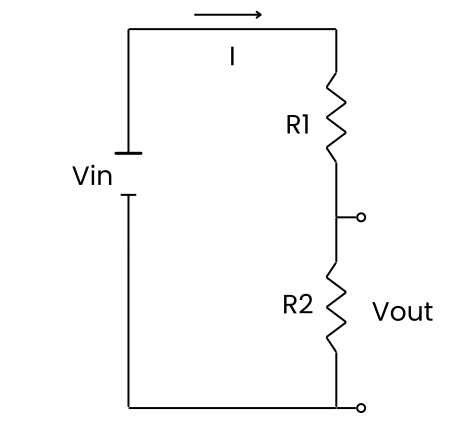
A two-resistor voltage divider is a circuit that takes an input voltage and produces a smaller output voltage, determined by the ratio of the two resistors in series.
This popular circuit is formed by two resistors and , which are connected in series across the input voltage , and the output . You can see a diagram of this circuit below, and by selecting the corresponding option in the voltage drop across a resistor calculator.
The equation to compute the output voltage is given by:
This type of circuit is present in several devices, such as a potentiometer in an audio amplifier, radio, or guitar; multimeters and oscilloscope probes; thermostats and temperature sensors; joysticks and game controllers; and low-battery indicators.
How to find the dropping resistor
The resistance of the dropping resistor depends on the voltage drop across it and the current flowing through the circuit. This can be computed using the equation:
where:
- — Resistance of your dropping resistor;
- — Voltage supplied by the source;
- — Voltage needed by the load; and
- — Current.
Moreover, a resistor that drops voltage also turns that energy into heat, so it must be rated to handle the power without overheating. The dissipated power is computed using the following equation:
which gives you the resistor power rating. The power rating is defined as the maximum power your resistor can safely dissipate before it overheats and is damaged.
Unlike the resistance, the power rating is not color‑coded on the resistors, so if you do not have the product datasheet or the value printed on the resistor, you will need to infer it from the resistor’s physical size. In general, the power ratings for different resistors are:
- for body lengths ;
- for body lengths ; and
- Larger than for body lengths .
If you don’t have the right resistor, you can combine two or more of them to get the resistance you need. Use our series resistor calculator and parallel resistor calculator to quickly find the equivalent resistance.
Resistor voltage drop calculator — Example
Our resistor voltage drop calculator is easy and intuitive to use. All you need to do is:
- Select your circuit configuration.
- Fill in the inputs with your data for the voltages and the current.
- Read the results of your calculations.
Let’s demonstrate this computation with an example. Suppose that you have a red LED with a forward voltage running at from a supply. To find the correct value of the resistor, select the option “Find the dropping resistor” in our resistance voltage drop calculator. By inputting these values in our tool, you will find:
and .
These are precisely the values of the resistance and power dissipation you need in your circuit to keep your LED working properly.
🙋 You can find additional information about LEDs by visiting our LED resistor calculator.
How to calculate voltage drop across a resistor in parallel
One important point to highlight about this question is that resistors in parallel share the same two nodes, so the voltage across each one is identical. This happens because the voltage doesn’t divide across parallel branches the way it does in series — it’s the current that divides.
However, you can determine the voltage drop by considering a circuit with resistors in parallel connected in series with another resistor, as shown in the figure below.
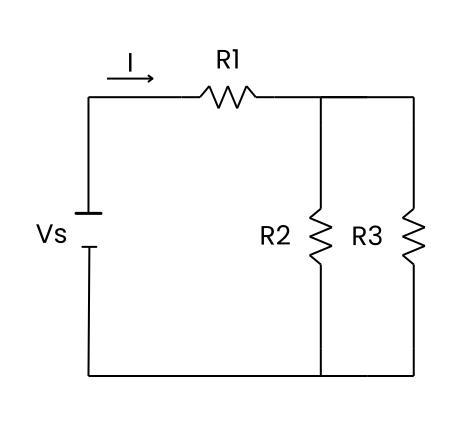
In such a case, you need to find the equivalent resistor for the circuit, and its resistance can be calculated using the following equation:
So, the formula for voltage drop across this resistor is:
FAQs
Does voltage drop across a resistor?
Yes, but only if current is flowing through it. Ohm’s law sets the drop voltage, V = I × R, so it scales with both the resistance and the current passing through the component.
Thus, a dropping resistor is connected in series with the load and, by sharing the current, absorbs the excess voltage. This process ensures that your device will work with the proper voltage.
How do I determine the wattage of a resistor?
You can determine a resistor’s power in watts by following the steps below:
- Measure the current in the circuit.
- Check the resistor’s resistance.
- Apply the formula P = I² × R, which gives the power dissipated by the resistor power rating.
- Write your final result in the proper units: watts = volts × amps.
What is the resistor needed to drop 12V to 5V?
You can find the answer by following the steps below:
-
Take the value of the current in your circuit. Suppose that I = 100 mA.
-
Take the supply voltage (12V) and the load voltage (5V).
-
Substitute these values into the formula for the resistor drop:
R = (12 − 5)/0.1 = 70 Ω
-
Or you can save time by using an online resistor voltage drop calculator.
What is the voltage drop across a 20 resistor?
To determine the voltage drop across a 20-ohm resistor, you need to know the value of the current. Let’s suppose that you have I = 0.6 A, in this case, you just need to substitute this data into Ohm’s law:
V = R × I = 20 × 0.6 = 12 V