
Table of contents
1 in 3 Parents Wrongly Believe Trump Account Withdrawals Are Tax-Free at 18
Report Highlights
Our 1,004-respondent survey of U.S. parents shows a wide gap between how many people have heard of Trump Accounts and how well they actually understand them, a gap that could leave a meaningful share of families exposed to costly tax surprises down the road.
Key Findings
- 79% of parents have heard of Trump Accounts, but only 7% feel "very confident" they understand how they work.
- 30% of parents wrongly believe withdrawals become completely tax-free once a child turns 18.
- Only 32% of parents know the $1,000 government deposit isn't automatic.
- 58% of new/expecting parents have opened or started an account, versus just 13%-14% of parents with older children.
- Parents got just 38% of basic Trump Account facts right, on average.
- 58% of all parents say the government explained the program "not well" or "not at all".
79% of parents say they've heard of Trump Accounts. That's a strong number for a program that's still new. But awareness and understanding are two very different things.
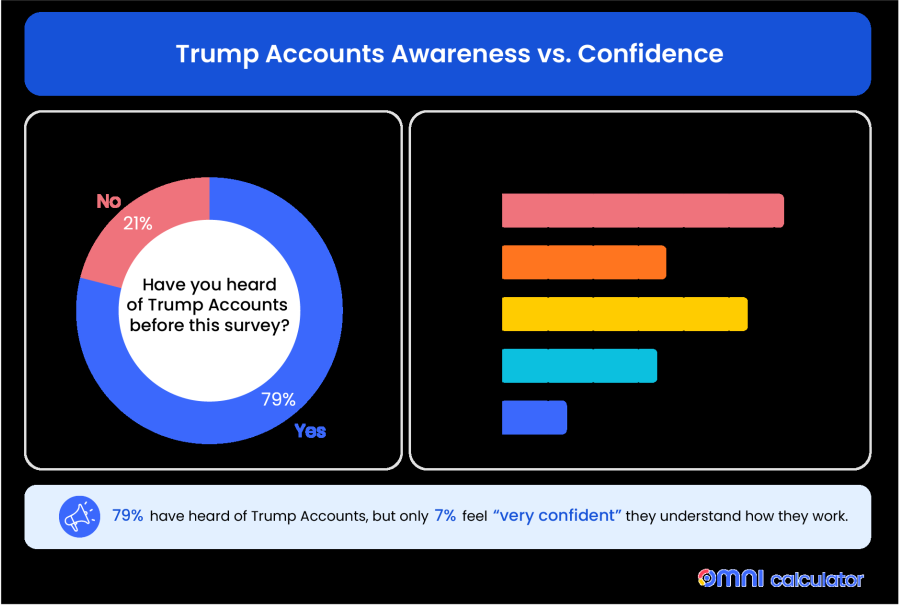
Only 7% of parents describe themselves as "very confident" in their understanding of how Trump Accounts work. Nearly half (49%) rate their understanding as a 1 or 2 out of 5.
🙋 Fewer than 1 in 10 parents feel fully confident they understand the program they've heard so much about.
Confidence varies sharply by how close a family is to the program. Parents expecting or raising a child in the 2025-2026 cohort are far more confident than everyone else: 37% of them rate their understanding a 4 or 5, compared to just 20% of parents with kids born 2016-2024 and 23% of parents with kids born 2009-2015. Awareness follows a similar pattern: 90% of new/expecting parents have heard of the program, versus 76% and 79% for older cohorts, respectively.
Awareness hasn't translated into action for most families. Across the full sample, 78% of parents haven't started the process of opening an account, while just 12% have fully opened one, and 10% have started but not finished.
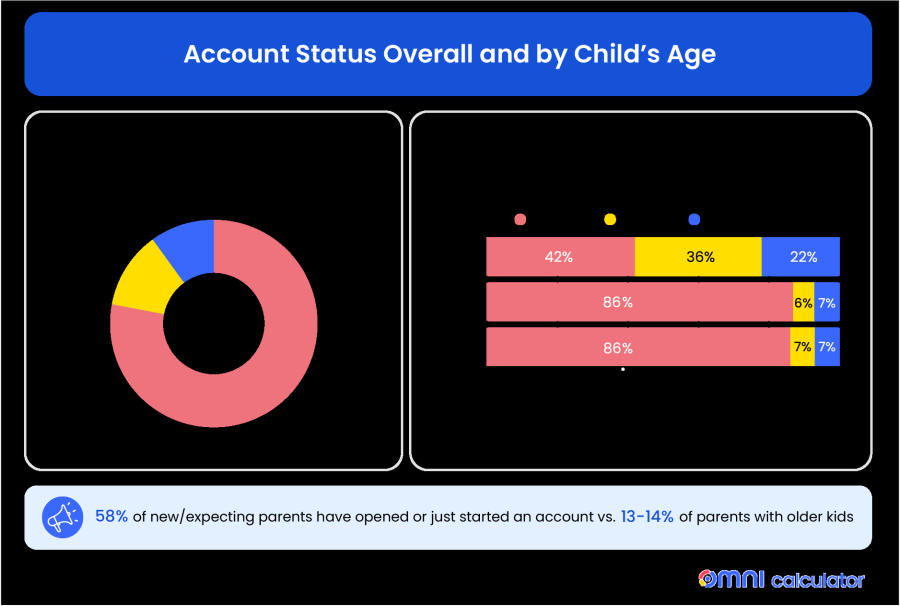
That national picture hides a dramatic split by proximity to eligibility. Among new and expecting parents, the group whose children qualify for the $1,000 deposit, 58% have taken action: 36% have fully opened an account, and another 22% have started the process. Among parents of older children, that combined engagement rate drops to just 13%-14%.
Younger parents are also more proactive across the board: 28% of parents aged 18-29 have started or finished the process, compared to just 12% of parents aged 46-61.
This engagement gap isn't unique to our sample. Independent reporting has found that only a fraction of the roughly 73 million eligible U.S. children have been signed up so far, and that lower-income families are consistently more likely to miss out on the program altogether (3), a pattern that lines up closely with the income-based gaps we found in both action taken and factual understanding.
To measure actual comprehension rather than self-reported confidence, we tested parents on nine true/false statements covering eligibility rules, investment structure, contribution rules, and withdrawal restrictions, then combined the results into a Composite Literacy Index (0%-100%).
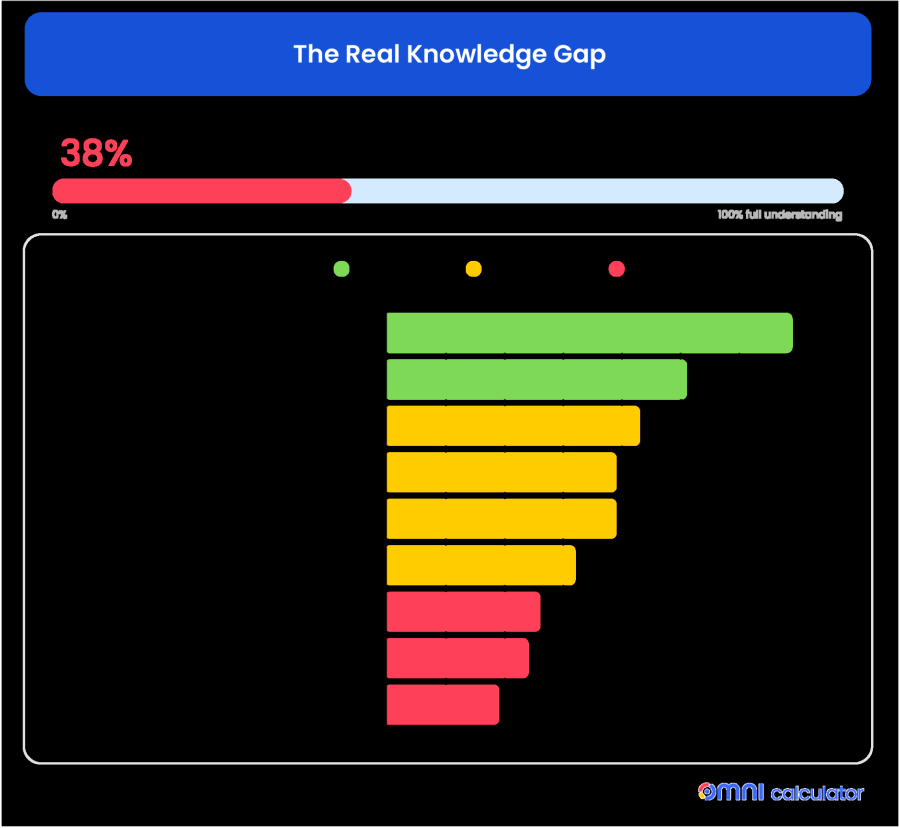
No group scores above a basic passing grade. Even the best-performing segment, new and expecting parents, averages under 50%.
Group | Overall Literacy Index Score |
|---|---|
National Average | 38% |
New Parents (2025-2026) | 48% |
Parents of children born 2009-2015 | 34% |
Upper-Middle Income ($150K-$200K) | 46% |
Lower Income (Under $50K) | 31% |
Graduate/Professional Degree | 43% |
No group scores above a basic passing grade. Even the best-performing segment, new and expecting parents, averages under 50%.
A few individual findings stand out:
- The automatic-deposit myth: Only 32% of parents correctly know that the $1,000 deposit requires a parent to actively file for it and isn't automatic. 42% of new/expecting parents, the group most likely to qualify, wrongly assume it happens on its own.
- The investment-risk blind spot: Just 39% of parents realize that the funds are invested in the market and could lose value, like stocks. 14% believe the balance is a guaranteed, fixed amount.
- The age-18 tax-free myth: Only 19% of parents correctly know that turning 18 does not make withdrawals tax-free for any purpose. 30% believe the money becomes an unrestricted, tax-free windfall at adulthood, while 51% aren't sure either way.
🔎 That last figure is the one with the most direct financial consequence: families who assume an 18th-birthday withdrawal is tax-free may be blindsided by ordinary income tax and, in some cases, an early-withdrawal penalty. Independent financial analysis backs this up: because Trump Account gains are only tax-deferred rather than tax-free, all investment growth is taxed as ordinary income upon withdrawal, and the size of that tax bill depends heavily on how much a family contributes beyond the initial $1,000, a low-income family relying solely on the seed deposit could see a balance of roughly $5,800 by age 18, while a family that maxes out annual contributions could see well over $300,000 (2).
Dawid Suida, Finance Expert at Omni Calculator
Assuming these funds become tax-free at 18 is the most financially dangerous misconception we found. Parents who treat these like tax-free savings are setting themselves (and their children) up for a severe tax shock the moment they access the money.
We asked parents directly: how well has the government explained how Trump Accounts actually work?
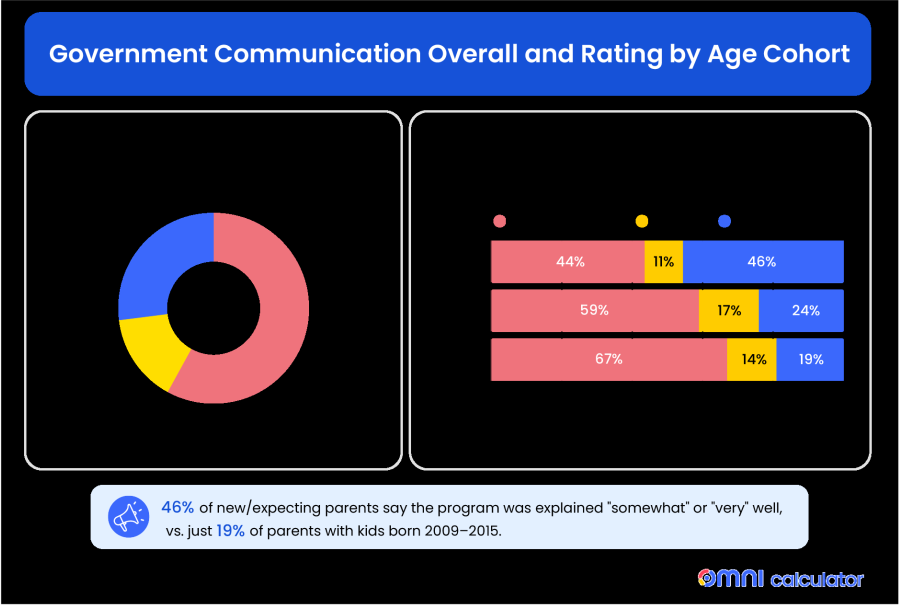
Nationally, 58% of parents say the program was explained "not well" or "not at all," while only 27% rate the explanation positively.
That dissatisfaction grows the further a family is from the program's launch. Among new/expecting parents, 46% say the program was explained "somewhat" or "very" well. Among parents of children born 2009-2015, that figure drops to just 19%, while negative sentiment climbs from 44% among new parents to 67% among this older cohort.
🔎 Parents may have good reasons to feel underinformed.
Financial reporting on the program has repeatedly noted that key details remain unresolved even now, including how gift-tax filing requirements apply to family contributions and exactly how future distributions will be taxed, with one savings-plan executive describing the program as having "more unanswered questions than answered" (4).
Given how many of the misconceptions in this report are about numbers — what the account is actually worth, whether it can lose value, what happens at withdrawal — one practical fix is a tool that lets parents test those numbers themselves rather than relying on assumptions.
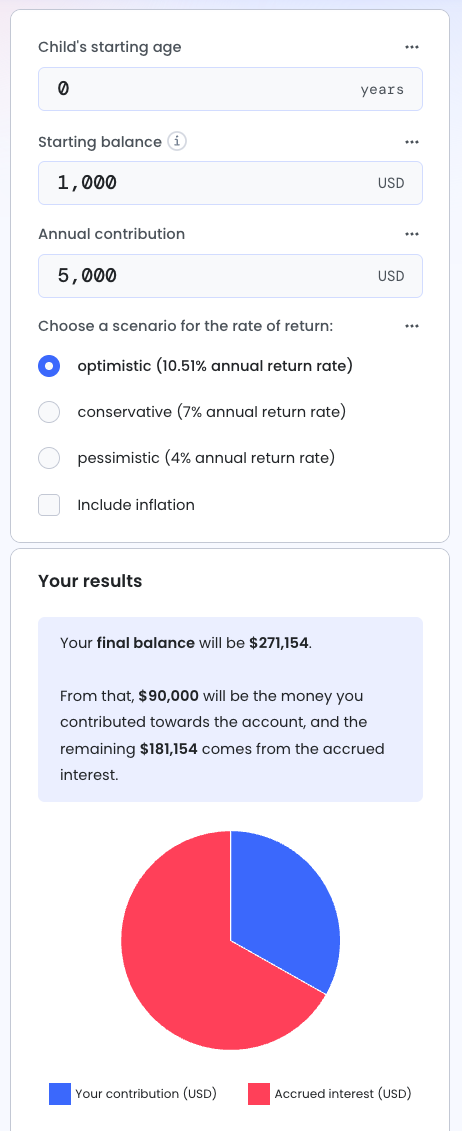
Omni Calculator's free Trump Accounts Calculator lets parents enter their child's age, starting deposit, and planned annual contributions, then see projected growth under three return scenarios: optimistic, conservative, and pessimistic, rather than a single best-case number. Users can also toggle in average inflation to see what the account will realistically be worth in today's dollars, and the tool's guide walks through exactly the kind of eligibility and withdrawal rules this survey found most parents get wrong, and compares Trump Accounts with other savings programs like 529 plans, so parents can see how the two options stack up before deciding where to put their money.
With only 39% of parents realizing the funds are market-invested and could lose value, and only 19% understanding the real tax treatment at age 18, a tool that models realistic outcomes rather than optimistic ones may help close some of the gap this report has measured.
Dawid Suida, Finance Expert at Omni Calculator
Families are making long-term decisions based on marketing strategies, which is exactly why we built the calculator. We want parents to see the hard math, adjusted for inflation, and market scenarios.