
Omni Calculator logo

Table of contents

1. Introduction

Fans think Spotify Pays Artists The Most — But Does It?

Add as preferred on Google

Report Highlights

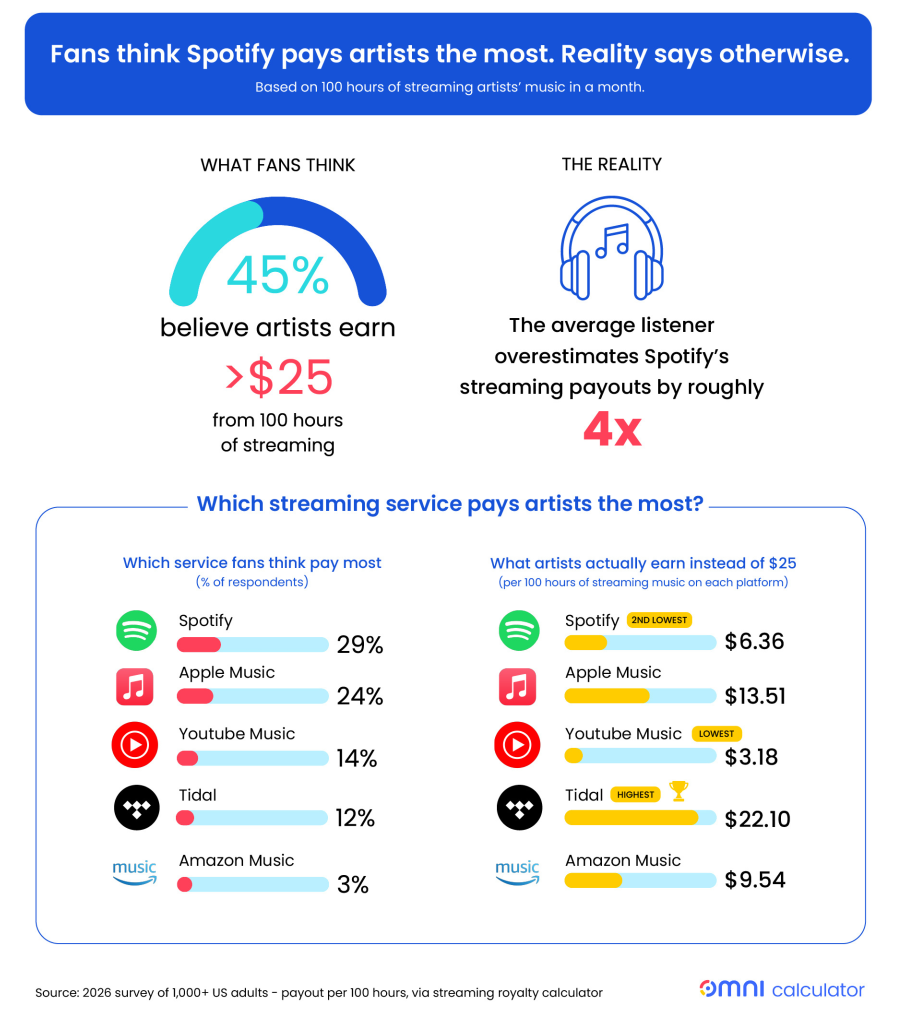
  • 45% think an artist earns over $25 from 100 hours of their streaming, while the cross-platform average is ~$11
  • Fans rank Spotify the #1 artist-payer; it pays $6.36 per 100 hours — second-lowest of five
  • Tidal pays the most ($22.10) but ranks 4th in public perception
  • 82% have never looked up what streaming services pay artists
  • Only 3% choose an app based on how well it pays artists; 77% choose on library and price
  • 45% are unlikely to switch apps even if their favorite artist earned more elsewhere
  • 65% of Gen Z use Spotify and 50% think it’s paying the artists the most

Most people have a number in their head for what streaming pays artists. Almost no one has checked it.
To measure the distance between what fans believe and what artists actually earn, we surveyed more than 1,000 US adults about how they think streaming royalties work, then ran identical listening through a streaming royalty calculator to establish what each platform really pays for the same 100 hours of listening. The result is a consistent, measurable gap — not just in how much fans think artists make, but in which platforms they believe are generous.
This report lays the two sides next to each other, platform by platform.

We asked listeners a simple question: how much do you think your favorite artist earns from 100 hours of your streaming in a month?
Nearly half (45%) answered "more than $25." That single figure is the heart of the gap, because $25 is more than any major platform actually pays for 100 hours of listening. Even Tidal, the most generous of the five, returns $22.10. The average across all five platforms is roughly $11. On Spotify, the app most people actually use, the same 100 hours is worth $6.36.

In other words, the most common belief about artist pay sits above the ceiling of what any platform delivers, and roughly more than two times the real-world average.

Perceived earnings (100 hrs/month)

Share of respondents

More than $25

45%

$10–$25

11%

$5–$10

11%

$1–$5

13%

Less than $1

8%

Not sure

11%

The reality is starker still when measured against a living wage rather than a per-hour rate. An analysis by Music Business Worldwide found that only around 0.2% of artists on Spotify generate more than $50,000 a year in payouts — a figure close to the US median wage — out of roughly seven million artists on the platform. Spotify's own 2026 Loud & Clear report puts about 13,800 artists above $100,000 and just over 1,500 above $1 million. By any of these measures, the income most listeners imagine is reserved for a fraction of a fraction of artists.
Streaming-pay-reality-vs-perception

When asked which app pays artists the most per stream, the public's ranking comes out almost inverted from reality.
Spotify (29%) was the most common answer, followed by Apple Music (24%). Tidal, which actually pays the most, landed near the bottom at 12% below "not sure." YouTube Music, the lowest-paying of the five, was rated more generous than Tidal at 14%.
The likeliest explanation is that visibility is standing in for generosity. Lifestyle and audio guides consistently describe Spotify as the platform that wins on ubiquity, discovery, and convenience rather than on quality or payouts, a reputation built on being everywhere, not on paying best.

💡 That cultural dominance appears to shape what fans assume about its economics: nearly a third of the public crowns Spotify the most generous platform for artists, despite the fact that it pays roughly half of what premium services like Apple Music and Tidal offer.

An audiophile survey by Headphonesty points the other way, its respondents named Spotify's low artist payouts as a direct reason it didn't rank higher, while citing Tidal's better compensation as a selling point. The general public has the opposite impression.

To see what it costs in real money, take seven of the most-streamed songs by today's biggest artists and ask a single question: if all of that song's streams had happened on one platform, how much would those plays generate in gross recording royalties — and how far does that number move from one app to the next?
The figures below convert each song's public Spotify stream count into listening hours (using the track's runtime), then run those hours through the same streaming royalty calculator used throughout this report. They are illustrative gross figures, the royalty the streams generate before the label, distributor, and publishing splits that determine what an artist actually keeps, and they assume, as a thought experiment, that all of a song's streams occurred on a single platform. Stream counts are public Spotify totals as of late June 2026 and rounded.

Song (artist)

Streams

Spotify

Apple Music

Tidal

Spotify → Tidal gap

Blinding Lights (The Weeknd)

5.40B

~$19.1M

~$40.5M

~$66.3M

+$47.2M

Birds of a Feather (Billie Eilish)

3.70B

~$13.7M

~$29.2M

~$47.7M

+$34.0M

That's What I Like (Bruno Mars)

3.21B

~$11.7M

~$24.8M

~$40.6M

+$28.9M

Cruel Summer (Taylor Swift)

3.20B

~$10.1M

~$21.4M

~$35.0M

+$24.9M

Sorry (Justin Bieber)

2.98B

~$10.5M

~$22.4M

~$36.6M

+$26.1M

Tití Me Preguntó (Bad Bunny)

2.26B

~$9.7M

~$20.6M

~$33.7M

+$24.0M

Diamonds (Rihanna)

1.89B

~$7.5M

~$16.0M

~$26.1M

+$18.6M

The pattern is identical for every artist, because the platforms' rates are fixed: the same plays are worth roughly 3.5 times more on Tidal than on Spotify, and about twice as much on Apple Music. For a catalog-defining hit like "Blinding Lights," that platform choice alone is the difference between about $19 million and $66 million in gross royalties for the identical listening.

This is the perception gap made concrete. Fans guessed an artist earns more than $25 from 100 hours of their own streaming; here is what the listening of millions actually generates and how much of it depends not on the artist, but on which app the plays happen to land in. It also reframes the report's central reality check: even these once-in-a-generation hits, streamed billions of times, turn into single-digit or low-tens-of-millions gross on the platform most people use and only a sliver of that reaches the artist after splits.

Most listeners sense that platforms differ but can't say how. When asked whether all major apps pay artists the same per stream, **82% **correctly recognized a difference (44% "differ a lot," 38% "differ slightly"), and only 5% thought they all pay the same.
The deeper finding is how little anyone has actually checked. 82% of listeners have never looked up what streaming services pay artists. Among the reasons:

Have you ever looked up artist streaming pay?

Share

No — it's not something I consider important

32%

No — it's important, but I haven't done it

29%

No — I wouldn't know where to find that information

21%

Yes

18%

That middle band is the opening. 29% of listeners say the issue matters but they have never looked into it, and a further 21% say they wouldn't even know where to find the information. Together, that's half the population that is either willing or curious but structurally stuck: they have the interest, and no obvious place to act on it.

✅ This is precisely the gap a public, plain-language streaming royalty calculator closes. It turns an abstract question, "what does my listening actually pay an artist?", into a number anyone can see in seconds, on any platform, without needing to parse a label contract or an annual transparency report.

If half of listeners are at least curious about artist pay, almost none of them act on it when choosing a platform. Asked which single factor matters most when picking a music app:

Deciding factor

Share

Music library

45%

Price

32%

Audio quality

16%

Supporting artists

3%

Recommendations

3%

Podcasts

2%

Catalog and cost together decide 77% of choices. "Supporting artists" came in at just 3% tied at almost last with recommendation algorithms. Whatever fans feel in principle about artists' pay, it is close to irrelevant at the moment of decision.
That helps explain the market itself. Spotify is the primary app for 49% of listeners, more than double any rival, with YouTube Music second at 22% and Apple Music third at 15%. The platform people use most is the one that pays among the least, and it holds that position because **the things people actually choose on are library and price, not artist payouts.

Knowing the gap exists is one thing. Changing behavior is another, and here the survey finds firm limits.

  • 45% wouldn't switch to a different app if it paid their favorite artist more — "not very" or "not at all likely." 26% weren't sure and just 29% were open to switching.
  • Only 11% would pay a higher monthly fee for an app that paid artists better; 49% said no outright, and 40% hedged with a maybe.
  • Among everyone, the appetite runs shallow: 47% would pay nothing extra, 36% would stretch to $1–$5 more, and just 4% would go higher.

Support for artists is broad in sentiment and thin in action, with a hard ceiling of a few dollars a month for the minority willing to put money behind it.

Run the whole survey through age and one group separates from the rest at every turn: Gen Z is the most informed, the most willing, and — in the end — the most contradictory.

The generational divide on streaming services

  • They've actually checked. 29% of Gen Z have looked up how much artists earn from streaming. Which is nearly triple the rate of Gen X (11%) and almost six times that of Boomers (5%).
  • They'd switch. 34% say they're likely to move to a different app if it paid their favorite artist more, compared with half of Boomers who rule out switching entirely.
  • They'd pay more. 41% of Gen Z would pay an extra $1–$5 a month to support artists, against 26% of Boomers.
  • They read the market best. Gen Z is the age group most likely to correctly name Tidal as a top-paying platform (17%, versus 8% of Gen X).
  • They're on Spotify anyway. 65% of Gen Z name Spotify as their main app, the highest concentration of any generation, and the platform they're best placed to know pays among the lowest.
  • And they listen the most. 32% of Gen Z stream more than two hours a day, the heaviest of any age group (27% Millennials, 19% Gen X, and 9% Boomers)
  • Willingness to pay drops with age. Refusal to pay anything extra climbs steadily from 42% of Gen Z to 64% of Boomers.

🙋 You don't have to take the averages on faith. Whichever app you open every day — Spotify, Apple Music, YouTube Music, Amazon Music, or Tidal — you can see what your own listening actually pays the artists you love. Enter your platform and how much you listen into our streaming royalty calculator, and it turns your habits into a real dollar figure.

Then try switching the platform while keeping your listening the same. The number moves, sometimes by three or four times the amount, which tells you something the averages can't: the same hours you already spend on your favorite artist are worth far more on some apps than others. If you've ever wondered whether your listening is reaching the people who make the music you love, this is the fastest way to find out.

This report is based on a survey of more than 1,000 US adults, conducted via Prolific with results weighted to be nationally representative by age, gender, and region, and age quotas set to ensure usable generational subgroups. Respondents were screened for streaming music use. Statistical significance was tested using Pearson's chi-square at the 95% confidence level; differences cited as significant cleared that threshold.
Payout figures reflect estimated artist earnings per 100 hours of listening, calculated using the streaming royalty calculator and presented as approximations, since no platform pays a fixed per-stream rate; actual earnings vary by listener country, subscription type, and rights splits. The calculator serves as the reader-facing tool and reality benchmark; platform rates were cross-checked against the primary industry sources listed below.

Authors of the report

Ask the authors for a quote

Copyrights